


Maybe you pictured that first moment like something from a movie: your baby on your chest, tears, instant overwhelming love. Or maybe what you felt most was exhaustion, relief—or not much at all at first. Both are normal. Attachment doesn’t happen in one magical moment. It grows over weeks and months as you notice your baby’s cues and respond to them reliably: with skin, eye contact, and your voice; with comforting, carrying, and attentive feeding—at the breast or with a bottle, as a mom or as a dad.
At a glance
- Bonding
- over months
- Too late?
- Never
- Skin to skin
- at least 1 hr.
- Get help
- after 2 weeks
When the love takes time
No love at first sight? That’s far more common than movies suggest. In a British study from 1980, around 40 percent of first-time mothers later remembered feeling mainly indifference when they first held their baby. Among women who already had children, it was about one in four—so even with a second baby, love can take time to arrive. For most, affection came within the first week, and no long-term downsides were seen. For others, it takes longer, especially if the birth was difficult, the baby had to go to the newborn unit, or pain and sleepless nights leave little room for anything else.
You don’t have to feel love to act lovingly. Every time you pick up, feed, change, or comfort your baby, you’re building your relationship—even on days when you feel more like an exhausted service provider. For many parents, the warm feeling arrives quietly: with the first real smile, the smell of that little head, or on an ordinary Tuesday morning.
Do you just need time—or help? A rough guide: No overwhelming love yet, but moments of warmth or protectiveness keep showing up—that’s normal and usually grows with time. If for more than two weeks you feel nothing at all, feel empty, or can’t enjoy anything—talk about it (see “No feelings for your baby?” below). And whether your baby is three days or three months old: you can start everything in this article today.
Calm nights start here.
Download Moonsleep and find the rhythm that fits your baby.


Bonding vs. attachment?
Bonding describes the feelings parents develop for their child in the first days and weeks—it goes from you to your baby. Attachment is the relationship your baby builds with their main caregivers over the first year of life so they feel safe and protected—it goes from your baby to you. In everyday life, most people simply say bonding for all of it—whether they mean parent-child attachment, mother-baby attachment, or the parents’ feelings—so that’s what we’ll do here too.
How does that bond grow? Experts talk about sensitivity. They mean four steps you’re probably already doing on your own:
Notice: Your baby smacks their lips, turns their head away, fusses.
Interpret: Hunger, quiet, closeness, or a fresh diaper?
Respond promptly: without making your baby wait a long time.
Respond appropriately: with what your baby needs right then.
Out of thousands of scenes like these, one basic feeling grows: My people are dependable. That’s what people mean by secure attachment: later, your baby uses you as a safe haven when they’re afraid and as a base from which to explore the world. With a newborn, you don’t need to identify attachment styles—or worry about them.
Perfection is not the goal. In one study where mothers and babies were filmed playing, they were truly in sync for only a small part of the time. The rest was back and forth between connection and misunderstanding. So yes, you will often read your baby wrong—sometimes it’s not hunger, it’s tiredness. What matters is that you try again. That adjusting and readjusting is what bonding looks like in everyday life.
What doesn’t harm attachment
Many mothers lie awake at night wondering what they may already have “ruined.” So let’s be very clear: these things do not destroy bonding.
Your baby cried because you were in the shower, in the bathroom, or with an older sibling.
You were annoyed or even got loud once—and then turned back toward your baby again.
You looked at your phone during a night feed to stay awake.
You had a survival-mode day when only the bare minimum was possible.
You put your baby down safely in bed for a few minutes because you simply couldn’t do any more.
What matters is coming back: going over, picking your baby up, comforting them. That’s how your baby learns: even if something goes wrong sometimes, someone comes back.
What really strains bonding is a long-term state: when over weeks and months a baby rarely experiences anyone responding to their signals—usually because parents are exhausted, depressed, or left without support. That’s why getting help during times like these is one of the best things you can do for your bond.
About phones: a quick glance doesn’t hurt. But one or two feeds a day without a screen are worth it, because that gives your baby a chance to find your gaze. During skin-to-skin, your phone should stay away for another reason: you need to keep your baby’s face in view.
Attachment doesn’t mean getting it right every time. It means coming back, again and again.
No feelings for your baby?
Crying a few days after birth without really knowing why—that happens to almost every second woman. These baby blues usually go away on their own within two weeks. Up to 15 out of 100 women develop postpartum depression in the first three months after birth; it can begin during pregnancy and up to a year afterward. About 1 in 10 fathers becomes depressed around the time of birth too.
Common signs are ongoing low mood or emptiness, loss of joy, guilt, constant anxiety—and sometimes exactly this: not feeling a bond with your baby. That is not a character flaw and not proof that you’re a bad mother. It’s an illness that usually gets better with treatment.
Three other challenges often show up right here too
Disturbing thoughts: Unwanted images that something might happen to your baby or that you might harm them—for example, dropping them. These thoughts are tormenting, but not uncommon, and having them does not mean you will act on them. Talk to a doctor soon; this is very treatable.
A traumatic birth: Nightmares, intrusive images, or avoiding anything that reminds you of the birth can block closeness. A debrief with the hospital and, if needed, therapy can help.
Postpartum psychosis: Rare—about 1 in 1,000 mothers—usually sudden in the first two weeks: hearing or seeing things that aren’t there, unusual beliefs, confusion, barely sleeping despite the chance to sleep. This is an emergency: call 911 (or your local emergency number) right away. People experiencing it often don’t notice it themselves—then loved ones need to act.
How to get help: Call your OB-GYN, midwife, or family doctor’s office; you can also bring it up at your baby’s checkups, where pediatricians ask how the mother is doing, too. One sentence is enough: “I gave birth 10 weeks ago, I’ve felt empty for weeks, and I hardly feel anything for my baby. I need an appointment soon.” Then comes a conversation; depending on the situation, talk therapy, practical support, or medication may help—many antidepressants are compatible with breastfeeding.
The fear that keeps many people silent is: “Will they take my baby away?” That is very rare. There are even mother-baby units where both mother and baby are admitted together. In the US, Postpartum Support International (PSI) advises mothers, fathers, and relatives through its HelpLine at 1-800-944-4773 and can point you to specialists, support groups, and units like these.
For partners: If your partner feels no bond, take it seriously without blame. Take over nights, go with her to the appointment, and give the baby lots of closeness yourself—that way you support them both.
You do not have to wait until it feels “bad enough.” One phone call is enough for a first step.
Bonding through skin-to-skin contact
Hardly anything calms a newborn as reliably as bare skin. The recommendation is to place babies directly on the mother’s chest right after birth, uninterrupted—after any type of birth, for at least 1 hour or until after the first latch. A 2025 review of 69 studies confirmed what this does:
more stable blood sugar, body temperature, breathing, and heart rate
less stress and less crying
more exclusive breastfeeding
This releases oxytocin, which helps milk flow during breastfeeding. When your baby lies quietly on you, they often find their own way to the breast—give them time.
Bonding after a C-section is often possible too: if you’re both doing well, your baby may be able to lie on you right in the operating room. If you need medical care, your partner can take over skin-to-skin. And if it doesn’t work at all: nothing has been missed. You can start skin-to-skin at any time, even weeks later. After that, rooming-in helps keep you together: your baby stays in your room day and night.
Here’s how to do it at home
Undress your baby down to the diaper and lay them tummy down on your bare chest, chest to chest, with their legs tucked up.
Keep their face visible: head turned to the side, nose and mouth clear, neck straight, chin not pressed onto the chest.
Cover their back with a light blanket or your shirt—indoors, they don’t need a hat.
Sit comfortably in a semi-upright position so you stay awake, and give your baby a few minutes to snuggle in.
How long and how often? As often as you like—at home, there’s no minimum length. Even a few minutes count, and one regular moment a day is completely enough—better in the morning when you’re rested than at night when your eyes are closing.
For preemies, this is called kangaroo care: since 2022, WHO has recommended keeping babies born before 37 weeks of pregnancy or weighing less than 5 lb 8 oz (2,500 grams) skin to skin for as many hours a day as possible, as long as their condition allows it. For preemies, all ages in this article are counted from the due date (corrected age).
Safe snuggling
Stay awake: If you notice your eyes closing, lay your baby on their back in their own bed or hand them to someone who is awake.
Never fall asleep with your baby on a sofa or armchair: This is especially dangerous—because of the risk of sudden infant death syndrome and because your baby can slip into a position where they can’t breathe. Don’t fall asleep with your baby on your chest in bed, either.
No substances: After alcohol, cannabis, or other drugs, and after medication that makes you sleepy, do not do skin-to-skin without a second awake adult present—no matter how old your baby is.
Right after birth: In the first hours, there should always be another awake person keeping an eye on both of you, especially after a C-section, with severe exhaustion, or while using pain medication.
Don’t overheat: Feel between the shoulder blades: warm and dry is good, sweaty means one layer less.
Warning signs: If your baby becomes pale or bluish, unusually floppy, or is breathing with difficulty, end the position immediately, lay your baby on their back, and speak to them. If they are not breathing normally: call 911.
Do you need to bed-share?
No. Feeding, comforting, and settling your baby back to sleep at night are closeness too. Your baby sleeps safest like this:
in their own bed in the parents’ bedroom—a securely attached bedside sleeper combines closeness and safety
always on their back, in a sleep sack instead of under a blanket
with no pillows, crib bumpers, stuffed animals, sheepskins, or nursing pillows in the bed
at a room temperature of about 61–64 °F (16–18 °C) and in a smoke-free home
Sleeping together is especially dangerous after smoking, alcohol, drugs, or sleepy-making medication, with severe exhaustion, for preemies and very small babies—and always on a sofa, armchair, or waterbed.
“My baby only falls asleep on me.” That’s normal at first. A contact nap is safe as long as you stay awake, sit semi-upright, and keep your baby’s face clear. If you get sleepy, lay your baby on their back in their bed.
Feeding, soothing, and helping your baby back to sleep at night—that’s closeness, too.
Reading your baby’s cues
Newborns see most clearly at about 8 to 12 inches (20 to 30 centimeters)—almost exactly the distance from your face when you’re holding or feeding your baby, and ideal for eye contact. They love looking at faces, especially yours. Most parents naturally settle into that distance without even thinking about it.
Your baby already knows their mother’s voice from the womb and soon after birth can tell it apart from others; dad’s voice becomes familiar quickly too. So talk to your baby, even if it feels like a one-sided conversation: “Okay, here comes a fresh diaper. Oops, cold, right?” Hum during diaper changes, sing the one song whose words you can still remember at 3 a.m.
Usually in the second month comes the first social smile that’s really meant for you. By about 3 months, your baby squeals, grunts, and laughs—and “answers” you. Join in: say something, count slowly to five in your head, and respond to the cooing as if it’s part of the conversation.
These signals can help you read your baby
Ready for contact: alert eyes, relaxed face, gaze seeking you out.
Needs a break: looks away or turns their head, yawns, squirms, arches their back, gets fussy.
Getting tired: fixed stare, rubbing eyes, eyes getting smaller.
Hungry: early on, lip-smacking, searching head movements, hand to mouth; later, crying. First calm a crying baby briefly, then feed.
If your baby looks away, that usually isn’t rejection—it’s a breather. Then it helps to get quieter, lower your gaze, just hold them for a minute or two—and then offer yourself again.
At first, calm-alert moments are short: usually 35–75 minutes at a time, and by about 2 months more like 60–90—useful guide values, not rules, and your baby’s cues matter more. You do not need to schedule these windows. It’s enough to notice them consciously now and then.
When to bring it up: If by about 3 months your baby still doesn’t smile back at all, doesn’t follow your face with their eyes, or never startles at loud noises, mention it at the pediatrician’s office—your baby’s 4-month checkup is coming up anyway. Also ask whether the hearing screen after birth was normal.
When your baby looks away, it’s usually not rejection—just a little breather.
Can you spoil a newborn?
“Don’t pick him up right away every time, or he’ll get used to it.” For the first months of life, that idea is outdated. The American Academy of Pediatrics (AAP) agrees: responding sensitively to crying does not spoil a young baby.
The reason: a newborn cannot soothe themselves yet. Especially in the first 3 to 4 months, they can’t come down from strong distress on their own and need you as outside regulation. Babies who are comforted quickly early on tend to cry less in the weeks that follow. After that too, comforting is still the right thing to do; sleep training that leaves a baby to cry is not meant for these first months.
Responding does not mean you can stop every cry. Crying often peaks around the sixth week and eases noticeably by about 3 to 4 months. There will be evenings when nothing helps. Even then, this still counts: you are there. A baby crying in your arms is not crying alone.
If you don’t know what’s wrong, this order can help:
Hungry? Watch for early signs: lip-smacking, hands to mouth, searching head movements.
Body? Full diaper, needs to burp, too warm or too cold (neck check between the shoulder blades)? If the crying starts suddenly and is inconsolable, undress your baby completely and check whether a hair is tightly wrapped around a finger, toe, or penis.
Sick? Does the cry sound shrill, whimpering, or weak? Is your baby drinking poorly, floppy, or do they have a fever (under 3 months: from 100.4 °F / 38.0 °C, measured rectally): call the pediatrician right away, and at night use the after-hours line. For breathing trouble or bluish skin: call 911.
Too much? Dim the lights, lower the noise, postpone visitors.
Closeness: skin-to-skin, gentle rocking, quiet humming, a walk in the carrier, or fresh air.
And you? If you can’t do it anymore, the box right below can help.
If your baby cries more than 3 hours a day on at least 3 days a week, for 3 weeks, or if the crying is pushing you to your limit no matter how long it lasts, get support. Talk to your pediatrician, who can check for medical causes and help you find support. Some communities also offer free, voluntary home visiting programs for new parents—help, not surveillance.
When you can’t cope
Lay your baby on their back in their own bed, with no loose blankets or pillows.
Pull the door to and go into another room.
Stay there for a few minutes until your breathing slows. Drink a glass of water, open a window, and breathe out slowly and fully.
Call someone: a trusted person, the National Parent & Youth Helpline (1-855-427-2736), or 988 if you’re in crisis—both answer day and night.
Go back and check on your baby. If needed, repeat the break.
If this happens often, talk to your pediatrician’s office.
A few minutes of crying while safely laid down will not harm bonding—but shaking will. Even a few seconds of shaking can seriously injure a baby’s brain.
Babywearing
Being carried is familiar to your baby from nine months in the womb: warmth, movement, your heartbeat. In a wrap or carrier, many babies settle more easily, and you have your hands free.
Wrap or carrier? A structured carrier with an adjustable seat is often easier at first; a wrap adapts more flexibly, but takes practice. Make sure the carrier is approved by the manufacturer for your baby’s weight and supports the neck and back of the head.
How to put on a carrier by yourself
Practice the first few times sitting down over the bed.
Adjust the carrier to your baby—the seat should go from knee to knee—and fasten the waistband firmly at waist level.
Set your baby upright against your chest, tummy to tummy. The legs are bent and slightly spread, with the knees a little higher than the bottom—the so-called M-position.
Pull the back panel up until it supports the back, neck, and—as long as your baby can’t hold their head steadily yet—the back of the head.
Fasten the shoulder straps and tighten them until your baby no longer tips away from you. To take your baby out, support their back with one hand first and then undo the buckles.
This check helps every time you put the carrier on:
Tight: The wrap or carrier fits snugly; your baby is not slumped.
Visible: One glance down lets you see your baby’s face without moving fabric aside.
Close enough to kiss: The head is high enough that you can kiss it by leaning forward slightly.
Chin clear: Leave at least a finger’s width under the chin, and keep the nose and mouth clear.
Supported: A slightly rounded back with tummy and chest close to you is fine. What’s dangerous is a collapsed C-shape with the chin falling onto the chest—that makes breathing harder.
In daily life, this applies: bend your knees instead of bending at the waist, and support your baby with one hand. Put hot drinks out of reach first. Take your baby out to feed. If your baby falls asleep, keep checking regularly that the face and chin stay clear. For preemies, babies with breathing problems, or babies with hip problems, ask your pediatrician before babywearing.
If you want, babywearing consultants can help, often by video too—but it’s not necessary. And if babywearing isn’t your thing: that’s completely fine. Closeness grows just as much in your arms and during feeds.
Calm nights start here.
Download Moonsleep and find the rhythm that fits your baby.
Baby massage as a ritual
Baby massage is not a therapy, but an invitation. Clear health benefits for healthy babies have not been proven—but a few quiet minutes in which you get to know your baby from head to toe, and your baby gets to know your hands, are lovely enough.
The right moment: a calm-alert phase, neither hungry nor right after a big feed—often after a diaper change, in the middle of a wake window.
Preparation: Make the room as warm as for bathing (at least about 73 °F / 23 °C), with no drafts. Your baby lies on a towel on the floor or on your legs; on a changing table, never take one hand off your baby. Warm your hands by rubbing them together, and remove rings.
Settling in: Rest your hands quietly on the chest and tummy for a moment and say what’s coming next.
Legs: Use your whole palm to stroke from thigh to foot, then use your thumb over the sole from heel to toes.
Tummy: Stroke around the belly button clockwise with a flat hand—but only once the navel has healed completely.
Chest: Move both hands from the center outward, as if opening a book.
Arms: Like the legs, from shoulder to hand.
Back: Lay your baby tummy down across your thighs and stroke from neck to bottom.
The pressure is gentle, but firm enough not to tickle. If your baby looks away or gets unsettled, that’s enough for today. Five minutes that both of you enjoy are worth more than twenty you force yourselves through. Skip massage with fever, an infection, or inflamed skin, and avoid the injection site after a vaccination.
Oil is optional—no oil at all is completely fine. For the first about 4 weeks, plain water is enough; for preemies, at least 6 weeks. No olive oil from the kitchen, and no peanut oil. Essential oils such as peppermint, eucalyptus, camphor, or menthol are off-limits, including in cold balms: in infants, they can trigger laryngeal spasm with breathing trouble. If you’d like to learn it in a group, many hospitals and community centers offer classes.
Can you bond without breastfeeding?
In the first weeks, your baby usually feeds 8–12 times in 24 hours, and bottle-fed babies should also be fed on demand rather than by the clock. Those are hours every day in which a lot of your relationship grows quietly alongside everything else.
For bonding, what matters is not where the milk comes from, but the care around it: eye contact, body contact, and someone noticing when the baby is hungry and when they’re full. If breastfeeding doesn’t work, if you only pump, or if you chose something else on purpose, your baby is not missing out on bonding.
How to turn a bottle feed into cuddle time—at your baby’s pace
Hold your baby close to your body, semi-upright, with the head well supported, and look at them.
Gently touch the nipple to their lips and wait until they open wide and draw it in themselves.
Hold the bottle almost horizontal, only slightly tilted, so the milk flows evenly.
Allow pauses and lower the bottle when your baby sucks more slowly.
Stop when your baby seems full—they let go of the nipple, turn their head away, their hands relax, they get sleepy—even if there’s milk left in the bottle.
Switch arms from one feed to the next, just as you would switch sides when breastfeeding.
Never prop the bottle up, and never let your baby drink from it alone—they could choke. In the first weeks, it’s best if mostly the same few familiar people give the bottle; familiar faces give security.
Not every feed has to be an intimate moment—at 3 a.m., it can just be a feed. One or two calm feeds a day when you consciously look at your baby are enough.
If breastfeeding hurts or isn’t working: Ongoing pain, sore nipples, a baby who won’t latch, or worrying whether the milk is enough are among the most common reasons the first weeks don’t feel close. Most problems can be solved, and earlier is better. Laid-back breastfeeding often helps: you semi-recline with good support and your baby lies tummy down on you. Help is available from a board-certified lactation consultant (IBCLC; your health plan may cover it), a breastfeeding clinic, La Leche League, or local breastfeeding support groups.
What counts for bonding isn’t where the milk comes from—it’s the loving attention that comes with it.
Bonding with dad
Especially if you’re breastfeeding, dads and co-moms often feel like bystanders at first—but it won’t stay that way. Babies can form close bonds with several caregivers, including grandparents. What matters for the bond between dad and baby isn’t milk, but reliable, loving care.
Skin to skin: Hold your baby wearing only a diaper on your bare chest, uninterrupted and with your phone out of reach—this is explicitly encouraged, even right after birth.
Your own rituals: the first diaper change in the morning, the evening round in the carrier, the same song every time before settling down.
Nighttime as a team: You do the diaper change, put a glass of water by the bed, and rock the full baby back to sleep so the breastfeeding parent can lie down right away.
You get to comfort too: Don’t hand the crying baby back immediately—your way of rocking is different, and that’s exactly what makes it valuable.
Pumped milk at night? This works best once breastfeeding is already well established. If a breastfeeding session is skipped, the breasts shouldn’t become uncomfortably full—if needed, pumping or hand-expressing at the same time can help.
“The baby cries with dad, they only want mom.” That’s normal and not a bonding problem. When babies are hungry or very tired, they often want the person who breastfeeds them. Practice handoffs in relaxed moments and keep going: repetition builds familiarity.
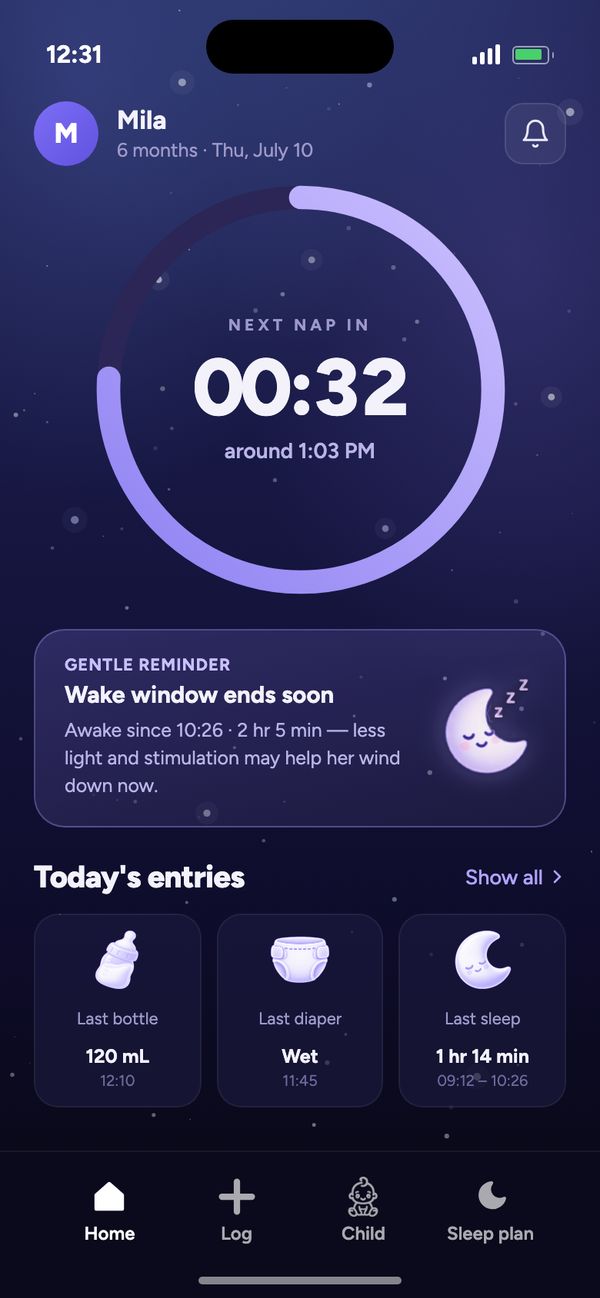
And to the parent who is breastfeeding: let the other parent do things their way, even if the diaper sits crooked. Your baby is learning that there is more than one dependable person. To make switching off at night easier, it helps to have a shared overview of when your baby last fed and slept—in Moonsleep, for example, both of you can see the same information, and if you want, so can Grandma or the babysitter.
Already have an older sibling? Then feeding time can become reading-and-cuddle time for the older child. With twins, skin-to-skin can happen with both babies at once or one after the other.
Protect the postpartum period: Keep visits manageable and accept help with meals and housework—then you’ll have more energy for closeness. Visitors should wash their hands before holding the baby, sick people should come later, and nobody with a cold sore should kiss the baby: herpes can be dangerous for newborns.
Alone with your baby
A lot of parenting advice assumes you have a partner who can take over at night. If you’re on your own: a baby can build a secure bond with just one reliable person. Your baby does not need two parents—just at least one person who keeps coming back.
Because no one can take the baby from you when your eyes are closing, skin-to-skin and contact naps are better in the daytime. At night, lay your baby in their own bed after feeding, and don’t move to the sofa. And you are allowed to ask for help without having to justify it.
Calm nights start here.
Download Moonsleep and find the rhythm that fits your baby.
Attachment in the first year
- First smile
- in month 2
- Prefers you
- ~3 mos.
- Stranger anxiety
- ~6–8 mos.
- Separation anxiety
- from ~8 mos.
Signs your baby is attached to you
You don’t need a test for this. In the first few weeks, attachment shows up quietly: your baby settles more easily in your arms and turns toward your voice; they feel secure mainly through physical contact. Around the third month, they clearly show that they prefer you to other people, let you comfort them, and direct their needs specifically to you. Eye contact and voice become more and more important now.
Between 6 and 8 months, many babies become wary of strangers: the friendly neighbor suddenly gets cried at. That isn’t a setback. It shows that your baby can tell familiar people from unfamiliar ones. Pick them up, give them time to make contact in their own way, and feel free to ask other people to keep a little distance. From about 8 months on, separation anxiety often joins in; it’s usually strongest at 10–18 months and eases by around the second birthday. You’re the safe harbor.
Not a bad sign if your baby cries in your arms, looks away, or settles faster with someone else—a rested set of arms sometimes simply works better than exhausted ones. You do not need to speed anything up.
Attachment isn’t built in the perfect moment, but in the many ordinary ones.
Watch for this
You’ve felt low, empty, numb, or unable to enjoy anything for longer than 2 weeks, or you hardly feel anything for your baby: call your OB-GYN, midwife, or family doctor’s office. The same goes for partners.
Unwanted, frightening images that something might happen to your baby or that you might harm them are tormenting you: speak with a doctor in the next few days. This is treatable and does not make you dangerous.
You’re thinking about ending your life, you’re afraid you might lose control, or you hear or see things other people don’t: call 911 right away or go to the nearest ER. If you just need to talk: call or text 988, any time.
The crying is pushing you to your limit: lay your baby safely on their back in their bed, leave the room for a moment, and call someone. Never shake your baby.
Your baby is under 3 months and has a temperature of 100.4 °F (38.0 °C) or higher, is barely drinking, floppy, hard to wake, or crying very differently than usual: get medical advice right away—at night through your pediatrician’s after-hours line or the ER.
Short, irregular breathing pauses of a few seconds are normal in newborns. Warning signs are pauses lasting more than about 20 seconds, blue or gray lips, very fast breathing at rest, pulling in between the ribs, flaring nostrils, or grunting with every breath: end the position, lay your baby on their back, speak to them, and call 911—the 911 dispatcher can guide you on the phone.
Your baby still isn’t smiling back by about 3 months, doesn’t follow faces with their eyes, or never reacts to loud noises: bring it up at the pediatrician’s office—don’t wait for the next routine check-up.
Frequently asked questions
Is it normal not to love your baby right away?
Yes. Many parents experience that first moment more as exhaustion, relief, or overwhelm. In a British study, about 40 percent of first-time mothers remembered feeling mostly indifferent when they first held their baby; for most, affection came within the first week, and for some, later. Bonding grows through caring, looking, and comforting, even without big feelings at the start. Moments of warmth are a good sign. But if for more than 2 weeks you feel empty, low, or numb toward your baby, speak with your OB-GYN or family doctor. It could be postpartum depression, and that is very treatable.
How long does it take to bond with a baby?
Parents’ feelings for their child usually grow over days to weeks. A baby’s attachment to their people develops over the whole first year: around the third month, babies clearly show they prefer you, and by 6 to 8 months it becomes visible to everyone through stranger anxiety. There is no deadline by which something has to be finished.
Can you catch up on bonding after a C-section or time in the newborn unit?
Yes. There is no time window that closes. After a C-section, time in the newborn unit, a difficult birth, or a late emotional start, you can begin any time: one skin-to-skin moment each day, one or two regular closeness rituals such as bath time or an evening walk in the carrier, and attentive feeding. If the feelings stay completely absent for weeks, get help from a doctor’s office—not because anything is lost, but so you can feel better.
Does it harm bonding if I let my baby cry sometimes?
Single moments do not. If you were in the shower or you safely laid your baby down in bed for a few minutes because you couldn’t do any more, what matters most is that you go back afterward and comfort them. Sleep training that leaves a baby to cry is not meant for the first months of life, because a young baby cannot soothe themselves yet. Shaking, on the other hand, is always dangerous.
Does it harm bonding if I look at my phone while breastfeeding?
No—a quick look at your phone, especially at night to stay awake, does not harm bonding. But it’s worth having one or two feeds or cuddle times a day without a screen, because that gives your baby a chance to find your gaze. During skin-to-skin, the phone should stay away for safety reasons: you need to keep your baby’s face in view.
When does my baby recognize mom and dad?
Your baby already knows their mother’s voice from the womb and can soon after birth tell it apart from others. Dad’s voice and the voices of other close people also become familiar quickly. Babies like looking at faces from the start and see most clearly at about 8 to 12 in. (20 to 30 cm). Around the third month, they clearly show that they prefer you over strangers.
How does dad bond if the baby is breastfeeding?
With time and his own jobs. Skin-to-skin is just as possible for fathers and co-mothers and is explicitly encouraged. Then come tasks that belong to him: the first diaper change in the morning, the evening round in the carrier, nighttime diaper changes, and rocking the full baby back to sleep. It’s normal for a hungry or tired baby to prefer the breastfeeding parent—taking over works best in relaxed moments.
How long and how often should I do skin-to-skin with my baby?
After birth, at least 1 hour of uninterrupted skin-to-skin is recommended. At home, there is no minimum length: even a few minutes count, and one regular moment a day is completely enough—even months later. Only for preemies do hospitals recommend longer kangaroo-care sessions of at least 1 hour. The important thing is always this: you stay awake, and your baby’s face stays clear.
Moonsleep offers guidance, not medical advice. It is based on clinical guidelines and expert sources, checked against the Moonsleep reference database.