


It’s 43 °F (6 °C) in the morning, sunny at noon, with a warm grocery store and a car ride in between—and every time things change, you wonder: is my baby too warm or too cold right now? The overview further down shows what works at which temperature. Even more important are three habits: feel the back of the neck instead of the hands, use several thin layers instead of one thick piece, and take something off as soon as you’re indoors. Here’s what that means at home, at night, in the stroller, in the carrier and in the car—for every season, with checklists you can check off.
At a glance
- How to check
- back of neck
- Layers (max.)
- you + 1
- Under the harness
- nothing bulky
- Cold hands
- usually normal
Why babies handle heat and cold differently
Relative to their body volume, newborns have about three times as much skin surface as adults. That’s why they lose heat quickly in the cold—and pick it up just as quickly in a warm room. Your baby can’t sweat as well as you can yet and gets rid of extra heat mainly through the head.
The takeaway: Being too warm is riskier for a baby than being a little too cool. Overheating is considered a risk factor for sudden infant death syndrome (SIDS). Your baby usually lets you know they’re a bit chilly by fussing and crying, but often doesn’t signal being too warm at all—they just keep sleeping. If a baby gets really cold, on the other hand, they become quiet and floppy. So a calm baby alone doesn’t mean everything is fine.
Is my baby too hot or too cold?
Whether your baby is cold or too warm, the skin on their torso tells you: the back of the neck, between the shoulder blades, or the chest and tummy. On the go, it works like this: If you’ve just come in from the cold yourself, warm your fingers first, or everything will feel hot. Then slide two fingers down the back of the collar until you feel skin—in the stroller, the carrier and the infant car seat, usually without waking your baby. Leave your fingers there for a moment; first impressions can be misleading.
Warm and dry means: just right. Damp, clammy or hot means: one layer off. Cool means: one layer on. Change only one thing at a time and check again a few minutes later. Sweat, damp hair, red cheeks or a hot chest also tell you your baby is too warm. They’re too cold if the neck feels cool and your baby turns pale and fussy. How to check properly in the crib at night is covered in the article “The right temperature for your baby’s room.”
Check whenever something changes: shortly after you head outside, as soon as you’re indoors, in the car, when the sun comes out. At night, it’s enough to check when you put your baby down, before you go to bed yourself, and when you’re up anyway for a feeding or diaper change—no need to set an alarm for it. After a few weeks, you’ll know whether your baby warms up quickly or tends to get cold. So all the numbers here are a starting point; the neck has the final say.
Your hand on the back of the neck tells you more than any chart.
How to dress your baby by temperature
What should your baby wear at 50, 68 or 86 °F? There’s no official chart—babies, fabrics and weather vary too much. As a starting point for outdoors—in the shade, in a stroller without a bunting or in your arms—this overview helps. It refers to the temperature in the shade, as your weather app shows it. Add a layer if it’s windy or wet. A quick word on terms: a onesie is the bodysuit that snaps at the crotch, a sleeper is pants with feet, often with straps or as a one-piece, and an outdoor suit is the one-piece outfit for going outside.
86 °F (30 °C) and up: in the shade, just a diaper and a lightweight onesie, plus a sun hat; spend the midday heat in the shade or indoors.
77 to 84 °F (25 to 29 °C): a thin short- or long-sleeved onesie and a sun hat.
70 to 75 °F (21 to 24 °C): a thin long-sleeved onesie and light pants, thin socks.
61 to 68 °F (16 to 20 °C): onesie, pants and a top, a thin jacket, socks, a thin hat.
50 to 59 °F (10 to 15 °C): onesie, tights, pants and a sweater, a light jacket or a thin outdoor suit, a hat.
34 to 48 °F (1 to 9 °C): onesie, tights, pants, a sweater or fleece, a warm outdoor suit, a hat over the ears, mittens.
32 °F (0 °C) and colder: a warm base layer of wool-silk or merino, a sweater or fleece, a winter outdoor suit, a hat that covers the ears, mittens, thick socks.
In the stroller, the bunting replaces the outer layer, meaning the jacket or outdoor suit. In a carrier, your baby needs about as much as you’re wearing; the babywearing cover or your zipped-up jacket is their outer layer. In the infant car seat, no bulky outer layer goes under the harness. Indoors, the outer layer and hat come off. Two examples for 54 °F (12 °C):
Stroller with bunting: onesie, tights, pants, sweater, hat—no jacket; the bunting takes care of that.
Carrier: onesie, tights, pants, sweater, hat, plus wool socks or leg warmers; the babywearing cover or your jacket closes over the top.
And age? In the first weeks, your baby can’t regulate their temperature well yet and barely moves outdoors: check more often and keep walks shorter when it’s windy. Kids who already walk around outside need about as much as you do. Once they sit in the stroller, the extra layer goes back on—your child needs it as long as they’re lying or sitting still.
What should my baby wear at night and for naps?
What should your baby wear at night? Less than you think. Around 64 °F (18 °C) in the bedroom is ideal, anything between 61 and 68 °F (16 and 20 °C) works well for any night, and in hot weather the room shouldn’t go above 79 °F (26 °C). Instead of sleeping under a blanket, your baby sleeps in a sleep sack. How warm it is shows in the TOG rating on the label—the higher, the warmer. As a rough guide based on manufacturers’ charts:
Below 61 °F (16 °C): a thick 3–3.5 TOG sleep sack over a onesie and pajamas, or turn up the heat a little.
61 to 66 °F (16 to 19 °C): around 2–2.5 TOG, with a long-sleeved onesie underneath and, if it’s cool, pajamas.
68 to 73 °F (20 to 23 °C): a light sleep sack around 1 TOG over a short- or long-sleeved onesie.
75 °F (24 °C) and up: 0.5 TOG over a short-sleeved onesie, or no sleep sack at all; on hot nights, a diaper alone is enough.
This is a starting point, not a rule book—your sleep sack’s chart and the back of the neck come first. If the neck feels cool despite the sleep sack, add a thin layer underneath or switch to a warmer sleep sack, never a blanket on top. Your baby doesn’t need socks in a sleep sack; cool feet are normal. If it’s cool, use footed pajamas; in the heat, footless ones. You’ll find examples for specific nights in the article “The right temperature for your baby’s room.” Without a sleep sack, place your baby with their feet at the foot of the crib and tuck a light blanket in firmly—no higher than the chest. On hot nights, a thin sheet is enough. Also:
Head and hands uncovered: no hat, no hood, no gloves or scratch mittens—not even for preemies who wore them in the hospital. If your baby scratches their face, trim the nails with rounded baby scissors.
A sleep sack that fits: neck opening no bigger than the head—check this on your baby, not just the label—and length roughly your baby’s height minus the head plus 4 to 6 inches (10 to 15 cm).
No second layer on top: no blanket over the sleep sack, no two sleep sacks on top of each other.
No swaddling: In Germany, the national guideline on preventing SIDS and the federal public health authorities advise against swaddling, that is, wrapping your baby up snugly—more on this in the questions below.
Sweating means taking something off, even if your baby is asleep.
Safe sleep: on the back, on a firm, flat mattress, in their own crib in your bedroom, with no pillows, bumpers, sheepskins or hot-water bottles, in a smoke-free home.
Calm nights start here.
Download Moonsleep and find the rhythm that fits your baby.


How many layers does my baby need?
How many layers your baby needs depends on the temperature—usually three, like the layers of an onion. Several thin layers keep your baby warmer than one thick piece because air collects between them, and when it’s warm you simply take one off:
Inner: the onesie, short- or long-sleeved.
Middle: pants and a top, or a sleeper. In the cold, add tights and a sweater; if the sleeper gets tight at the toes, skip the tights.
Outer: depending on the weather, a thin jacket, an outdoor suit or the bunting. This layer is the first to come off indoors.
And the rule of thumb “one more layer than you”? Imagine standing in the same spot without moving and without a blanket: what would you need to feel comfortable? Your baby gets that plus at most one extra layer. The American Academy of Pediatrics (AAP) sees this rule as an upper limit, not a target. Sleep sacks, buntings and carrier fabric count as a layer. If you’re wearing a T-shirt and a sweater, for example, a onesie, a sleeper and a thin little jacket are enough for your baby. If you’re pushing the stroller briskly uphill, you’ll warm up—your baby won’t.
Which fabric? For most days, cotton is fine: soft, affordable and easy to wash, but quickly clammy once it’s sweaty. Wool-silk and fine merino wool handle temperature swings better and don’t feel wet right away when your baby sweats. For babies born in the cold months and for babywearing, two or three of these onesies are worth it—often much cheaper secondhand. Boiled wool, a densely felted wool, blocks the wind as an outer layer. Fleece is light but doesn’t breathe much: good on the outside, not ideal right against the skin.
Better several thin layers you can open up than one thick piece.
Cold hands, sweaty head
Cold hands but a warm neck? Wet head, cold neck? When the signals don’t match, this overview helps:
Cold hands, warm neck: All good. Babies’ hands and feet are often cool—and that easily tempts parents to overdress them.
Bluish or mottled hands and feet: Common and usually harmless outdoors, after a bath or while undressing; they turn pink again once your baby is warm. Blue or gray lips or tongue, or a bluish face, on the other hand, are an emergency: call 911 (or your local emergency number) right away. On darker skin, you’ll see the color best on the lips, tongue, gums and the inside of the eyelids.
Cold hands, cool neck: Now your baby really is cold. Add a thin layer, outdoors a hat and mittens, then check again.
Neck cool but damp—or head wet, neck cold: Usually your baby was too warm before, and the sweat is cooling as it evaporates. Take off a layer, pat the skin dry and change damp clothes. If your baby also seems pale or floppy or is feeding poorly, move them somewhere cooler and call 911.
Wet head during sleep: If your baby’s head sweats while sleeping, they’re usually too warm—even if the neck still feels dry. Remove a layer or choose a lighter sleep sack and check the room temperature, even if your baby wakes briefly. Wet head on you: Your body adds warmth. A slightly damp back of the head while cuddling is common—feel the neck and take off a layer if needed.
Back of the head wet while feeding: Feeding is work for your baby, and they’re lying close against you. If the neck is dry again afterward, all is well. If your baby sweats heavily at every feeding, struggles to feed, breathes hard while feeding or isn’t gaining weight well, have it checked soon at the pediatrician’s office—don’t wait for the next checkup. For blue lips or trouble breathing, call 911.
Neck hot but dry: Take off a layer, move somewhere cooler, offer the breast or bottle. Under three months, take a rectal temperature right away—the next section explains how.
Cold nose, cheeks or ears: Normal outside in the cold; they warm up again after a few minutes indoors.
And if Grandma thinks the baby is cold because those little hands are so chilly? Put her hand on the back of the baby’s neck. The advice has changed—it’s not a criticism, just newer knowledge.
Baby overheated: what to do
If your baby is sweating a lot and has a flushed face and dry lips—even if their skin feels cool—or the neck is hot, they’re probably overheated. Whatever you do, don’t add more clothes. Follow these steps:
Get out of the heat: into the shade or a cool room.
Undress: outer layer, hat and anything tight off; in the heat, down to diaper and onesie.
Cool down: dab the neck, arms and legs with lukewarm damp cloths—never cold.
Fluids: offer the breast or bottle.
Watch closely: If your baby seems floppy, very sleepy or hard to rouse, call 911.
If your baby is younger than three months, don’t wait to see whether they cool down—take a rectal temperature after undressing them. Here’s how: Lay your baby on their back, on their side or tummy-down across your lap. Put a little cream on the tip of a digital thermometer and very gently insert it about ½ inch (1 cm), no more than ¾ inch (2 cm), until you feel slight resistance. Read it after one to one and a half minutes or when it beeps. Ear thermometers are only reliable from about six months, and forehead thermometers give only a rough idea in young babies—a normal forehead reading in a hot baby under three months doesn’t mean all is clear.
If the thermometer shows 100.4 °F (38.0 °C) or higher in a baby under three months, get medical help right away—even at the first reading, even at night. Don’t blame such a reading on the clothes: in a normally warm room, bundling up mainly raises the skin temperature, hardly the rectal one. Whether it was just overheating after all is for the doctor to decide.
Dressing your baby without tears
Many newborns don’t like having things pulled over their head. Crying while getting dressed is common and doesn’t mean you’re doing anything wrong. These tricks make it easier:
Lay everything out first. On the changing table, always keep one hand on your baby—even small babies roll unexpectedly.
Top half on your lap, bottom half on a flat surface: Dress your baby’s upper body while they lie on your lap, and do pants and legs on the changing table or bed.
Over the head: Stretch the neck opening wide with both hands, start at the back of the head and bring it forward in one quick move. Use your fingers to keep the fabric away from the face and ears.
Sleeves: Don’t push the arm in. Reach through the sleeve from the outside, take your baby’s hand and gently pull it through.
Belly button: As long as the umbilical cord stump is still attached, fold the diaper down below it.
In the first weeks, side-snap onesies and clothes with snaps or zippers in front will save your nerves.
Which size? In the US, baby clothes are sized by age (newborn, 0–3 months, 3–6 months and so on), but babies grow at different rates, so go by the length and weight ranges on the size chart rather than your baby’s age. Newborn size, for example, usually fits up to about 21.5 inches (55 cm). During the day, clothes can be a bit big; just roll up sleeves that are too long. For sleep, they should fit so nothing slides over the face; once things get tight at the toes, it’s time for the next size.
Dressed safely: no cords or strings at the neck—snaps or hook-and-loop fasteners are better. Necklaces, including amber or teething necklaces, and bracelets don’t belong on a baby; never put a pacifier clip around the neck or in the crib. Wash new clothes before the first wear to rinse out chemical residues.
Crying while getting dressed doesn’t mean you’re doing anything wrong.
Indoors: light layers, no hat
Indoors at 70 to 73 °F (21 to 23 °C), a onesie, a sleeper or pants with a shirt, and a thin cardigan are usually enough; if it’s warmer, skip the cardigan.
At home, keep your baby’s head uncovered: Your baby doesn’t need a hat indoors. The head is how they get rid of extra heat, and a hat traps it. German public health authorities explicitly advise against it, and the AAP also recommends no hat at home once you’re back from the hospital. The reverse is true as well: outside in the cold, your baby loses heat quickly through the head, so that’s where the hat belongs. Exceptions apply only if the hospital specifically sent you home with one, for example for a preemie—and even then never for sleep. Outdoors, your baby wears a thin hat at 68 °F (20 °C) and below, sooner if it’s windy, and a warm one over the ears below 50 °F (10 °C); when it’s warmer, a sun hat is enough.
After a bath, the hooded towel comes off as soon as the hair is dry. Cool feet alone aren’t a reason for socks. Your child doesn’t need shoes to learn to walk: indoors, barefoot or in socks with grippers is best; outdoor shoes need at least ½ inch (12 mm) of room in front of the toes—check every three to four months whether they still fit. Keep the bouncer, play mat and crib away from heaters and heating vents, drafts from the AC and direct sunlight.
Hat or no hat?
- Indoors
- none
- In bed
- never
- In the cold
- over the ears
- In the sun
- sun hat
Strollers and buntings
In cold weather, the bunting replaces the outer layer in the stroller: underneath, a onesie, tights, pants and a sweater are often enough; below freezing, add a thin wool or fleece outdoor suit. A thick snowsuit inside a sheepskin bunting is almost always too much. To block cold from below, insulate the stroller floor with a piece of foam camping pad or rigid foam board. A sheepskin is fine on a walk, but not in the crib; hot-water bottles and heating pads stay out of the stroller too.
If your baby falls asleep outside in the cold, keep the hat on as long as you’re outdoors. What to do when you come inside is covered below under “Shopping, cafés and visits.”
In summer, don’t drape a muslin cloth or blanket over the stroller. It looks like shade but traps heat: in a measurement from Sydney, it was 6.7 °F (3.7 °C) warmer under a dry cloth than outside after about 20 minutes. A damp cloth only helps briefly: as soon as it dries, it traps heat just like a dry one. Use a stroller umbrella or sunshade that lets air circulate. The bunting and sheepskin come out in hot weather.
When it rains, the rain cover protects your baby, but only while it’s raining. When the sun comes out, take it off, or heat builds up underneath. Look for air vents: if the plastic fogs up on the inside, there isn’t enough air.
Calm nights start here.
Download Moonsleep and find the rhythm that fits your baby.
In a baby carrier and in your arms
In a carrier, your baby needs about as much as you’re wearing—one layer less than in the stroller, because the carrier fabric and your body add warmth. In a small study, the skin on babies’ tummies was about 2 °F (a good 1 °C) warmer after a quarter of an hour of babywearing, and the mothers didn’t notice. So check more often. The face stays visible, the chin off the chest, the head close enough to kiss—that way your baby breathes freely, and you’ll notice right away if they get too warm.
In cold weather, you have three options: A babywearing coat has an insert for your baby and can later be worn on its own. A coat extender zips into your own jacket. A babywearing cover goes around you both like a cape and comes off fastest. You can also do without: with a roomy jacket that closes over both of you, and underneath a thin wool or fleece outdoor suit with feet and a hat. A thickly padded snowsuit doesn’t work well in a carrier because it compresses. The weak spots are the legs and feet, because in the spread-squat (M) position, pant legs ride up—leg warmers and wool socks help. Toddlers lose heat about twice as fast as adults, and in a carrier they barely move, especially in a back carrier. Instead of a long scarf that can fall over your baby’s face, wear a short neck warmer yourself.
In summer, a thin onesie is often enough, with a breathable carrier and a sun hat rather than a cloth over the head. Babywear in the morning and evening when you can.
Briefly in your arms, say from the front door to the car, a hat and a blanket or your open jacket around your baby are enough in cold weather.
Infant car seat: no bulky coat
In the infant car seat, it’s all about safety: thick winter coats, snowsuits and padded outdoor suits don’t belong under the harness. In a crash test by Germany’s largest automobile club, the belt cut deep into the belly over thick winter jackets at just 10 mph (16 km/h)—tested with an adult and a child dummy, not with an infant car seat. In an infant car seat, there’s more: the padding compresses in a crash, the harness is suddenly loose, and your baby can slip out. Here’s how to keep your baby warm anyway, even if you’re driving alone:
Store the car seat indoors so it isn’t ice-cold.
Dress in thin layers: tights or leggings, a long-sleeved onesie, pants and a sweater. A thin fleece or wool-fleece outdoor suit can stay on; thick, padded ones come off. Hats, mittens and socks don’t interfere with the harness.
Buckle your baby into the car seat indoors and pull the harness snug.
Pinch test: If you can still pinch the harness strap into a fold at the shoulder, it’s too loose.
Warmth on top: a blanket, or the jacket put on backward, over the buckled harness, no higher than the chest—the face stays uncovered. That way you can carry your baby to the car nice and warm.
As soon as the car is warm: hat off, blanket back—even if your baby wakes up.
A bunting with harness slots is only an option if your car seat’s manufacturer approves it for that exact model and nothing thick is under your baby’s back; it still has to pass the pinch test afterward. A blanket remains the simplest option.
How long at a stretch? The often-quoted 2-hour rule isn’t backed by studies. On long trips, plan breaks and take your baby out; avoid long drives with preemies and newborns. Ideally, a second adult sits in the back; if you’re driving alone, a back-seat mirror helps. If your baby’s head slumps forward onto the chin, pull over, take your baby out and put them back in with their bottom all the way back—inserts as the seat’s manual says, harness snug, pinch test. At your destination, lay your baby down flat.
In summer, a parked car turns into a heat trap: the same automobile club measured over 122 °F (50 °C) inside after half an hour with less than 86 °F (30 °C) outside, and buckles got as hot as 176 °F (80 °C). Never leave your baby alone in the car—according to the AAP, heatstroke can happen inside when it’s as mild as about 57 °F (14 °C) outside. Put your phone or bag in the back next to the car seat, especially on days that don’t go as usual. Cover the empty seat with something light-colored when parked, never while driving.
Warm and safe go together—it just takes one extra step.
Shopping, cafés and visits
In cold weather, the real sticking point is the switch: 36 °F (2 °C) outside, over 68 °F (20 °C) in the grocery store, often even warmer on the bus. After a few minutes in the warmth, your baby sweats in the outdoor suit, and outside the damp skin then cools quickly. That’s why the UK’s National Health Service (NHS) also recommends this: as soon as you’re inside—at home, in a store, in the car, on the bus or train—the hat and extra clothing come off. If that wakes your baby, it’s a small price to pay. In practice, four moves are enough:
At the door: hat off—the most important step.
Inside: unzip wide, open the bunting or fold back the blanket; in a carrier, open the cover or jacket.
After a few minutes: feel the back of the neck. If it’s damp, take one layer off completely.
Before you head out: close everything up again, hat on.
At a café or a visit, you’ll stay longer: take the outer layer off completely, and don’t put your baby next to the heater or under the couch throw. If they fell asleep in the car seat, take them out and lay them down flat. For pediatrician visits, dress your baby in clothes that open and close quickly, and pack a spare onesie.
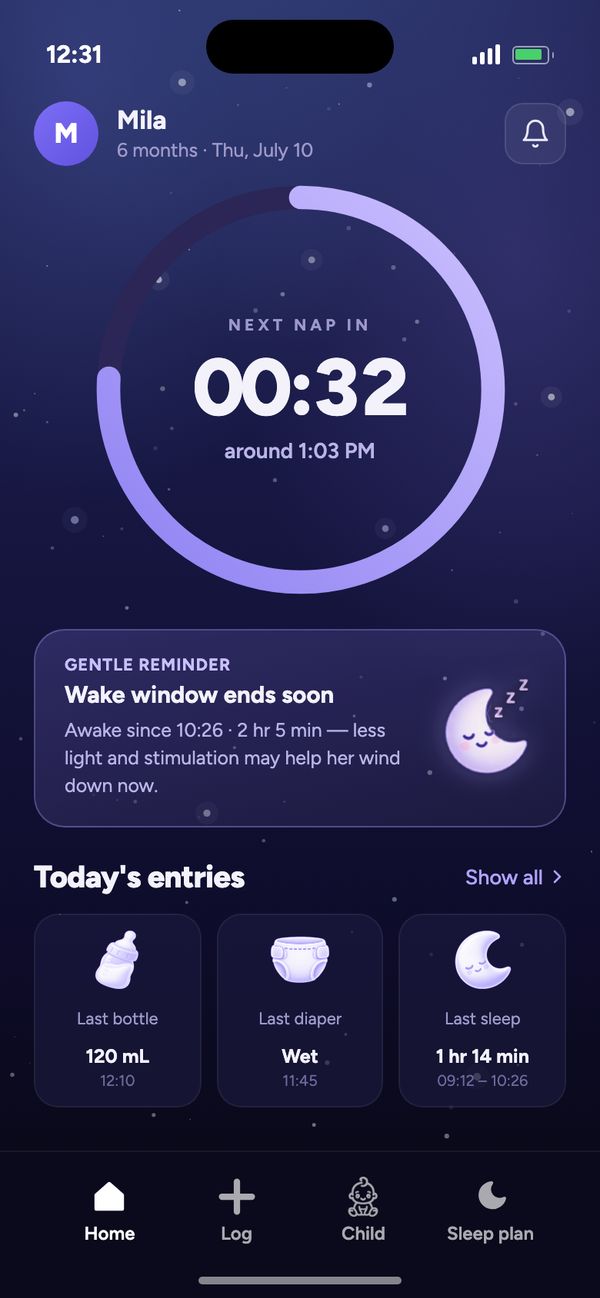
A planning trick: If the next nap is coming up, do your shopping first and go for a walk afterward—then your baby sleeps outside instead of in the warm store. Moonsleep shows you roughly when the next sleep window is coming.
Summer: dressing for 86 °F and sunshine
At 77 or 86 °F (25 or 30 °C), your baby mainly needs shade—and as little fabric as necessary. In the shade and indoors, a thin onesie is enough, and in extreme heat even just a diaper. In the sun, it’s the other way around: long, breathable clothes protect better than bare skin. In the first year, though, your baby shouldn’t be in direct sun anyway, and between 11 a.m. and 3 p.m. it’s best to stay in the shade altogether. Up to 80 percent of UV rays get through clouds.
Light and loose: one breathable layer of cotton or linen.
Light-colored and tightly woven: Light colors keep your baby cooler, while tightly woven fabric protects against UV. Hold it up to the light—the less light shines through, the better. For UV clothing, look for an ultraviolet protection factor (UPF) of at least 30 on the label.
A hat, even in the shade: with a brim or visor and a neck flap that covers the ears, since tree canopies block at most a fifth of UV rays. Child-friendly sunglasses with UV protection protect the eyes if your child keeps them on.
And sunscreen? The AAP recommends keeping babies under 6 months out of direct sun and dressing them in protective clothing instead, using sunscreen only on small exposed areas—like the face and hands—when shade and clothing aren’t an option; from 6 months on, regular sunscreen is fine. The same “from 6 months” advice comes from the UK’s NHS. (German health authorities are stricter and advise skipping sunscreen for the whole first year.) From the first birthday on, add sunscreen with at least SPF 30, and SPF 50+ near water and in snow—as a supplement, not a replacement for shade.
On hot days, breastfeed more often, and offer formula-fed babies the bottle more often—with their usual formula, mixed exactly as the package says and never watered down. Breast milk or infant formula is enough even in the heat: according to German health authorities, your baby only needs extra drinks once they’re eating three solid-food meals a day.
Tiny red dots on the neck or nape after warm days are often heat rash: dress your baby in lighter clothes and keep the skin cool and dry. A drinking glass helps you tell the difference: press it firmly on the spot and look through the bottom. If the dots stay visible, it isn’t heat rash—call 911 right away, especially if your baby has a fever or seems sick.
Sun in the first year
- Direct sun
- none
- Sunscreen
- from age 1
- 11 a.m.–3 p.m.
- shade
- UV clothing
- UPF ≥ 30
Spring, fall and rain
In spring and fall, it’s easy to get it wrong: chilly in the morning, sunny at noon, windy in the evening. Dress your baby for the coolest hour of the outing and take off layers as it warms up. A sweater, a spare onesie and a thin hat in the diaper bag keep you flexible.
Wind cools more than the thermometer shows. A windproof outer layer, such as boiled wool or softshell, a hat over the ears and the stroller canopy keep it out. For rain, a water-repellent outer layer helps, and in the stroller, a ventilated rain cover. Change wet clothes soon, because wet and cold together chill your baby fast.
The sun is already strong in spring; from a UV index of 3, you need sun protection. And 59 °F (15 °C) with sun or with wind? In the shade, the wind matters most: add a layer when it’s windy. But if the stroller is sitting in the sun, it heats up quickly inside—so check more often.
One layer in the bag beats one layer too many on the baby.
Winter and below-freezing temps
If you live somewhere with cold winters: German public health authorities recommend getting children outside for one to two hours a day whenever possible, in winter too and in any weather—shorter outings count just as much. Short trips, like the way home from the hospital, are fine from the start; longer winter walks rather from about two weeks. There’s no official below-freezing limit; well bundled up, outings are possible even at 14 °F (−10 °C), according to one pediatrician. If you read numbers like “15 minutes at 23 °F (−5 °C),” those are rules of thumb from individual guides, not official guidance. In wind, wet weather and the first weeks of life, keep outings shorter. And cold alone doesn’t make your baby sick: colds come from viruses, usually from sick people nearby, not from the walk.
Head and ears: a warm hat over the ears.
Hands and feet: mittens or outdoor suits with fold-over cuffs, thick socks, the bunting.
Neck: a balaclava or short neck warmer instead of a long scarf.
Metal: keep zippers and snaps off bare skin, for example at the chin; take out metal earrings beforehand.
Face: If you use a cream, choose a greasy, water-free cold-weather balm, because water-based creams can freeze on the skin. It helps against rough, chapped skin, but not against the cold: in Finnish studies with young men, those who used cream to protect against the cold actually had frostbite more often—probably because they felt safer. If the sun is shining on snow, a child over one year also needs sunscreen with SPF 50+.
So in freezing weather, check the cheeks, nose and ears regularly. If patches turn pale gray or whitish and cold, go somewhere warm right away. Don’t rub them; warm them slowly against your body or under a blanket and take off wet clothes—no hot bath, no hot-water bottle. If the skin stays white, gray or bluish afterward, swells or blisters, have your baby seen by a doctor.
The opposite happens often too: sheepskin bunting, snowsuit, three layers underneath—and your baby is sweating. Winter clothing means warm enough, not as warm as possible.
Common mistakes
Almost all parents know these pitfalls—a reminder, not a reproach:
Feeling the hands instead of the back of the neck.
A hat indoors or in bed.
A bulky jacket under the car seat harness.
Leaving everything on in the store because your baby is asleep.
A cloth over the stroller or the rain cover in the sun.
Bundling up a baby with a fever.
And for you: nobody gets every layer right every day. After a few weeks, you’ll know your baby, and a glance at the weather and a quick feel of the neck will be enough.
Calm nights start here.
Download Moonsleep and find the rhythm that fits your baby.
Quick checklists
To save and share:
Nighttime and naps
Bedroom 61–68 °F (16–20 °C), ideally around 64 °F (18 °C)
Sleep sack matched to the temperature, neck opening no bigger than the head
Clothes underneath per the TOG guide above
no hat, no mittens, no blanket on top
place on the back, feel the neck before you go to bed yourself
Fall walk
dress for the coolest hour
hat, thin sweater and spare onesie packed
rain cover with an air vent, sun hat when it’s sunny
open up right away indoors
Stroller in cold weather
onesie, tights, pants and sweater
warm bunting instead of an extra snowsuit
hat over the ears, mittens, thick socks
stroller floor insulated
Stroller in summer
one breathable, light-colored layer and a sun hat
stroller umbrella instead of a cloth, shady routes
breastfeed or offer the bottle more often
Carrier
as much as you’re wearing
in cold weather, a cover or babywearing coat, hat, leg warmers
face visible, chin off the chest, head close enough to kiss
Infant car seat in cold weather
seat stored indoors, thin layers, no bulky outdoor suit
harness snug, pinch test passed
blanket over the harness, face uncovered
seat rear-facing, ideally in the back seat; in the front only with the passenger airbag turned off—never in front of an active airbag
out of the seat after the drive
Diaper bag, all year round
spare onesie and a change of clothes
socks and a thin hat, a sun hat in summer
a light blanket for your arms or the car
Frequently asked questions
What should my baby wear at 68 °F (20 °C)?
Indoors at around 68 °F (20 °C), a onesie, a sleeper or pants with a shirt, a thin cardigan and socks if needed are enough. Outdoors in the shade, your baby wears a thin jacket instead of the cardigan, plus socks and a thin hat, and one more layer if it’s windy. In a stroller with a bunting, the bunting replaces the jacket. In a carrier, your baby needs about as much as you, because the carrier fabric and your body add warmth. At night at 68 °F (20 °C), a sleep sack around 1 TOG with a onesie underneath works well. The neck tells you if it’s right: warm and dry is just right.
Baby has a fever: fewer or more clothes?
Fewer, if anything. Dress your baby as usual for the room temperature and don’t bundle them up extra: clothing that’s too warm can push the temperature up further, and sick babies tend to need fewer layers so they can get rid of heat. If your baby shivers while the fever is rising, one thin extra layer is fine; as soon as they feel hot or sweat, take it off again. If your baby’s whole body is shaking (chills), have them seen the same day by your pediatrician—outside office hours, call your pediatrician’s after-hours line. If your baby is younger than three months and you measure a rectal temperature of 100.4 °F (38.0 °C) or higher, get medical help right away, even at night.
Can my baby sleep outside in the stroller in cold weather?
A nap during a walk is fine in cold weather too, as long as your baby is healthy and dressed appropriately. They lie completely flat, the face stays uncovered, nothing is draped over the stroller, and you keep an eye on them. Outside, the hat stays on; check the neck now and then and look at the cheeks and nose. As soon as you come inside: hat off, bunting open. A stroller isn’t meant as a regular place to sleep—Germany’s health authorities advise against letting babies routinely sleep in one. German health authorities don’t name a below-freezing limit. In wind, wet weather, severe cold or the first weeks of life, keep outings shorter, and a sick baby sleeps indoors.
Can I swaddle my baby?
In Germany, the national guideline on SIDS prevention and the federal public health authorities advise against swaddling babies for sleep—that is, wrapping them up snugly—and the UK’s NHS also considers a sleep sack safer. If you swaddle anyway because it calms your baby: use thin fabric like muslin and count the swaddle as its own layer, so your baby needs less underneath. The legs stay loosely bent and free to move at the hips, your baby always lies on their back, and nothing is weighted. As soon as your baby shows the first signs of trying to roll over, stop swaddling—according to the AAP, usually at three to four months, sometimes earlier.
Does my baby need a snowsuit?
Not necessarily. In the stroller, a warm bunting does the same job, with a onesie, tights, pants and a sweater underneath. In the infant car seat, a snowsuit doesn’t belong under the harness, and in a carrier the thick padding compresses. Indoors, it also constantly has to come off and go back on. It’s mainly practical for kids who are already crawling or walking and play outside in the snow. If you buy one, pick one that opens all the way down the front.
Bunting or blanket: which is better in the stroller?
In cold weather, usually the bunting. It doesn’t slip off, can’t be kicked away and doesn’t end up over the face, and in a store you simply open it up. A blanket is handy in spring and fall if you tuck it in well and keep an eye on your baby. In the infant car seat, the blanket always goes over the buckled harness, never under it.
Watch for these signs
Call 911 right away if you notice any of these in your baby:
they’re breathing hard, very fast or gasping for air,
their lips, tongue or skin are blue or gray, or their body looks pale and blotchy (just cool hands and feet are normal),
they’re hot after being in the heat and also floppy, very sleepy or hard to rouse,
their body feels cold or cold and clammy—especially if they’re also floppy and unusually quiet or not feeding,
they’re hard to wake or cry unusually weakly or in a high-pitched way,
they’re having a seizure,
they have a rash that doesn’t fade under a glass pressed firmly against it.
Call 911 too if you find a child alone in a hot car.
Until help arrives: In the heat, move your baby somewhere cool, undress them down to the diaper and dab their skin with lukewarm damp cloths—never cold. In the cold, get somewhere warm, take off wet clothes and warm your baby skin to skin: undressed down to the diaper on your bare chest, both of you covered, their face uncovered. No hot bath, no hot-water bottle, no rubbing.
Get medical help right away—at a children’s hospital ER or by calling 911—if your baby:
is younger than three months and you measure a rectal temperature of 100.4 °F (38.0 °C) or higher—even at night, even if they otherwise seem alert and you think they were just bundled up too warmly,
is younger than three months and you measure a rectal temperature below 97.7 °F (36.5 °C)—warm them skin to skin until then,
is between three and six months old and you measure 102.2 °F (39.0 °C) or higher (that’s the advice of the UK’s NHS),
hasn’t had a wet diaper in more than eight hours or has a sunken soft spot (fontanelle).
Have your baby checked soon—at the pediatrician’s office or, outside office hours, through your pediatrician’s after-hours line—if from day five on they have fewer than about six heavy wet diapers in 24 hours, their pee is dark, their mouth and lips are dry or they hardly have tears when crying, if after a freezing day patches of skin stay white, gray or bluish, swell or blister—or if you’re simply worried.
Moonsleep offers guidance, not medical advice. It is based on clinical guidelines and expert sources, checked against the Moonsleep reference database.