


3 a.m.: your baby is feeding, and next to you your partner is bravely keeping their eyes open—out of solidarity. It feels like teamwork, but in the end it just leaves both of you tired. Here you’ll find four timed shift plans for taking turns at night—with a breastfed baby too, and even if you’re on your own at night.
At a glance
- 8+ feeds in 24 hrs
- often 10–12
- Longest gap at first
- about 4 hrs
- Core sleep
- about 4–5 hrs
- Couch with baby
- never doze off
In short
Splitting nights with a baby into shifts means only one of you is on duty at a time, while the other gets about 4–5 hours of uninterrupted sleep, ideally in another room. If you’re breastfeeding, your partner handles everything except the feeding itself; a bottle of pumped milk can be added once breastfeeding is well established. Your baby always sleeps in their own bed in the parents’ bedroom.
Being on duty means being responsible, not staying awake. Whoever is on duty can sleep between feeds—in the bedroom, with the baby in their own bed right next to them. The plan only तय who gets up, not when your baby feeds: if you’re breastfeeding, you still feed on demand.
“You” usually means the person on duty—whether that’s mom, dad, or a co-mom. If you’re on your own, you’ll find your section further down.
Why taking turns helps
Why should you take turns at night instead of both staying awake together? A newborn feeds at least 8 times, and often 10 to 12 times, in 24 hours—and nighttime is part of that. A feed often takes 20–45 minutes at first, plus diaper changes, burping, and settling back to sleep. In the evening and first half of the night, many breastfed babies feed especially often.
In a small pilot study from Israel, young adults were similarly inattentive and low in mood after just one night with four longer interruptions as they were after only four hours in bed. So fragmented sleep can strain you in a similar way to too little sleep—even if, technically, you were in bed long enough. That’s what a shift system gives you:
an uninterrupted stretch of sleep—first for one of you, then for the other
no 3 a.m. negotiations about who gets up
space for your partner to build their own routines
protection against exhaustion
Disturbed sleep after birth is considered a risk factor for postnatal depression. In a recent review, experts say that for mothers at increased risk, protecting 4–5 hours of uninterrupted nighttime sleep is necessary and effective—for example, by having another adult cover one or two nighttime feeds. Your risk is higher, for example, if you had depression before or during pregnancy, feel unsupported in your relationship, or feel overwhelmed and alone. If that sounds like you, bring it up with your OB-GYN or primary care doctor and keep an eye on the “Watch for this” box.
If you can’t manage the longer block right now, that does not automatically mean you’ll become ill. And this affects both parents: about 1 in 10 fathers also shows depressive symptoms around the time of birth.
A good team means one of you has slept enough to catch the other.
The 4-to-5-hour rule
Behind every good shift plan is one idea: each adult gets one protected block of about 4–5 hours of uninterrupted sleep per night—here we call it core sleep. Anything beyond that is a bonus.
Why uninterrupted? Your body gets its most restorative deep sleep in the first hours of a sleep phase. So what counts is an undisturbed block—whether it starts at 9 p.m. or 1 a.m.
What matters is that the block is protected. Whoever is off duty sleeps out of earshot: in a guest room, or if you only have one bedroom, alone on the couch or a mattress in the living room. That’s okay—the couch warning below applies to falling asleep with the baby. Earplugs or a sleep mask can help, but only for the person who is safely off duty.
This isn’t easy: in a Danish study, mothers still checked on the baby more often at night even while fathers were on parental leave. Off duty means off duty. And sleeping in separate rooms for a while isn’t a verdict on your relationship—it’s division of labor.
The first few weeks
If you’re exclusively breastfeeding and your baby feeds every 1.5–3 hours, a four- or five-hour block often isn’t possible for you at first. Until your baby is back to their birth weight—usually after 10–14 days—they also shouldn’t go longer than about 4 hours at night without a feed. Count from the start of the last feed, not the end. Whoever is on duty sets an alarm.
That limit applies to healthy, full-term babies. If the hospital or your pediatrician’s office told you to use shorter intervals—for example because of jaundice or an early birth—follow their guidance. A sleepy newborn is easiest to wake during light sleep: they twitch, smack their lips, or move their eyes under the lids. Open the sleep sack, change the diaper, and do skin-to-skin. If your baby falls asleep again at the first breast, change the diaper before offering the second.
And after that? Once your baby is back to birth weight and gaining well, you can let them sleep at night—even for five hours at a stretch. The 4-hour limit is a rule for the first few weeks, not an ongoing rule, unless your pediatrician says otherwise because of weight gain. If your breasts feel uncomfortably full while your baby sleeps, hand-express a little milk briefly.
The tightly packed nights of the first weeks are a phase—not how it will always be.
Keep night feeds short
Until a longer block becomes possible, the main way to save sleep is to keep each waking as short as you can. These are things you can manage even on your own:
Respond to early hunger cues. Rooting, lip-smacking, hands to mouth, restlessness: if you latch or offer the bottle now, you don’t first have to calm a crying baby.
Keep lights dim and stay quiet. A small warm lamp is enough; talk as little as possible, don’t play, and avoid screens.
Only change the diaper if needed. If there’s poop or the diaper is very wet, ideally before the feed or when switching sides, so your baby stays drowsy afterward.
Wait briefly for a burp. A few minutes upright is enough; many breastfed babies don’t burp at all.
Put baby right back to bed. On their back in their own bed, then lie down yourself.
4 schedules with times
Which nighttime shift plan works for you depends on how your baby feeds and who has to be up in the morning. The times here are examples—shift them to fit your baby.
If you’re exclusively breastfeeding in the first few weeks, Model 2 plus a morning shift usually fits best. Once breastfeeding is going smoothly and you have milk pumped ahead, Model 3 can work—one nighttime bottle during the breastfeeding parent’s sleep block. If your baby gets formula by bottle, Model 1 or Model 4 may fit. If one of you has to be up early, put that person’s shift in the first half of the night, then have them take the morning shift on weekends. If you’re on your own or alone at night: go to bed early and hand off individual shifts—more on that below.
Which model fits you?
- Breastfeeding only
- Model 2
- Pumped milk
- Model 3
- Formula
- Model 1 or 4
- Up early for work
- first-half shift
Model 1: Split the night
You cut the night in half, and each of you fully covers one half: feeding, diapering, soothing. This works if your baby gets a bottle at night. If you’re breastfeeding, this model only makes sense once breastfeeding is well established—and usually with a quick pause to hand-express once your breasts feel too full. In the first few months, they often don’t tolerate five or six hours without milk removal very well.
Shift 1, about 8:30 p.m. to 1:30 a.m.: One person is responsible; the other sleeps in the quiet room.
Around 1:30 a.m.: Quick handoff, then switch.
Shift 2, about 1:30 to 7 a.m.: Now it’s the other person’s turn.
From about 7 a.m.: Whoever had the first shift takes the morning; whoever had the second shift sleeps in.
The key point: if you have the second shift, you’re in bed by 9 p.m. at the latest—not after the 11 p.m. episode. And even during the first shift, your baby sleeps in their own bed in the bedroom, not on someone’s arms on the couch.
Calm nights start here.
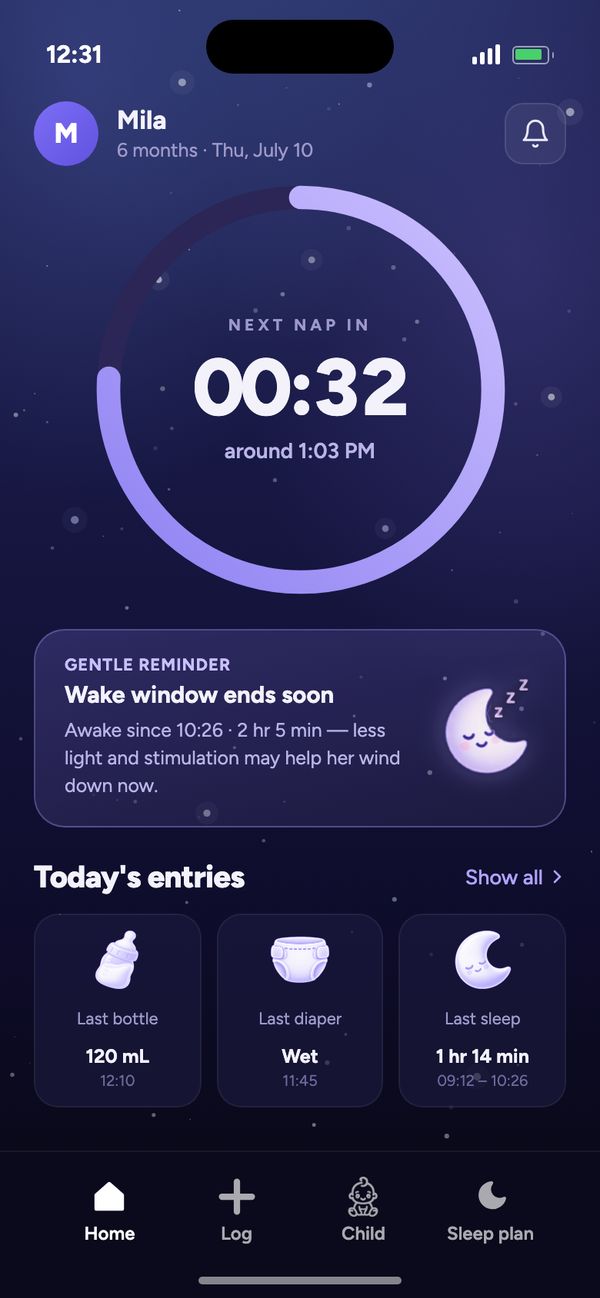
Download Moonsleep and find the rhythm that fits your baby.


Model 2: You’re breastfeeding
If you’re exclusively breastfeeding, the feeding stays with you. But someone else can still do everything before and after. Honestly: in this model, you won’t get a core sleep block in the middle of the night. What you gain is shorter wake-ups—and your long sleep block comes in the morning.
About 8:30 p.m. to 1 a.m., partner on duty: They sleep in the same room, get up at the first sound, change the diaper if needed, and bring you the baby. You only sit up or breastfeed lying down (safety rules below).
After each feed: They wait for a burp, soothe, and place your baby on their back in their own bed. Between feeds, both of you sleep.
About 1 to 6 a.m.: Your partner moves to the other room. You take over; your baby sleeps in their own bed right next to you.
About 6 to 8 a.m.: Right after a breastfeeding session, your partner takes the baby and you keep sleeping. If your baby gets hungry, they bring the baby to you to feed and then take them back again.
That way, your awake time per feed shrinks to the breastfeeding itself, and because someone else puts your baby back, they won’t be left beside you if your eyes close. This model is especially valuable after a C-section.
Model 3: One nighttime bottle
Once breastfeeding is going smoothly, one nighttime feed with pumped milk can go to someone else:
Around 8 p.m.: You breastfeed and go straight afterward to the quiet room.
Next feed, for example around 11 p.m.: Your partner gives the bottle.
The feed after that, for example around 1:30 a.m.: They wake you. You breastfeed and take the rest of the night; they go to sleep.
In the morning: Morning shift as agreed.
In the best case, that gives you your 4–5 hours in a row. If your breasts feel too full when you wake, latch baby or briefly hand-express some milk. One honest note: pumping takes time during the day—the nighttime bottle saves sleep, not necessarily work.
Model 4: Alternate whole nights
If your baby drinks formula from a bottle, you can even alternate whole nights: one person is on duty for the entire night while the other sleeps through, then you switch the next evening. The advantage: each night, one of you really gets to switch off. The downside: whoever had the long duty night needs a nap the next day and should not drive that morning.
A building block for all models: the morning shift. From about 6 to 8 a.m., one person takes the baby while the other keeps sleeping. With a breastfed baby, the partner takes over right after a feed and brings the baby back as soon as they show hunger. On weekends, this is a good place to start.
When can you add a nighttime bottle?
When your partner can give a bottle at night depends on breastfeeding: nursing at night helps keep your milk supply going. Prolactin, the hormone behind it, is highest at night and in the early morning, and babies drink about one-fifth of their 24-hour milk intake overnight. Long gaps in the first few weeks can lower your supply. So the rule is: wait to add a nighttime bottle until breastfeeding is going smoothly.
There’s no fixed week for this, but you can judge it yourself. Breastfeeding is going smoothly when …
your baby is back to birth weight and gaining steadily—your pediatrician’s office keeps track of the numbers, and in between you can ask for a weight check,
they have at least six heavy wet diapers in 24 hours,
in the first weeks they have several soft yellow stools a day, usually three or more (from around six weeks, breastfed babies often poop less often; that’s normal),
latching works without help, no longer hurts, and your nipples are not sore,
your breasts feel softer after feeding, and
your baby seems satisfied after most feeds and you don’t need to supplement.
If all of that is true, you can start. If one point is off, get advice first: from a lactation consultant or your pediatrician’s office—how to find breastfeeding help is under “Where to find help.” If you plan to make the nighttime bottle a regular part of your routine, keep offering it regularly afterward; otherwise, some breastfed babies may reject it again later.
No calendar can tell you when breastfeeding is going smoothly—you can judge that yourself.
The first nighttime bottle
Pump when your breasts are fullest. For many people, that’s in the morning, for example right after the first breastfeeding session.
Expect small amounts. If you’re exclusively breastfeeding, you’ll often pump only ½–3 fl oz (15–90 mL) between feeds. That says nothing about how much your baby gets at the breast—for one nighttime bottle, you often need two or three sessions.
Portion the right amount. A breastfed baby drinks just under 2.7 fl oz (80 mL) per feed on average at the breast, but the range is wide. To start, about 2–3.4 fl oz (60–100 mL) is usually enough, plus a small second portion as backup.
Collect and freeze. You can add chilled milk to milk that is already frozen and build up one full portion, labeled with the date. At 0 °F (−18 °C), it keeps for about 6 months. Thaw it in the refrigerator or under lukewarm running water; then use it within 24 hours and never refreeze it.
Practice the first bottle. Do it during the day, in a calm moment, before your baby is very hungry. Ideally, your partner gives it while you’re out of sight and smell range.
Your breasts during bottle time. Whether you need to pump at the time of the skipped feed depends on your breasts: if they feel too full, hand-express just until comfortable—not until empty. In the first three months, at least one milk removal should still happen during the night or early morning; in Model 3, that’s your breastfeeding session at the end of your block.
Hand expression is often faster at night than setting up a pump: wash your hands, place your thumb and finger in a C-shape about 0.8–1.2 in (2–3 cm) behind the nipple, press gently together, release, and repeat in a rhythm. Then move your hand around the breast.
Formula at night
Whether you give formula at night is up to you. If you want to keep breastfeeding, know this: if powdered formula regularly replaces a breastfeeding session, your milk supply can drop. At 3 a.m., this is the fastest way to do it:
Prep in the evening: set out a clean bottle and nipple, and pre-measure the powder for one feed into a clean, dry container.
Mix it fresh at night: wash your hands and prepare the water according to the package directions—in the first months of life, boiled water is safer. Mix the bottle when the water is only lukewarm, no more than 104 °F (40 °C).
Measure exactly: fill the scoop loosely, level it off, and stick to the mixing ratio on the package—never “a little extra.”
Check and feed: shake, put a few drops on your wrist, and give it right away.
Throw leftovers away: anything left is discarded, never saved or reheated. Clean the bottle and nipple right afterward.
Why the fuss? Powdered formula is not sterile, so pre-mixed bottles made ahead are off limits. The only no-wait option is ready-to-feed liquid formula—for nighttime, that can be a practical alternative. And: don’t pressure your baby to finish the bottle, and don’t add cereal to the milk to make them sleep longer. Your baby can feel for themself how much they need.
Your baby can sense how much they need. You can trust that.
For partners
Not the one breastfeeding? Then you’re not the helper at night—you’re the other half of the team:
get the baby, change the diaper, and bring them for breastfeeding
hand over the pillow, water, and burp cloth
burp, soothe, and put baby back—on their back, in their own bed
restock burp cloths, laundry, and the night station
keep notes: time, side, diaper
take the morning shift
If your breastfed baby roots for the breast while with you: if they’re showing early hunger cues—rooting, lip-smacking, hand to mouth—bring them to breastfeed right away. Hunger can’t be soothed away, and in the first few weeks you don’t delay a feed so someone can sleep longer. If your baby is fussy even though they just fed, try skin-to-skin contact or rock them upright on your shoulder.
Agree in advance on a time limit, for example ten minutes: if your baby isn’t settled by then, you wake the breastfeeding parent. They can also latch the baby again shortly after a feed—a breastfed baby cannot be overfed. That way, they don’t have to lie awake in the next room listening to whether you’re managing.
How to make a night shift plan
The worst time to talk about night duty is during the night itself. Ideally, have the conversation in pregnancy. Already in the thick of it? Then do it tomorrow over breakfast: ten minutes and these questions are enough. Start small—this week maybe just with a morning shift and a wake-up rule.
Who is breastfeeding, and who is recovering from birth? After a C-section or a difficult birth, the mother needs the longer breaks at first.
Who has to be out the door in the morning? Whoever has to start work early takes the first half of the night and then sleeps until the alarm. Whoever barely slept does not drive—not even to the baby’s checkup.
Who’s a night owl and who’s a morning person? Whoever naturally stays up late takes the first shift; whoever gets up easily takes the second or the morning shift.
Your wake-up rule: wake the other person for breastfeeding, for fever or other warning signs from the “Watch for this” box, if your baby can’t be settled within the agreed time limit—and always if the person on duty is about to fall asleep or the crying is making them angry or desperate.
How do you wake each other? Knocking, tapping a shoulder, or a phone call. The off-duty person’s phone stays on Do Not Disturb—with an exception for the person on duty.
If one of you is working: here’s how to keep it fair. On weekdays, the person who has to work in the morning takes the first shift until about 1 a.m. and then sleeps through; on weekends, the parent on parental leave sleeps in. Parental leave is daytime duty too, not free time. If possible, schedule your partner’s vacation or parental leave for the first few weeks—in the US, what’s available depends on your employer and state, so talk to the employer early.
For handoff, two minutes and a note by the changing table or an app (see box below) are enough, because when you’re overtired it’s easy to mix up 11:40 p.m. and 12:40 a.m. Writing it down helps for another reason too: in the Danish study, mothers and fathers both estimated the other parent’s nighttime effort as lower than that parent reported. When you’re awake alone, you don’t see what the other person is doing. So fair doesn’t mean everyone is awake for exactly the same number of minutes—it means everyone gets their sleep block.
Try your plan for one week and then sit down again: what’s working, what isn’t? If one of you feels overlooked, look at your notes instead of relying on the feeling alone. Babies change quickly. Your plan can too.
Calm nights start here.
Download Moonsleep and find the rhythm that fits your baby.
Fallen asleep while feeding?
You can’t plan tiredness away. In a large U.S. survey, more than 1 in 4 mothers had fallen asleep while feeding in the previous two weeks—usually unintentionally. So parents need a plan for exactly that moment:
Keep the baby in the bedroom. Couches and armchairs are the most dangerous places to nod off: if a baby sleeps there with an adult, the risk of sleep-related death is many times higher—according to the American Academy of Pediatrics, up to 67 times higher. That applies in every shift. So move the adult who is off duty, not the baby.
Breastfeeding in bed? Then prepare for it. Your baby lies flat on the mattress, away from pillows; your blanket only comes up to your waist, and the nursing pillow is removed from the bed first. Your baby must not be able to fall out or slip between the mattress and the wall. If you wake up, place your baby on their back in their own bed.
Never fall asleep together if … anyone in the bed smokes or vapes, you’ve had alcohol, cannabis, or anything that makes you drowsy—including over-the-counter sleep aids—or if your baby is very small or was born early. Siblings and pets never belong in the bed.
A bedside bassinet counts as a separate bed if it has its own firm, flat mattress, is securely attached to the parents’ bed, and there’s no gap.
The bottle is held. A baby never drinks alone and never from a propped bottle.
Sober on duty. Whoever is on duty does not drink alcohol or take anything that makes waking difficult; otherwise the other person takes over. If you’re alone, you’re on duty every night—if you take medication that makes you sleepy, ask your clinician or pharmacist in advance how to keep your nights safe.
Make staying awake easier. Sit upright, keep water within reach, use dim light, and choose an audiobook rather than scrolling.
It’s okay to wake the other person. If you notice you’re nodding off, place your baby in their bed and wake the other person. If you’re alone, put your baby in their bed even if they cry.
Avoid small accidents. Keep one hand on your baby at the changing table at all times; no hot drinks while you’re holding your baby.
You’ll find when to get help right away in the “Watch for this” box at the end.
Alone at night
If you’re a single parent—or your partner works shifts, travels for work, or is away during the week—“you’re on duty, I sleep” may sound like a bad joke. But the principle still works: you spread the shifts across other people and across the day.
Be honest with yourself: on your own, with a fully breastfed newborn, a four- or five-hour block usually just isn’t possible. It only comes once you hand off a shift, someone gives a bottle, or your baby naturally sleeps longer. Until then, every sleep stretch counts—even two shorter ones plus a nap in the daytime. You have not failed if it feels pieced together.
Sleep when your baby sleeps. Go to bed early in the evening, lie down for the first daytime nap, and above all sleep when your baby has their longest stretch. If your baby wants to feed constantly in the evening, move the evening into the bedroom: nurse sitting up, lie down in between, keep the lights dim.
Keep the distances short. Your baby sleeps in their own bed right next to yours, and the night station is within reach.
Cut household tasks to the minimum. Cook ahead, freeze meals, get food delivered—laundry can wait.
Hand off individual shifts. Maybe your mother sleeps over every Friday and takes the second half of the night, and a friend comes Sundays from 6 to 9 a.m. A few regular helpers are better than constantly changing ones, because babies feel safer with familiar people—someone who comes every week becomes familiar quickly.
Schedule a daytime shift for your sleep. Someone takes the stroller out right after a feed and brings your baby back as soon as they’re hungry. You sleep.
If family lives far away: ask at a community center whether volunteers help out new parents, and use contacts from your childbirth or baby class. Specific asks help: “Could you take the stroller on Saturday from 2 to 4 p.m.? Then I can sleep for two hours.”
Your backup plan: leave a spare key with someone nearby, save emergency numbers in your phone’s medical ID, and decide ahead of time who will come if you get sick yourself. And find one person you’re allowed to call at night.
If the crying pushes you to your limit: place your baby on their back in their own bed, close the door, go into another room for a few minutes, drink a glass of water, call or text 988 if needed—then go back. A few minutes of crying in a safe bed is okay.
Support in the US
- First checkup
- at 3–5 days
- Lactation support
- often covered
- Postpartum visit
- by week 12
- Local help
- call 211
Where to find help
Breastfeeding support: In the US, most health plans have to cover breastfeeding support and counseling without cost-sharing, for as long as you breastfeed, with in-network providers—plus a breast pump. Ask your birth hospital about lactation consultants or a breastfeeding clinic. La Leche League Leaders and, if you’re in WIC, WIC peer counselors can help too, also by phone or online; if you see a lactation consultant outside your plan’s network, ask about the cost beforehand.
Practical help: ask family and friends for concrete help, so you can catch up on sleep. Here’s how to ask:
Be specific: “Could you bring us dinner on Tuesday and do one load of laundry?”
Ask for the tasks that free up the most time for you, such as groceries, cooking, or laundry.
If your mother or another relative lives far away, ask whether they could come for a few days and take over some nights.
If your partner lives with you but has to work, ask others anyway: what matters is whether someone can actually keep the household running.
There’s no fixed limit on how long you can lean on others. Help with the household can also free up time for daytime sleep.
Volunteer family support services: in some places, volunteers come to your home once or twice a week for a few hours during the first year. Any hourly fee is usually discussed in the first meeting. Don’t let cost stop you from asking.
Home visiting programs and local help: some communities offer free, voluntary home visiting programs for new parents; your pediatrician or local health department can tell you what’s available. For local help with things like food or diapers, you can call 211. Reaching out is care, not a confession of failure. A support organization for single parents may also be able to advise you.
Being tired is not failure. It’s the sign that it’s time to hand something off.
Cluster feeding and more
No shift plan survives every night unchanged. Sometimes your baby wants to feed almost nonstop. That’s called cluster feeding; many people also talk about a growth spurt—but there’s no fixed calendar for it. These phases usually last two to three days, occasionally up to a week.
It’s no longer typical cluster feeding if other things show up too: fewer than six wet diapers in 24 hours, fewer than three stools a day in the first weeks, very long feeds without your baby seeming satisfied, sore nipples, or not being back to birth weight after two weeks. If that happens, get advice within 24 hours from your pediatrician’s office or a lactation consultant.
Emergency mode with a breastfed baby: your partner covers everything except the breastfeeding itself in short 2–3 hour shifts—diapering, carrying, putting baby back down—and you sleep between feeds, however short those stretches are.
At the same time, your baby’s sleep changes. In the first weeks, babies usually sleep between 30 minutes and 3 hours at a time. From around 8–12 weeks, many start developing a day-night rhythm, and the longest sleep stretch gets longer—averaging just under six hours across the first five months, with huge differences between babies. Daylight in the daytime and dim light at night support that. Put the breastfeeding parent’s core sleep exactly into your baby’s longest stretch, instead of filling that time with chores.
Night feeds are a completely normal part of the first half-year, and for many breastfed babies, much longer than that. So your plan is a tool you keep adjusting: sometimes the full split, sometimes just the weekend morning shift. And one day you’ll notice you don’t need it anymore.
Frequently asked questions
Do I need to wake my baby to feed at night?
In the first few weeks, yes: until your baby is back to birth weight, usually after 10–14 days, they shouldn’t go longer than about 4 hours at night without a feed, counted from the start of the last feed. After that, no: if your baby is gaining well, they can sleep for five hours or longer at a stretch—and so can you. Exception: if the hospital or your pediatrician’s office gave you different intervals because of weight, jaundice, or an early birth, follow their guidance. If your breasts feel too full while your baby sleeps, briefly hand-express a little milk until it feels better.
When can my partner give a bottle of pumped milk at night?
As soon as breastfeeding is going smoothly—there isn’t one fixed week for it. Check for yourself: your baby is back to birth weight and gaining steadily, has at least six heavy wet diapers a day, latching no longer hurts, your breasts feel softer after feeding, and your baby seems satisfied after most feeds. If that all fits, you can start. If one point is missing, ask a lactation consultant or your pediatrician’s office first. The article above walks you through the first nighttime bottle step by step.
How much pumped milk should go in the nighttime bottle?
A breastfed baby drinks just under 2.7 fl oz (80 mL) per feed on average at the breast, but the range is wide. To start, about 2–3.4 fl oz (60–100 mL) is usually enough. It’s better to keep a small second portion ready than to start with one large bottle, because leftovers have to be thrown away. More important than the number are your baby’s cues: if they let go of the nipple, turn away, or relax their hands, they’re full—even if there’s still milk in the bottle. Amount charts for formula only partly fit breastfed babies, because after the first month they usually don’t keep increasing their total daily intake much.
Do I need to pump if my partner gives the nighttime bottle?
Not necessarily at the exact same time—otherwise your sleep block would disappear. Go by your breasts: if they feel too full when you wake, latch your baby or briefly hand-express, only until comfortable. In the first three months, at least one milk removal should still happen during the night or early morning; in the model with a nighttime bottle, that’s your own breastfeeding session after your block. If your partner gives the bottle every night and you notice your milk supply dropping, add an extra pumping session and get breastfeeding support.
What if our breastfed baby won’t take a bottle from my partner?
Practice during the day in a calm moment, when your baby is awake but not very hungry yet. The breastfeeding parent should be out of sight and smell range. Try a different position—more upright, for example, or with your baby’s back against your partner’s chest—and a slow-flow nipple. Don’t push it: if it isn’t working after a few minutes, stop and try again later. If it still isn’t working after several days, a lactation consultant can talk through alternatives such as feeding with a small cup. And if your baby is hungry at night and won’t take the bottle, the breastfeeding parent gets woken up.
Should my partner get up at night if they have to work in the morning?
Yes—but in the right shift. Whoever has to be up early takes the first half of the night until about 1 a.m. and then sleeps until the alarm. On weekends, you reverse it, and the parent on parental leave sleeps in. Parental leave is not a vacation: being alone with the baby in the daytime is also duty. And anyone who barely slept shouldn’t drive. Try the plan for a week and then talk about what feels fair to both of you.
I finally have time off and still can’t fall asleep. What helps?
Your body is tired, but your mind is still listening—that happens to many new parents. Real distance helps: another room, earplugs, and not using your phone to scroll in bed—calls from the person on duty can still come through. Agree clearly on when you’ll be woken so you don’t have to stay on alert yourself. A small ritual can make it easier to switch off, such as brushing your teeth, turning out the light, and taking a few calm breaths. But if you can’t sleep for more than two weeks even when you have the chance, or you feel persistently low, talk to your OB-GYN or primary care doctor. That can be a sign of postnatal depression, and effective help is available.
We have a preemie. Does all of this apply to us too?
The basic principle does, but the details may not. If the hospital or your pediatrician’s office gave you a feeding plan, that always comes first—before any shift plan. So discuss your split there. Good teamwork matters even more in that situation. Important: a baby born early or very small should never sleep in an adult bed, only in their own bed next to you.
Watch for this
A shift plan can help, but it doesn’t replace medical advice. Wake each other and get help if …
your baby is struggling to breathe, turns pale, has bluish lips, seems limp and unresponsive, or is very hard to wake: call 911 right away. Here’s the difference from a normal sleepy spell: if your baby wakes when undressed or changed and then feeds, that’s reassuring. If they’re still hard to wake that way, only suck a few times, and seem floppy, it’s an emergency.
your baby is under three months old and has a fever—100.4 °F (38.0 °C) or higher taken rectally (lubricate the thermometer tip and insert it only 0.4–0.8 in/1–2 cm): have your baby checked by a doctor that same night. If the office is closed, go to the ER or call your pediatrician’s after-hours line.
your newborn, who is not yet back to birth weight, sleeps through feeds, or your baby has fewer than six wet diapers in 24 hours from day 5 onward: call your pediatrician’s office the same day.
one area of your breast is red, hot, and painful: keep breastfeeding, cool the area, express only gently, and take ibuprofen or acetaminophen if needed. If it isn’t better within 12–24 hours or you start feeling worse quickly, see your OB-GYN or primary care doctor the same day; overnight, go to urgent care.
you feel low and drained for more than two weeks, or can’t sleep even when you’re allowed to: talk to your OB-GYN or primary care doctor. This applies to fathers and female partners too. In the US, you can also call or text the National Maternal Mental Health Hotline at 1-833-852-6262 (1-833-TLC-MAMA), any time.
the mother suddenly seems unlike herself—unresponsive or extremely tense, full of fear, confused, or having delusional thoughts: this could be rare postpartum psychosis and needs immediate medical help, if necessary via 911. As a partner, watch especially carefully for this.
you have thoughts of harming yourself or your baby: call 911 right away, or call or text 988.
If your baby’s crying pushes you to your limit, place them safely on their back in their own bed, leave the room for a few minutes, and get someone to take over if possible. Never shake your baby. Day or night, you can call or text 988 or the National Parent & Youth Helpline at 1-855-427-2736.
If you’re outside the US, use the local emergency number and the crisis helplines where you are.
Moonsleep offers guidance, not medical advice. It is based on clinical guidelines and expert sources, checked against the Moonsleep reference database.