


You feed, change, rock to sleep—and the minute you lie down, your baby needs you again. If you feel like you’re moving through fog right now, nothing is wrong with you: sleep deprivation is almost unavoidable in the first months with a baby. But you can do more than just endure it—split nights wisely, bank sleep, and get the help that’s out there. There’s a separate section for partners further down.
What helps most
- Biggest help
- sleep in shifts
- In the evening
- early to bed
- Naps
- ~10 or 90 min
- Off-limits when tired
- sofa with baby
Why babies wake so often
Your baby is born without a finished internal clock. In the first weeks, they sleep in stretches of about 30 minutes to 3 hours, spread fairly evenly across day and night, and usually feed 8–12 times in 24 hours—including overnight. If you’re breastfeeding, that frequent nursing is exactly what keeps your milk supply going.
Many babies also feed every little while for hours in the evening. This cluster feeding is normal and not a sign that your milk isn’t enough; these phases usually last two or three days.
Important in the first few weeks: Until your baby is back to their birth weight—usually after 10–14 days—they shouldn’t go longer than about 4 hours without a feed, even at night. If they sleep longer, wake them gently: unwrap them, change the diaper, hold them skin to skin. So a long stretch in week two isn’t a gift to savor. Only once your baby is gaining well and, from about day 5 onward, has at least 6 heavy, wet diapers in 24 hours, can they sleep as long as they want at night.
From about 8–12 weeks, a day-night rhythm starts to emerge. “Starts” really does mean starts—often one nighttime stretch gets a little longer than the others. That rhythm usually doesn’t settle in until around 3–6 months, and at least one night feed is normal until about 6 months. Frequent waking by itself is not a reason to worry; call your pediatrician if your baby is feeding poorly, has fewer wet diapers, or isn’t gaining well. For premature babies, all ages are counted from the due date.
Worried your baby isn’t getting enough sleep? Newborns usually manage only about 35–75 minutes awake at a time at first, and around 60–90 minutes by 8 weeks. If they’re yawning or rubbing their eyes, they’re ready to sleep again.
Newborn sleep early on
- Sleep stretches
- 30 min.–3 hr.
- Feeds in 24 hours
- 8–12
- Wake at first
- after ~4 hr.
- Rhythm from
- 8–12 weeks
Fragmented sleep
Seven hours in bed and still feel wrecked? That’s about the pattern, not you. Sleep runs in cycles of about 90–120 minutes, and your body gets its deepest sleep as early as possible in the sleep period. If you’re woken every hour or two, your body keeps having to start over.
A sleep study in young adults recreated this: one night with 8 hours in bed, interrupted by four wake periods of about 15 minutes each, hit attention and mood about as hard as a night with only 4 hours of sleep. So broken-up sleep counts for less than the clock says it does.
That’s why this matters: one uninterrupted block of 4–5 hours includes two to three full sleep cycles and helps you more than the same amount of time in fragments. That’s exactly why going to bed early and using shifts matters so much.
Calm nights start here.
Download Moonsleep and find the rhythm that fits your baby.


How long does this last?
Sleep deprivation with a baby is usually hardest in the first two to three months. A large review from Germany found that in the first three months after birth, mothers slept about an hour less per night on average than before pregnancy, and fathers about 15 minutes less. Very roughly, it tends to look like this—though every baby has their own pace:
Weeks 0–6: Feeding around the clock, often with evening cluster feeding. Nights are usually at their most broken up.
From about 8–12 weeks: A day-night rhythm begins, and one stretch at night often gets a little longer.
3–6 months: The rhythm settles more. Long stretches become more common—but setbacks do too.
6–12 months: Many babies still wake, for example because of teething, infections, or new developmental leaps.
For perspective: between ages 0–5 months, the longest sleep stretch averages just under 6 hours at a time—in the first weeks, it’s usually shorter.
Many parents talk about a “4-month sleep regression.” There isn’t one fixed, scientifically proven age for it. Still, bumpier weeks are normal and they pass—you haven’t done anything wrong.
Sleeping through the night is not a deadline. Many babies still aren’t sleeping 6–8 hours at a stretch at 6 months, or even at 1 year—and they develop just as well as the others (in one Canadian study, depending on age and definition, that was anywhere from a little over one quarter to more than half).
Signs of sleep deprivation
You stand in front of the open fridge and can’t remember what you came for. A dropped pacifier makes you want to cry, and a well-meant comment suddenly sounds like criticism. That isn’t a character flaw—it’s sleep deprivation. Common signs are:
Your mind: it’s harder to focus, you forget more, and your reactions are slower.
Your emotions: your mood swings, you get irritated faster, and small hurdles feel huge.
Your body and daily life: constant yawning, feeling groggy when you wake up, being tired all day—and dozing off the moment you sit still.
The tricky part is that you barely notice how impaired you are. Adults in a lab who slept no more than 6 hours a night for 2 weeks performed, by the end, about as badly on tests as after up to 2 sleepless nights—but after the first few days, they hardly felt any sleepier. On top of that, sleep and mental health are tightly linked: people who sleep especially poorly after birth are more likely to have depressive symptoms, and low mood in turn worsens sleep. At this stage, sleep isn’t a luxury—it’s preventive care.
Sleepiness gets dangerous behind the wheel. Being awake for 17 hours straight affects reaction time roughly like a blood alcohol level of 0.05% (0.5‰). Broken-up nights can make you just as unreliable, without you realizing it. Warning signs are frequent yawning, fading attention, and struggling to stay in your lane. If you notice it while driving: pull over at the next safe place, take a short sleep break with an alarm, then continue—or have someone pick you up. If a trip has to happen, for example for your baby’s checkup, ask who can drive, take the bus or a taxi, or schedule the appointment after your longest sleep block. If your baby is sick, your pediatrician’s after-hours line can also advise you by phone.
You don’t have to earn sleep. You need it—just like your baby needs milk.
Split nights into shifts
The biggest game changer for sleep deprivation is a shift system: instead of both of you lying half-awake every night, one person is on duty and the other gets real sleep.
The person on duty sleeps without earplugs in the bedroom, where your baby also sleeps in their own bed—in the first year, that’s where your baby belongs. Never do your shift on the couch or in an armchair: if you nod off there with your baby in your arms, it puts them in serious danger.
The person off duty sleeps with earplugs in the next room. They’re only woken if your baby seems sick or the person on duty is nodding off with the baby in their arms or reaching their limit—not to ask where the burp cloths are.
Instead of fixed times, divide the night around the feeds. The first shift goes to the person who isn’t breastfeeding or who doesn’t have to be up early; the other person goes to sleep as soon as the baby falls asleep in the evening. Switch after the first feed after midnight: if feeds happen at 11:50 p.m. and 2:30 a.m., you switch after the 2:30 a.m. one.
If you’re breastfeeding, no one can take the feed itself from you—but they can take almost everything around it. The rule of thumb: you breastfeed, the other person handles the rest. The person on duty brings you the baby at early hunger cues like lip smacking, rooting, or hand-to-mouth—an already crying baby latches less easily. Stretching out the hunger so you sleep longer doesn’t help: your milk supply depends on how often your baby feeds. Afterward, your partner handles burping, diapering, and putting the baby back, and stays awake until your baby is on their back in their own bed. You go back to sleep.
During cluster phases, your protected sleep block may simply start after the cluster, or your partner can bring you the baby to nurse in bed and take them away again afterward. That’s also how sleeping in on weekends can work—or with one feed of pumped milk.
Example night when breastfeeding with a partner
8 p.m.: Breastfeed, your baby falls asleep—you go straight to bed.
Around 11 p.m.: Your partner brings you the baby, you breastfeed lying down, and they handle the rest.
After the first feed after midnight: Handover—your partner sleeps, you’re on duty, and your baby is in the bedside sleeper.
Morning: Your partner takes over for an hour before work, and you keep sleeping.
With a nighttime bottle: Your partner gives pumped milk at 11 p.m.—you get one solid stretch of sleep.
Example night with bottles or on your own
Bottle, first shift: Your partner feeds until the first feed after midnight, and you sleep.
Bottle, second shift: From that feed on, you’re on duty and your partner sleeps until morning.
One person works: During the week, do an early shift from 5–7 a.m.; on weekends, one full night.
Solo: Once a week, someone stays overnight and takes a shift.
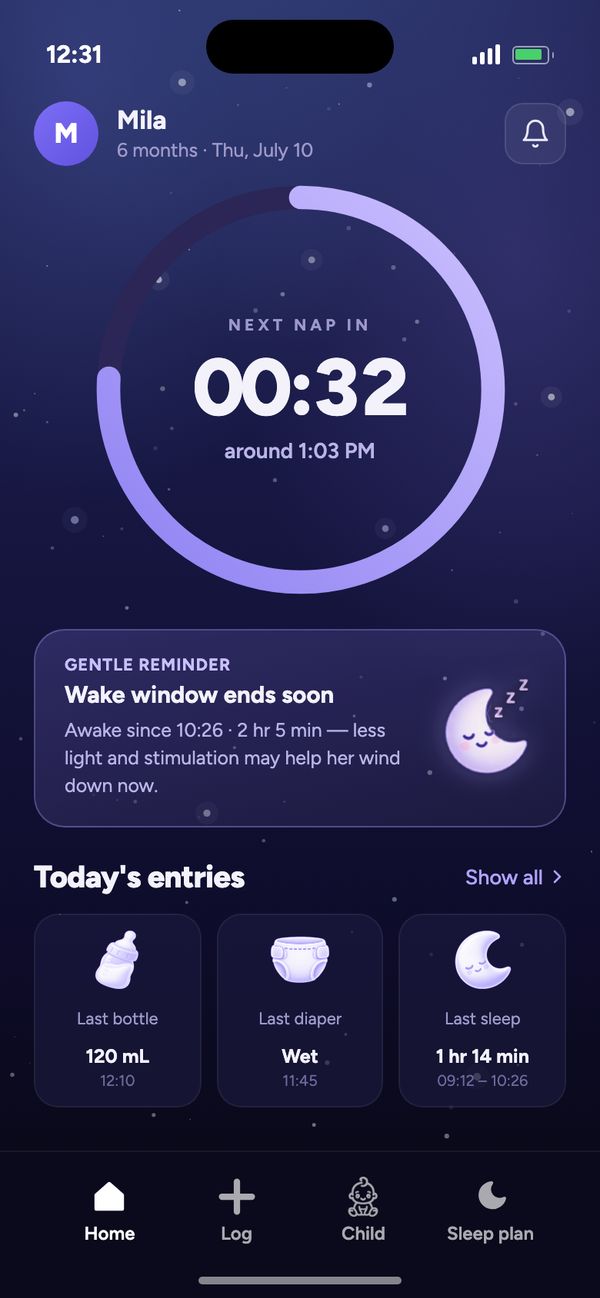
Talk through the plan in daylight, not at 3 a.m.—nobody is diplomatic then. And keep one shared overview: when did your baby last feed, how long did they sleep? Fever and pain medicine should be logged with the time so nothing gets given twice overnight. Whether it’s a note on the fridge or a shared app like Moonsleep, where partners, grandparents, and babysitters can all see the same information, the point is this: no one should have to reconstruct, half asleep, what happened 2 hours ago.
A nighttime bottle while breastfeeding
A bottle of pumped milk can replace one night feed for you—and give you a full block of sleep. Start only once breastfeeding is going smoothly. You can judge that yourself: your baby is back to birth weight and gaining well at weight checks, such as at your baby’s checkups; they have at least 6 heavy, wet diapers a day; latching doesn’t hurt; and your breast feels softer after a feed.
Pumping: right before you lie down for your sleep block. If you get only a little at first, that’s normal—fully breastfeeding mothers often pump only ½–3 fl oz (15–90 ml) between feeds. Morning is usually when output is highest, so that can be a good time to put some aside for the next night.
Storing: at the back of the fridge on the bottom shelf, not in the door, for no more than 4 days.
Warming: in warm water or a bottle warmer, never in the microwave. A drop on the inside of your wrist should feel warm, not hot. Throw away leftovers.
Feeding: your partner holds the baby semi-upright, allows pauses, and doesn’t push them to finish the bottle. That way, your baby controls the pace and amount.
Relieving your breasts: Long night breaks can lower milk supply in the first months. If your breasts wake you because they feel tight, hand express briefly: place thumb and index finger in a C-hold a few centimeters behind the nipple, press back toward the chest wall, compress, release, and repeat around the breast—only until the pressure eases, not until the breast is empty. Then cool the area. As soon as you wake up, breastfeed or pump.
If your baby won’t take the bottle, try when they’re awake and only lightly hungry, and let your partner feed while you’re out of the room.
Warning sign: A hard, red, hot, or painful area in the breast suggests a plugged duct: keep breastfeeding or pumping, and cool the area in between. If you also get a fever or flu-like symptoms, or it isn’t better within a day, get medical advice the same day.
Handing off one night feed can give you a whole block of sleep.
Alone with your baby
If you’re parenting solo or your partner is away for longer stretches, there’s no one to tap in. Then short distances and deliberately organized backup matter most.
Keep everything close: Put the crib or securely attached bedside sleeper right next to your bed, with your night station beside it. You shouldn’t have to get up overnight.
Go to bed early with your baby: Lie down in the evening as soon as your baby falls asleep. Whatever doesn’t get done, doesn’t get done—nothing gets tackled at night.
Think beyond family: Not just your mom or sister. Ask a friend, a neighbor, a coworker. One night a week when someone else takes one shift makes a real difference.
Paid help: a babysitter who comes for 2 hours during the day while you sleep.
Volunteer help: In some places, volunteer family-support services for the first year after birth can match you with someone who comes once or twice a week for a few hours—so you can lie down, for example. Local single-parent organizations may also be able to advise you.
Honestly: if you’re breastfeeding, a night with help usually works only with pumped milk or a bottle—the how-to is in the section above.
Tips for coping with sleep deprivation
Getting more sleep with a baby mostly means this: as long as your baby still feeds often at night, every bit of sleep counts—even during the day.
Make early evening your night. Lie down as soon as your baby falls asleep in the evening—whether that’s 8 p.m. or 11 p.m. That first block is the most valuable. Ideally every evening: the show will still be there tomorrow, this chance to sleep won’t.
Schedule your nap. When someone gets home or comes by, hand over the baby and lie down before you get caught talking. Set an alarm: after a short night, even 10 minutes makes you noticeably more alert, while after 30 minutes you often wake up groggy at first. If someone has your baby longer, sleep for about 90 minutes—a full cycle.
If no one can relieve you during the day: Put your baby on their back in their own bed or in a flat stroller in the same room for your nap, and lie down next to them. Never fall asleep with your baby on your chest or stomach—not even “just for a minute.”
Rest counts, even without sleep. Lying down, closing your eyes, staying still—it isn’t wasted time.
Keep coffee to the first half of the day, and if you’re breastfeeding, no more than about 200 mg of caffeine a day (more in the questions below).
Don’t use alcohol to help you sleep. It makes sleep more restless, and if you’re breastfeeding, avoiding it is recommended anyway.
Don’t take sleep meds on your own. Some sleep aids and older antihistamines make you harder to wake; what’s okay while breastfeeding is covered in the questions below.
If you can’t sleep because you’re listening for every sound: Babies breathe irregularly in their sleep, grunt, and pause for 5–10 seconds without changing color—that’s normal. Sensor socks and breathing mats do not reduce the risk of SIDS. If false alarms are keeping you awake, you can leave them out. When you do need to act is in the “Watch for” box.
The show will still be there tomorrow. Tonight’s chance to sleep won’t.
Tired but still awake
At last the baby is asleep—and you’re wide awake, listening and worrying. So many parents know this feeling. What can help:
Hand the baby monitor and responsibility to the person who’s on duty. If you’re alone, your baby is next to you anyway.
Don’t look at the clock or calculate how much sleep time is left. Turn the clock away.
Keep a notepad and pen by the bed. If something keeps circling in your mind, write it down—it’ll still be there tomorrow.
Breathe calmly for a few minutes and make your exhale longer than your inhale.
For daytime sleep when someone else has the baby: sleep mask, earplugs, darkened room.
If this barely works for weeks even though you have the chance to sleep, talk to your primary care or OB-GYN office. Insomnia despite having the chance to sleep can also be a sign of postnatal depression—more on that below.
Make nights easier
At night, every extra step is one too many. Set up a night station right next to your bed before evening:
a bottle of water—drink to thirst; drinking more than you want does not increase milk supply
a one-handed snack, like a banana or granola bar
diapers, wipes, a burp cloth, and a clean sleeper for your baby
for you: nursing pads, postpartum pads, and a fresh shirt
a small warm light you can dim instead of the overhead light
if you’re formula feeding: boiled water in a clean thermos and the powder pre-measured into a dry, clean bottle. Mix only right before feeding—water first, then powder. Never keep prepared milk warm; throw away leftovers.
A bedside sleeper saves the most steps. Your baby has their own sleep space within reach. Important: it should be firmly attached to the adult bed, both sleep surfaces level, no gap, and the correct original mattress with no extra topper. You nurse lying down and then slide your baby back into their bed.
Keep nighttime boring. Lights dim, voice quiet, no playing. Change the diaper only when needed—after a poop, a very full diaper, or a sore bottom—ideally before the feed or when switching sides. You don’t need to force a rhythm: you’re not setting times, just gently showing your baby the difference between day and night.
Phone use: brief and dark. Bright screen light at night can shift your internal clock. If you log something overnight: brightness down, dark mode on, log it, put it away. And if you’re reading this at night right now: I’m glad you’re here. The rest can wait until tomorrow.
Get daylight during the day. Daylight is the single most important cue for your internal clock, ideally already in the morning. A walk helps both of you—with your baby in the shade, because in the first year they shouldn’t be in direct sun.
Calm nights start here.
Download Moonsleep and find the rhythm that fits your baby.
Postpartum can be simple
Part of the exhaustion doesn’t even come from the baby—it comes from everything else we think we should still manage at the same time: a tidy home, hosting visitors, answering messages. Cross off as much of that as you can. An old rule of thumb for the postpartum period says: one week in bed, one week on the bed, one week around the bed.
For the first months, one small goal is enough: Everyone is fed, everyone is safe, and you slept at some point during the day. Everything else is extra. You’re allowed to have days when you got nothing done except being there for your baby. That isn’t nothing. Right now, it’s the main thing.
Getting help after birth
“Let me know if there’s anything I can do.” You probably hear that a lot right now—and then never let anyone know. Partly because at 3 p.m. you still don’t know what will save you at 5 p.m. Flip it around: make a list of tasks and hand it over the moment someone asks. The more specific the request, the easier it is for people to say yes:
“Could you bring over a meal on Thursday that we only need to reheat?”
“Could you take the stroller for a walk for an hour so I can sleep?”
“Could you do one load of laundry and hang it up?”
“Could you pick up our older child from daycare on Friday?”
“Please come by—but bring something to eat and don’t stay longer than an hour.”
Help from a distance
“Could you arrange meal or grocery deliveries for us for 2 weeks?”
“Would you like to gift us a cleaning service for a few weeks?”
“Could you call me briefly every day at 11 a.m.?”
“Could you come for a few days and take over the nights?”
To make sure you’re not alone: loneliness makes exhaustion harder. During the day, you can meet other parents at community centers, parent groups, or breastfeeding groups, or at a postpartum exercise class. You do not have to show up cheerful—a coffee among people who are living through the same nights is enough.
Your plan for tomorrow morning
No family nearby? You can do these steps one by one on your own—and here’s a sentence to use on the phone for each one:
Your primary care or OB-GYN office: make an appointment for exhaustion. Ask for blood work and talk about your mood. “My baby is 10 weeks old, I’m completely exhausted, and I have no help. I need an appointment.”
Family and friends—practical help: If you can’t manage the household right now and no one in your home can take over, ask the people around you for concrete help, such as meals, laundry, or an hour so you can sleep. Even if your partner works during the day, ask anyway. “Could you bring us dinner on Tuesday and stay with the baby for an hour so I can sleep?”
A lactation consultant—even now: In the US, most health plans have to cover breastfeeding support and counseling without cost-sharing, for as long as you breastfeed, with in-network providers. Ask your health plan or the hospital where you gave birth. “I’m looking for a lactation consultant for breastfeeding support; my baby is 10 weeks old.”
Home visiting and local help: Some communities offer free, voluntary home visiting programs for new parents. Your pediatrician or local health department can tell you what’s available, and 211 can connect you with local help such as food or diapers. “I’m alone with my baby and completely exhausted. What support is available near me?”
Lactation support: If latching hurts, feeds almost always take a very long time, or your baby never seems satisfied, first check for yourself: chin against the breast, nose clear, cheeks rounded, and you can hear swallowing. If it’s still difficult, have a feeding observed—in a breastfeeding group or with an IBCLC (your health plan may cover it).
Use the checkup: At your baby’s next checkup, you’re allowed to talk about how you’re doing too—in the first months, pediatricians ask about the mother anyway.
If the exhaustion lasts for months, don’t just keep pushing through: talk to your doctor about what could help, and keep asking the people around you for concrete support.
Accepting help is not proof that you can’t do this. It’s how people do it.
For dads and partners
If you’re not breastfeeding, helping at night can sometimes feel like just standing by. It isn’t. Real help looks like this:
bringing the baby for breastfeeding, then burping, diapering, and putting them back—and staying awake until they’re safely in their own bed
bringing water and a snack so she doesn’t have to get up
taking a fixed early-morning shift before work and one full night on the weekend
managing visitors: have them bring food and kindly wrap things up after an hour
keeping the overview: when did the baby feed, was any medicine given, what’s coming up this week?
Don’t keep score about who’s more tired. Nobody wins that argument. Ask instead: what does each of us need to get through tomorrow safely and reasonably kindly?
Take care of yourself too: about 1 in 10 fathers experiences depression between pregnancy and their child’s first birthday. If you’re withdrawing, constantly irritable, or just functioning on autopilot, take that seriously—the support options below apply to you too.
Eating and drinking
When you’re exhausted, your own meals slide to the bottom of the list. But your body is healing right now—and if you’re breastfeeding, it’s also making milk.
Eat small things regularly that you can manage with one hand: sandwiches, yogurt with oats, fruit, soup you can reheat.
Drink throughout the day, ideally water or unsweetened tea, and keep the bottle where you breastfeed or feed.
Cook once, eat twice: freeze double portions—or hand cooking off completely to the people helping you.
If you’re breastfeeding: in Germany, a daily iodine supplement with 100 micrograms is recommended. If you have a thyroid condition, talk it over with your doctor first.
Always tired even after sleep?
If the exhaustion is unusually intense despite everything, or it just isn’t improving, it’s worth checking your body—instead of writing it off as “normal tired.”
Anemia: Blood loss during birth can lead to iron deficiency. It can make you feel weak, pale, and short of breath quickly. Blood work can show whether you need iron.
Thyroid: It can become inflamed in the months after birth and trigger exhaustion, insomnia, nervousness, heart palpitations, or low mood. A blood test can check that too.
Pain: It’s hard to sleep well after a C-section, with a birth injury, or with sore nipples. You do not have to just put up with it: ibuprofen and acetaminophen are considered the first-choice medicines while breastfeeding, but check the dose with your doctor or pharmacist. After a C-section, have the baby handed to you at night instead of lifting them yourself. For sore nipples, first check the latch, as described in the lactation support section.
You don’t have to just push through severe exhaustion—it’s often worth getting your body checked.
Baby blues or postpartum depression?
The baby blues show up in the first days after birth and affect about 1 in 2 mothers: you cry for no clear reason, feel thin-skinned, wildly happy one moment and desperate the next. They usually pass after hours or days, and by about 2 weeks at the latest. If you’re still crying almost every day after that, it’s time to bring it up with a doctor.
Postnatal depression is an illness, not a weakness. About 10–15% of women develop it in the first year after giving birth, and it can begin at any point during that year. Signs that last longer than 2 weeks:
You feel almost constantly low, anxious, irritable, or empty inside.
Things that normally bring you joy leave you cold.
You can’t sleep even though your baby is asleep.
You’re tormented by guilt, self-doubt, or spiraling worries about your baby.
Scary thoughts are common. Many new parents suddenly have images in their mind of something happening to the baby, or of harming the baby themselves. These unwanted thoughts feel alien and are not acted on. They do not make you dangerous—but do talk about them soon, because they can be treated well.
Your next steps
Take the EPDS self-test (a short questionnaire about postpartum depression)—as a starting point for the conversation.
Talk to your primary care, OB-GYN, or midwife’s office. In the US, you can also call or text the National Maternal Mental Health Hotline at 1-833-852-6262 (1-833-TLC-MAMA), any time.
There are effective treatments, especially psychotherapy and, if needed, medication. Many antidepressants are compatible with breastfeeding; an independent medicines-in-breastfeeding advisory service can guide you. And you do not necessarily have to be separated from your baby for treatment: there are mother-and-baby units where your baby comes with you.
In the US, Postpartum Support International (PSI) has a HelpLine at 1-800-944-4773 that calls you back between 8 a.m. and 11 p.m. ET (it isn’t a crisis line) and can point you to local support.
Rare, but an emergency: postpartum psychosis. It usually starts suddenly in the first 2 weeks after birth. One early sign: you hardly sleep but still feel sped up, with racing thoughts and words. Later, confusion, delusions, or hallucinations can follow. If you live alone, show these lines to someone you trust who can check in regularly. If you have bipolar disorder or have had postpartum psychosis before, it’s best to make a plan with your doctor and psychiatrist before birth—including who will handle night feeds.
Calm nights start here.
Download Moonsleep and find the rhythm that fits your baby.
Bottom line: It will pass
Sleep deprivation with a baby is normal, but you do not have to simply grit your teeth through it. The three biggest levers are: split the night into shifts, protect that first block of sleep in the evening, and ask clearly for concrete help. The first few months are usually the hardest, and then it gets easier step by step. If you feel empty or anxious for weeks, that isn’t something to tough out—it’s something to get medical help for.
Frequently asked questions
How long does sleep deprivation with a baby last?
For most parents, the first 2–3 months are the hardest. From about 8–12 weeks, a day-night rhythm starts to emerge, and between 3 and 6 months it settles more. Night feeds are normal until about 6 months, and many babies still wake after that too. So don’t wait for your baby to “sleep through”—protect one solid sleep block each night and plan a daytime nap now.
Will I sleep more if I stop breastfeeding or top up with formula?
Probably not. In one study, mothers in the first 3 months slept the same amount and just as well whether they breastfed, bottle-fed, or combined both. Another study even found about 40 minutes more sleep in parents whose babies were breastfed in the evening and at night. Replacing a breastfeed with infant formula also lowers your milk supply over time. What matters most is who handles what at night: with pumped milk or a bottle, someone else can take one feed while you sleep for one full block. The choice is yours—and lactation support can help with any option.
How much coffee can I drink while breastfeeding?
Up to 200 mg of caffeine a day is considered safe for your baby while breastfeeding. As a rough guide: one cup of drip coffee (about 7 fl oz / 200 ml) has about 90 mg, one espresso (2 fl oz / 60 ml) about 80 mg, one cup of black tea (about 7.5 fl oz / 220 ml) about 50 mg, one can of cola (12 fl oz / 355 ml) about 40 mg, and 1.8 oz (50 g) of dark chocolate—about half a bar—about 25 mg. Energy drinks are not recommended while breastfeeding; it usually says so on the can. It’s best to drink coffee right after nursing and in the first half of the day, so it doesn’t steal your next chance to sleep. If your baby seems noticeably restless afterward, try cutting back and see if it helps.
Can I take valerian, melatonin, or sleeping pills while breastfeeding?
Not on your own. Whether something is okay while breastfeeding should be checked with your doctor or pharmacist; an independent medicines-in-breastfeeding advisory service can also help. Important: some sleep aids and older antihistamines make you harder to wake. If you’ve taken something that makes you sleepy, your baby should absolutely not be in your bed. Often, reorganizing the night helps a lot already: one protected sleep block while someone else is responsible, plus the tips in the section on falling asleep. If the insomnia lasts for weeks, talk to your doctor’s office.
My newborn suddenly slept for 5 hours straight. Should I wake them?
In the first few weeks, yes. Until your baby is back to their birth weight, usually after 10–14 days, they should not go longer than about 4 hours without a feed. Wake them gently: unwrap them, change the diaper, do skin-to-skin, talk to them. Once they’re gaining well after that and, from day 5 onward, have at least 6 heavy, wet diapers a day, they can sleep as long as they want at night. If they’re very hard to wake, seem floppy, or barely feed for 2 feeds in a row, call your pediatrician or their after-hours line right away. If they can’t be woken at all, call 911 immediately.
Can I breastfeed lying down—and what if I fall asleep?
Breastfeeding lying down works well and saves a lot of energy at night. A bedside sleeper is safest: you nurse, then slide your baby back onto their own sleep surface. If you might fall asleep, prepare the bed: firm mattress, pillows and blankets away from the baby, your blanket only up to your waist, your baby in a sleep sack lying flat at chest level, and you facing them with bent knees and your lower arm above their head. If you wake up, put them back in their own bed. Never share a bed after alcohol, drugs, or medicines that make you sleepy, if you or your partner smoke, with a premature baby, or if your eyes are already closing when you lie down. And never nurse on a couch or in an armchair if you’re tired.
I’m having scary thoughts about my baby. Am I dangerous?
Very probably not. Unwanted, frightening images—such as your baby falling, or you harming your baby—are common after birth. They feel alien and are not acted on. Still, talk to your primary care or OB-GYN office about them soon, because they can be treated well; at night, you can call or text 988 any time. Call 911 if you’re thinking about ending your life, if those thoughts no longer feel alien but right, or if you’re afraid you may lose control.
My partner has to work in the morning. Should I handle every night?
No. Work is tiring, but a day with a baby is too—and you don’t get to clock off. Fair doesn’t mean both of you are awake for exactly the same number of hours; it means both of you get enough sleep to get through the day safely and more or less kindly. One possible mix: during the week, the working parent takes the late-evening hours or an early-morning shift before work, and on weekends one whole night. After a week or two, check together whether the plan is working for both of you.
Watch for
In your baby—call 911 immediately: a pause in breathing longer than about 20 seconds; blue, gray, or very pale lips or skin; limp or not waking; a seizure; grunting with every breath or visible pulling in of the chest.
In your baby—get medical help right away: fever of 100.4 °F (38.0 °C) or higher under 3 months old (taken rectally)—go straight to the ER. Refusing several feeds, clearly fewer wet diapers, unusual sleepiness or floppiness, or worsening yellow skin: call the pediatrician; outside office hours, call the after-hours line.
In you—call 911 immediately: sudden shortness of breath, chest pain, or a very fast heartbeat. Also call if you’re thinking about ending your life, if you’re afraid you might truly harm your baby, or if you or others notice confusion, delusions, or hallucinations. If you feel right now that you can no longer care for your baby safely: lay them on their back in their bed and call someone immediately.
In you—get medical care right away: a swollen, painful leg—the risk of a blood clot is higher in the first weeks after birth; severe headaches that don’t go away with simple pain medicine, visual disturbances or flashing lights, pain under the ribs, or sudden swelling of the face, hands, or feet—preeclampsia can also happen after birth.
In the US, you can call or text 988 or the National Maternal Mental Health Hotline at 1-833-852-6262 around the clock. All numbers in this article are for the US.
Talk to your primary care or OB-GYN office this week if low mood, anxiety, or inner emptiness lasts longer than 2 weeks, if you can’t sleep despite having the chance, or if you feel unusually weak and pale despite sleep and get short of breath with very little effort.
If your baby’s crying pushes you to your limit: put them safely on their back in their bed, leave the room for a moment, take a breath, and check on them every few minutes. Call someone to relieve you. Never shake your baby—even brief shaking can be life-threatening. If your baby cries for more than 3 hours a day on more than 3 days a week, for longer than 3 weeks, talk to your pediatrician, who can check for medical causes and help you find support—but you’re allowed to ask for help earlier than that. Crying often peaks around the sixth week of life and usually gets much better by 3–4 months. In the US, the National Parent & Youth Helpline (1-855-427-2736) is there for you by call or text, day or night.
Moonsleep offers guidance, not medical advice. It is based on clinical guidelines and expert sources, checked against the Moonsleep reference database.