


Some days your baby sleeps for three hours at a stretch, other days only 20 minutes — and at some point you start wondering whether any of this is normal. There’s no one sleep schedule that fits every child. But there are reliable guidelines: for every age from birth to the second birthday, with a wake window chart, sample days, and a guide to finding your baby’s rhythm. You’ll find the signs that mean you shouldn’t wait in the box called “Watch for this.”
The guidelines at a glance:
Total sleep: 14–18 hrs. at first, 12–16 hrs. at 4–9 months, 11–14 hrs. at 1–2 years
Night sleep: 8–11 hrs. at first, with breaks, 11–12 hrs. from about 9 months
Naps: 3–5 in the first months, 2 at 9–12 months, about 1 from 18 months
Wake windows: 35–75 min. after birth, 2–3 hrs. at 6 months, 5–6 hrs. at 2 years
Bedtime: flexible at first, often 6–7:30 p.m. from about 4 months, 6–8 p.m. from age 1
Preemies: use adjusted age until about age 2
At a glance
- Sleep at the start
- 14–18 hrs.
- Sleep at 1–2 years
- 11–14 hrs.
- Awake after birth
- 35–75 min.
- Naps
- 3–5, later 1
What is a wake window?
A wake window — also called awake time or an awake period — is the time from waking up until falling asleep again, including feeding and diaper changes. It ends when your baby is asleep again. With every minute awake, sleep pressure builds. For a newborn, it’s often high enough after just 35 to 75 minutes that they need sleep again. As babies get older, wake windows get longer.
To be honest, wake windows come from real-life experience, not from a medical guideline. That’s why the ranges are intentionally broad, and the values for individual months in the charts below are evenly calculated between the guideline ranges for the neighboring age groups. The other numbers are based on recommendations from the WHO, public health authorities, pediatric societies, and the American Academy of Pediatrics (AAP), as well as sleep studies (current as of September 2026). All numbers are ranges for guidance, not rules.
Two quick reading tips: “Night sleep” means everything your baby sleeps between evening and morning added together — with feeds and awake periods in between, not one uninterrupted stretch. And because total, daytime, and nighttime sleep come from different measurements, their maximum values don’t all happen at the same time.
How a sleep rhythm develops
From 4 to 6 weeks, sleep gradually becomes more regular.
From about 8 weeks, day and night become more clearly different.
At 9 to 12 weeks, your baby starts producing the sleep hormone melatonin in a day–night rhythm, and the longest stretch of sleep gets longer.
From 3 to 6 months, the rhythm becomes more established and nighttime turns into the main sleep period.
From about 8 months, many babies start taking naps reliably at similar times.
So nighttime becomes predictable first, and daytime naps may take months longer. If your baby still seems to mix up day and night at 10 or 12 weeks, they’re right in the middle of this development — not behind. You can gently help: daylight and normal household sounds during the day, even for naps, and dim light, few words, and calm diaper changes at night.
That’s why a by-the-clock schedule often causes more stress than calm in the first months. For example: at 4 months, a first nap around 9:30 a.m. works well if your baby woke at 8:00 a.m. But if that same baby was awake at 6:00 a.m. that day, 9:30 is much too late. Wake windows move with the morning; the clock doesn’t.
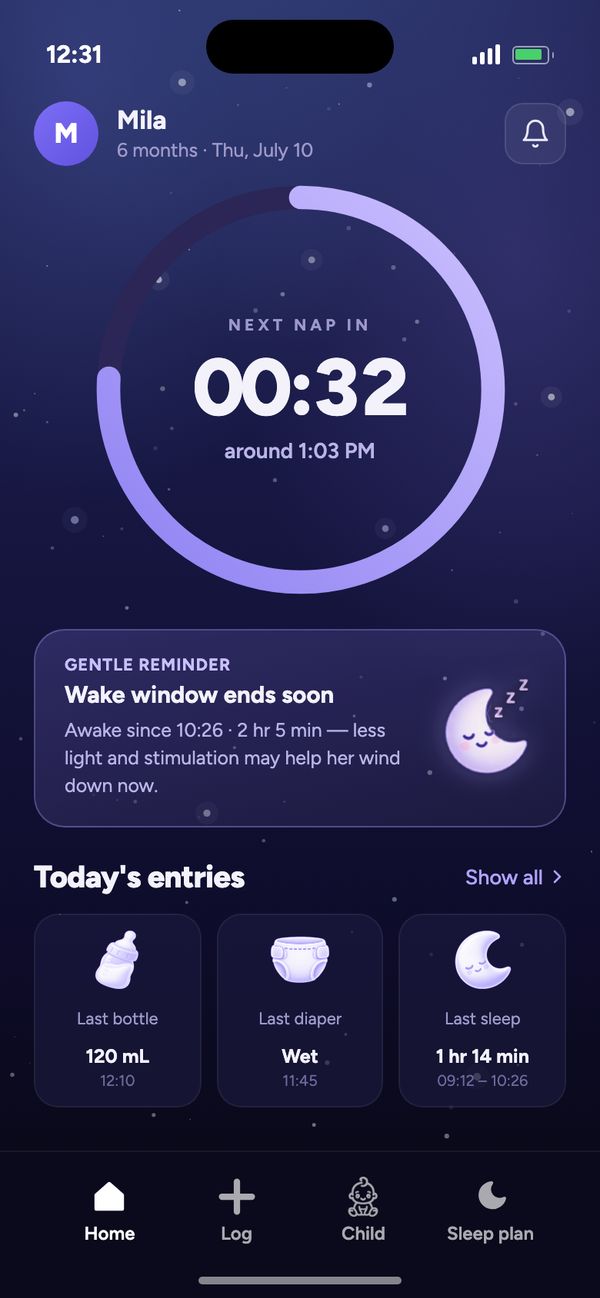
Calm nights start here.
Download Moonsleep and find the rhythm that fits your baby.


Wake window chart
Wake windows, naps, and night sleep from birth to 5 months:
Birth: awake 35–75 min., 3–5 naps, night 8–11 hrs.
1 month (just over 4 weeks): awake 50–85 min., 3–5 naps, night 9–11½ hrs.
2 months (just under 9 weeks): awake 60–95 min., 3–5 naps, night 9–11½ hrs.
3 months (13 weeks): awake 70–125 min., 3–4 naps, night 10–11½ hrs.
4 months (just over 17 weeks): awake 85–150 min., 3–4 naps, night 10–11½ hrs.
5 months (just under 22 weeks): awake 105–165 min., 3–4 naps, night 10–11½ hrs.
From 6 to 11 months:
6 months: awake 2–3 hrs., 2–3 naps, night 10½–11½ hrs.
7 months: awake 2 hr. 10 min.–3 hr. 10 min., 2–3 naps, night 10½–11½ hrs.
8 months: awake 2 hr. 20 min.–3 hr. 20 min., 2–3 naps, night 10½–11½ hrs.
9 months: awake 2½–3½ hrs., 2 naps, night 11–12 hrs.
10 months: awake 2 hr. 40 min.–3 hr. 40 min., 2 naps, night 11–12 hrs.
11 months: awake 2 hr. 50 min.–3 hr. 50 min., 2 naps, night 11–12 hrs.
Tired or hungry?
The ranges are the framework—your baby fills them in. Watch your baby’s cues. Tiredness often looks like this:
They look away, or stare blankly with glazed eyes.
They yawn; older babies rub their eyes.
Their movements get slower and less coordinated, and they lose interest in play.
They fuss and seek your closeness. Some furrow their brow, open their eyes wide, and clench their fists as if they’re trying to keep themselves awake.
Hunger can look very similar at first:
They search with an open mouth and turn their head to the side.
They smack their lips, lick their lips, or suck on a fist or fingers.
They get restless and make little murmuring sounds.
Crying is a late sign: a crying baby is harder to feed and harder to settle.
That’s why in the first weeks, when in doubt, offer the breast or bottle first. Feeding on demand always comes before the wake window.
Sleep at 0–8 weeks
In the first weeks, your newborn sleeps a lot, but in small chunks spread across the whole day and night. In between, your baby wants to feed, including at night: breastfed newborns usually feed 8 to 12 times in 24 hours, often close together in the evening. This cluster feeding is normal and not a sign of low milk supply. At first, your baby is only awake for short stretches—feeding, diaper changes, and a little cuddling fill that window quickly. They don’t need much more than that.
Until your baby is back to their birth weight, usually after 10 to 14 days, they shouldn’t go longer than about four hours without a feed. The count runs from the start of one feed to the start of the next. Those four hours are an upper limit for one single longer break, not a feeding schedule. If your baby sleeps longer, wake them gently:
Wait for light sleep: their eyes move under the lids, they twitch, or they make sucking noises.
Gently bring them into the day: make the light a little brighter, open the sleep sack, undress down to the bodysuit, put on a fresh diaper.
Talk to them: hold them upright, stroke their back and the soles of their feet, or do skin-to-skin.
Offer the breast or bottle. If they fall back asleep while feeding, gently compress the breast with your whole hand or switch sides.
If they stay very sleepy despite all this and barely feed, or they sleep through several feeds, have them seen by a doctor right away — during the day at your pediatrician’s office, and in the evening or on weekends through your pediatrician’s after-hours line when the office is closed. If you can’t wake them at all or they seem limp, call 911 (or your local emergency number) right away.
And don’t be surprised if they twitch, grunt, or breathe irregularly in their sleep. At this age, about half of their sleep is active sleep, and pauses in breathing of 5 to 10 seconds are normal. If a pause lasts longer than 10 seconds, have it checked by a doctor right away. If it lasts more than 20 seconds or their skin turns bluish, call 911 right away — more on that in the “Watch for this” box.
Guidelines for 0–8 weeks:
Total sleep: 14–18 hrs. in the first 4 weeks, then 14–17 hrs.
Night sleep: 8–11½ hrs. total, with several feeds
Daytime sleep: 5–8 hrs.
Naps: 3–5, 20 min.–4 hrs. — at first max. 4 hrs. from the start of the last feed
Wake windows: 35–75 min. after birth, 60–90 min. at 8 weeks
Bedtime: no set one yet — the rhythm is still developing
Sleep at 2–3 months
At 2–3 months, in weeks 9–13, more and more sleep shifts into the night, and the day starts to take shape. In no phase does the longest sleep stretch grow as much as it does between the first and fourth month: in a New Zealand study of 75 babies, about half slept from midnight to 5 a.m. for the first time at 3 months without their parents needing to step in. You may one day wake up yourself because it’s so quiet. Long stretches are normal now—you don’t need to wake your baby if they’re back to birth weight, gaining well, and the hospital or pediatrician’s office hasn’t given you a separate wake-to-feed plan.
At night, your baby will usually still feed once or twice; some babies feed three times, and some not at all. If your baby wakes, hunger is usually the reason at this age. How long a nap lasts is still hard to predict — anything from 20 minutes to several hours can happen. That’s not a flaw in your routine — it’s just baby sleep at this age.
If your baby stays awake until 10:00 p.m., that’s not unusual at 10 or 12 weeks: they’re only just starting to build the melatonin rhythm that makes evenings sleepy. You can’t force evening sleepiness, but you can prepare for it: daylight in the morning, dim light and calm in the evening, and the same short bedtime routine every night. From about 4 months, an approximate bedtime starts to make sense.
Many babies cry more in the late afternoon and evening — most around week 6, and noticeably less by 3 to 4 months. If your baby wants to feed constantly from 6:00 p.m. on and cries before falling asleep, hunger, tiredness, and too much stimulation are often all coming together. If your baby cries more than three hours a day, on more than three days a week, for longer than three weeks, talk to your pediatrician, who can check for medical causes and help you find support.
A short evening routine of about half an hour now becomes a first anchor. Don’t start it by the clock, but when the last wake window of the day is ending and your baby looks tired:
Dim the lights; turn off noise and screens.
Fresh diaper, bodysuit or pajamas, sleep sack.
Breastfeed or give a bottle in a calm, dim room.
One song or the same quiet words every night.
Into their own bed, on their back.
If your baby falls asleep while feeding, that’s fine at this age. In one survey, regular bedtime routines were already linked to longer nighttime stretches even in babies 1 to 15 weeks old. Similar every time, never perfect.
Guidelines at 2–3 months (weeks 9–13):
Total sleep: 14–17 hrs.
Night sleep: 9–11½ hrs. total, usually with 1–2 feeds
Daytime sleep: 5–8 hrs.
Naps: 3–5, still very variable in length
Wake windows: at 8 weeks 60–90 min., at 10 weeks 65–105 min., at 12 weeks 70–120 min.
Bedtime: still flexible — from about 4 months, an approximate bedtime can help
Calm nights start here.
Download Moonsleep and find the rhythm that fits your baby.
Sleep at 3–6 months
At 3–6 months, in weeks 14–26, night becomes the main sleep period and the biggest sleep block. Sometime during these months, the fourth nap usually drops away: wake windows have become long enough that four naps no longer fit into the day, and that last late-afternoon nap keeps pushing bedtime later.
Many parents hit more restless nights around 4 months and hear about the “4-month sleep regression.” Science doesn’t show a crash that happens to all babies — on average, sleep actually improves in the first four months. What really changes is the structure of sleep: it matures. That can feel bumpy for one to three weeks and still be a step forward.
From about 4 months, you can practice putting your baby down sleepy but still awake — as an option, not an obligation. Some babies now sleep six hours at a stretch; many still don’t. Compare your baby with who they were a few weeks ago, not with the baby at parent group.
Guidelines at 3–6 months (weeks 14–26):
Total sleep: 13–16 hrs. at 3 months, 12–16 hrs. from 4 months
Night sleep: 10–11½ hrs., usually still one feed at night
Daytime sleep: 3–4 hrs.
Naps: 3–4, and the shift from 4 to 3 often happens now
Wake windows: at 3 months 70–125 min., at 4 months 85–150 min., at 5 months 105–165 min., at 6 months 2–3 hrs.
Bedtime: from about 4 months, often between 6 and 7:30 p.m.
Sleep at 6–9 months
At 6–9 months, many babies say goodbye to the third nap: three becomes two. There are signs this is coming: that last late-afternoon nap stops happening, or it pushes nighttime sleep much later. Transition days with three naps some days and two on others are normal. On days with one less nap, bedtime can start earlier.
Nights may get choppier again. Around the ninth month, the share of babies waking more than twice a night is especially high — in one Italian study, it was a little more than one in four. Sometimes that lines up with new movement skills, like pulling up to stand. Usually it settles again after one to three weeks.
As your baby gets more mobile, their crib needs an update too:
Lower the mattress before they can sit — low enough that they can’t lean or pull themselves over the rails.
Take down a mobile over the crib as soon as your baby can push up on hands and knees, and by 5 months at the latest.
Keep cords, such as from a baby monitor, at least 3.3 ft. (1 meter) away from the crib.
Guidelines at 6–9 months:
Total sleep: 12–16 hrs.
Night sleep: 10½–11½ hrs., some babies still feed at night
Daytime sleep: 2½–3½ hrs.
Naps: 2–3, and the third one often drops now
Wake windows: at 6 months 2–3 hrs., at 9 months 2½–3½ hrs.
Bedtime: often between 6 and 7:30 p.m.
Restless nights sometimes come with new movements — and usually settle down again.
Sleep at 9–12 months
At 9–12 months, two naps are the norm, and the day settles into a reliable shape you can plan appointments and meals around.
Around the first birthday, some babies suddenly refuse one of their naps. Often that’s just a phase lasting one to three weeks, not the end of the nap for good. Give it a little time before rebuilding the whole day. On one-nap days, a quiet hour with cuddling, reading, or a walk can replace the missed break — and because the last wake window then gets very long, bedtime can start earlier.
Guidelines at 9–12 months:
Total sleep: 12–15 hrs.
Night sleep: 11–12 hrs.
Daytime sleep: 2–3 hrs.
Naps: 2
Wake windows: at 9 months 2½–3½ hrs., at 12 months 3–4 hrs.
Bedtime: often between 6 and 7:30 p.m.
Sleep at 12–18 months
For toddlers 12–18 months old, the big daytime change happens: usually between 14 and 18 months, though for some not until as late as 24 months, two naps become one midday nap. Signs your child is ready: over a week or two, they keep refusing one of the two naps, take a long time to fall asleep, or the second nap clearly pushes bedtime later. Transition days with one nap some days and two on others are normal, and the remaining midday nap usually gets longer.
Wake time jumps here too: with two naps, a child just before the switch often manages a little over three to almost four hours awake; with only one midday nap left, it’s 5 to 5½ hours. Not every day handles that jump equally well.
If your child is starting daycare now, the transition often overlaps with settling in. Ask about the daycare’s sleep times and work backward from the midday nap: if it ends at 2:00 p.m., bedtime after 5 to 5½ hours awake falls between 7:00 and 7:30 p.m. If the nap was shorter or didn’t happen, bedtime can start earlier. A similar rhythm on weekends helps. And during big transitions like this, your child often needs extra closeness, including at night.
Guidelines at 12–18 months:
Total sleep: 11–14 hrs.
Night sleep: 11–12 hrs.
Daytime sleep: 1½–2½ hrs.
Naps: 2, usually down to 1 between 14 and 18 months
Wake windows: at 12 months 3–4 hrs., with only 1 nap 5–5½ hrs.
Bedtime: often between 6 and 8 p.m.
Sleep at 18–24 months
By 18–24 months, most children have settled into a single midday nap—it’s enough for the day. Hardly any child drops it completely before their second birthday, even if they loudly protest it at noon sometimes. The wide range of 4–5½ hours awake at 18 months includes children who still take two naps. With just one midday nap, it’s more like 5–5½ hours.
Around 18 months, many families hit a wobbly phase: your child wants more control, separations feel harder, and maybe teeth are coming in too. That’s not a step backward but part of development, and it usually lasts one to four weeks. Stick with the bedtime routine — it gives security right now. Moving to a big bed is safest when your child is about 35 inches (89 cm) tall or when the crib rail reaches only to their chest — otherwise they may be able to climb out and fall.
Guidelines at 18–24 months:
Total sleep: 11–14 hrs.
Night sleep: 11–12 hrs.
Daytime sleep: 1½–2 hrs.
Naps: 1 midday nap
Wake windows: at 18 months 4–5½ hrs., with 1 nap 5–5½ hrs., at 2 years 5–6 hrs.
Bedtime: often between 6 and 8 p.m.
A wobbly phase isn’t a setback but development — your bedtime routine is an anchor.
Midday nap at 2–3 years
By age 3, only about half of children still nap at midday. Your child is ready to drop it when they can get through the afternoon in a good mood without sleep and still fall asleep well at night. If they become cranky and overtired by evening, they still need it. If a midday nap leaves them lying awake for a long time at bedtime, a quiet break with books or an audio story can take its place — rest time without pressure to fall asleep.
Guidelines at 2–3 years:
Total sleep: 10–14 hrs.
Night sleep: 10½–11½ hrs.
Daytime sleep: 1–2 hrs., if your child still naps
Naps: 1 — at 3 years, only about half still nap
Wake windows: 5–6 hrs., at 3 years 5–6½ hrs.
Bedtime: often between 6 and 8 p.m.
Nap transitions at a glance:
From 4 to 3 naps: usually at 3–6 months, when the 4th nap pushes bedtime later
From 3 to 2 naps: usually at 6–9 months, when the late 3rd nap no longer happens
From 2 to 1 nap: usually at 14–18 months, though for some not until as late as 24 months
No midday nap: hardly ever before age 2; at 3 years, about half still nap
On transition days: sometimes one more nap, sometimes one less — then an earlier bedtime
Nap transitions
- 4 to 3 naps
- 3–6 months
- 3 to 2 naps
- 6–9 months
- 2 to 1 nap
- 14–18 months
- Transition days
- early bedtime
How to find the right wake window
The ranges are wide because babies are different. Here’s how to find your baby’s wake window within that range, step by step—usually a week is enough:
Start in the middle of the range. At 10 weeks (65–105 min.), that means your baby should be asleep after about 85 minutes. At 6 months (2–3 hrs.), after about 2½ hours.
Start winding down in time. The wake window ends when your baby is asleep — the minutes it takes to fall asleep still count. So start about 15 to 20 minutes earlier: dim the lights, change the diaper, put on the sleep sack. Example at 10 weeks: awake at 7:00 a.m., start winding down around 8:05, asleep around 8:25.
Watch how long falling asleep takes. Count from the moment actual settling to sleep begins: putting your baby down, turning off the light, or the final latch with sleep as the goal. Up to about 20 minutes is normal.
Adjust in small steps: under 3 months by 5 to 10 minutes, after that by about 15 minutes. The two pictures below show you which direction to go.
Look at several days. One single day can mislead you; a pattern becomes reliable over five to seven days. Also watch the time of day: for many babies, the first wake window in the morning is one of the shortest.
Feeding on demand always comes first. If hunger shows up in the middle of the window, feed your baby — the plan adapts, not the other way around.
Too early or too late? Two pictures:
Not tired enough yet: your baby lies there content, looks around, babbles — and is still awake after half an hour. Make the next wake window a little longer.
Overtired: your baby cries hard, is very difficult to calm, and fights sleep even though they are clearly tired. Plan the next wake window a little shorter.
Bedtime also comes from the last wake window. If a 6-month-old baby’s last nap ends at 4:15 p.m., bedtime with a 2- to 3-hour wake window falls between 6:15 and 7:15 p.m. So the clock follows the day: a baby who wakes at 8:00 a.m. may also fall asleep at 8:00 p.m. In a survey of almost 30,000 families in 17 countries, average bedtimes for young children ranged from 7:27 p.m. to 10:17 p.m. depending on the country, and where children went to bed later, they also slept less overall. What matters, then, is whether the night is long enough — a child who falls asleep at 9:00 p.m. needs until 8:00 a.m. for 11 hours of night sleep.
A single day can be misleading — your baby’s wake window only shows in the pattern.
Overtired? This helps
Sometimes you miss the window and your baby gets overtired—it happens to everyone. Then fewer stimuli and more calm can help, step by step:
Get out of the commotion: go to a quiet room, dim the lights, turn off the TV and phone.
Offer closeness: hold your baby snugly, do skin-to-skin, or use a baby carrier.
Use steady movement: gentle rocking, slow walking up and down, or a walk outside with the stroller.
Use steady sound: quiet humming, a song, or a calm “shhh.”
Stick with one thing: give each calming method a few minutes instead of frantically trying everything. If your baby seems hungry, offer the breast or bottle.
Once your baby finally sleeps, plan the next wake window closer to the lower end of the range and bring bedtime a little earlier. A missed window isn’t a mistake, just a clue for tomorrow.
When you can’t do it anymore
Crying that won’t stop pushes anyone to the limit — especially if you’re handling the nights alone, without a partner or without family nearby. If you notice yourself becoming angry or desperate:
Lay your baby on their back in their own bed.
Leave the room for a moment and take some deep breaths.
Check on them every few minutes.
Call someone.
Never shake your baby. Just a few seconds of shaking can cause life-threatening brain injuries.
You can reach help here:
24/7 crisis support: in the US, call or text 988.
Urgent medical help: your pediatrician’s after-hours line when the office is closed.
Parent helpline: in the US, call or text the National Parent & Youth Helpline at 1-855-427-2736, day or night.
During the day: your pediatrician’s office, who can check for medical causes and help you find support, and your OB-GYN or family doctor.
Practical day-to-day support: some communities offer free home visiting programs for new parents, and calling 211 connects you with local help.
Have you been feeling low, joyless, or full of anxiety for more than two weeks? Or having thoughts of harming yourself or your child? These can be signs of postpartum depression. Get medical help right away, and in an acute crisis call 911 or call or text 988. In the US, you can also call or text the National Maternal Mental Health Hotline at 1-833-852-6262 (1-833-TLC-MAMA), any time. Asking for help is not failure.
Falling asleep and being put down
Is it okay for your baby to fall asleep at the breast, with a bottle, in your arms, or in a carrier? In the first months: yes. Feeding or carrying to sleep is not a bad habit. Babies this young can’t calm themselves down after excitement yet, and their need for closeness is inborn. The AAP recommends trying “drowsy but awake” only from about 4 months, and even then as practice, not an obligation. That does not include leaving a baby to cry: comforting does not spoil them.
The real problem at 3:00 a.m. is often transferring them. These steps make it work more often:
Wait for quiet sleep. Babies first fall asleep into active sleep: they twitch, their eyes move under the lids, and their breathing is irregular. When the twitching stops and breathing becomes calm and even, they’re in deeper sleep and less likely to wake.
Get everything ready first: put the sleep sack on beforehand, keep the sleep space clear, and dim the light.
Lay your baby down slowly on their back, using one calm, smooth movement into their own bed.
Stay a moment longer: hand on the tummy or chest, soft humming, or “shhh.”
If your baby wakes, pick them up, calm them, and try again. Or this time they sleep on you — as long as you stay awake. If your eyes start closing, put them in their own bed.
Sleep schedules up to 6 months
Three sample sleep schedules at 10 weeks, 4 months, and 6 months—to help you picture it, not to check off like a list. The clock times shift from day to day, but the gaps stay similar.
Sleep schedule at 10 weeks — honestly, a little chaotic
7:00 a.m. wake up, feed, fresh diaper
8:20–9:20 a.m. nap 1 (1 hr.)
10:50 a.m.–12:50 p.m. nap 2 (2 hrs., in the stroller on a walk)
2:20–2:40 p.m. nap 3 (only 20 min.)
3:55–5:05 p.m. nap 4 (just over 1 hr.)
6:30–7:00 p.m. nap 5 (30 min., in arms)
from about 8:15 p.m. bedtime routine, asleep around 8:35 p.m.
at night, feeds once or twice, around 12:30 a.m. and 4:00 a.m.
A feed follows each wake-up, and evenings often bring lots of short feeds. Altogether, that adds up to about 5 hours of daytime sleep.
If a nap lasts only 20 minutes: try for a few minutes with closeness and humming. If your baby doesn’t fall back asleep, get up with them and plan the next wake window at the lower end of the range — like here after nap 3.
If your baby won’t fall asleep at all in the evening: keep the last hour calm and dark. If it regularly takes longer than half an hour to fall asleep, lengthen the last wake window a little. A late bedtime is normal at this age.
Sleep schedule at 4 months
7:00 a.m. wake up, feed
8:30–9:15 a.m. nap 1 (45 min.)
10:50 a.m.–12:00 p.m. nap 2 (just over 1 hr.)
2:00–3:00 p.m. nap 3 (1 hr.)
5:00–5:30 p.m. nap 4 (30 min., often easiest on the go)
7:00 p.m. bedtime routine, asleep around 7:30 p.m.
at night, still feeds once or twice; some babies more often, some not at all
At 1½ hours, the first wake window is the shortest; later they’re up to 2 hours. Altogether, just under 3½ hours of daytime sleep.
Sleep schedule at 6 months
6:30 a.m. wake up, feed
8:45–9:45 a.m. nap 1 (1 hr.)
12:15–1:45 p.m. nap 2 (1½ hrs.)
3:45–4:15 p.m. nap 3 (30 min., a short catnap)
6:15 p.m. bedtime routine, asleep around 6:45 p.m.
at night, often still feeds once
When the third nap drops, bedtime simply moves a little earlier.
Sleep schedules from 9 months
Three more sample sleep schedules, at 9, 12, and 16 months.
Sleep schedule at 9 months
6:30 a.m. wake up, milk, breakfast later
9:30–10:45 a.m. nap 1 (1 hr. 15 min.)
after that, lunch, play, fresh air
2:00–3:30 p.m. nap 2 (1½ hrs.)
6:30 p.m. bedtime routine, asleep around 7:00 p.m.
at night, often still wakes once or twice — many 9-month-olds, especially breastfed babies, still feed then, and that’s normal
Wake windows grow across the day from 3 to 3½ hours. That gives 2 hrs. 45 min. of daytime sleep and around 11½ hours of night sleep with interruptions.
Sleep schedule at 12 months
6:45 a.m. wake up, breakfast
9:45–10:45 a.m. nap 1 (1 hr.)
2:15–3:30 p.m. nap 2 (1 hr. 15 min.)
6:45 p.m. after dinner: brush teeth, book, sleep sack
asleep around 7:15 p.m.
Teeth-brushing comes after the last meal — that way the toothbrush is the last thing to touch the teeth before night.
Sleep schedule at 16 months with one midday nap
7:00 a.m. wake up, breakfast
11:30 a.m. lunch
12:00–2:00 p.m. midday nap (2 hrs.)
afternoon: playground and snack, 6:00 p.m. dinner
6:45 p.m. bedtime routine with teeth-brushing and a book
asleep around 7:15 p.m., just over 5 hours after the nap
If your child wakes half an hour earlier, the whole day shifts with it. That’s exactly the point.
If your child wakes up earlier, the whole day shifts with it — that’s exactly how it’s meant to work.
Waking up at night
Waking up at night is part of baby sleep, just like falling asleep. Babies and toddlers briefly wake regularly when they move between sleep cycles, often several times a night, and some keep doing it into the preschool years. That doesn’t mean you’re doing anything wrong.
In the first few months, hunger is the most common reason — so if you’re unsure, offer the breast or bottle. Until about 6 months, at least one nighttime feed is still a normal part of the picture. After that, healthy babies who are growing well often no longer need milk at night. Even so, many keep feeding, especially breastfed babies — through the second half of the first year and beyond. Both are normal. From about 10 months on, hunger is less often the reason for waking.
And cereal in the bedtime bottle? Purees or cereal flakes in a bottle do not reliably lead to sleeping through the night, but they do raise the risk that your baby may choke or get too much. Purees belong on a spoon. Start solids when your baby is ready for them — in Germany, experts say no earlier than the start of the 5th month and no later than the start of the 7th month — not to improve sleep.
What helps many families:
Respond promptly to crying in the first months. Comforting does not spoil a baby.
If your baby is only grunting or murmuring, listen for a few seconds before stepping in — often they go back to sleep on their own. That does not apply to crying.
Keep lights low and words few; only change the diaper if needed, and do it calmly.
Use the same words or the same song as at bedtime — familiar things soothe.
From the second half of the first year, waking does not always mean hunger. Sometimes your voice and your hand are enough.
If your child is sick, teething, just had vaccines, or you’re traveling, the plan can take a break for a few days. Closeness comes first then; after that, you’ll find your way back to your usual rhythm.
If you give a bottle at night, prepare infant formula fresh each time — for example with boiled water from a thermos and powder portioned separately — and throw away leftovers. Ready-made milk does not belong in a warmer for hours. Never prop the bottle and never leave your baby alone with it in bed: they could choke, and constant sucking harms teeth.
If the nights are wearing you down for weeks, keep a sleep diary for about three weeks — on paper or in an app like Moonsleep — and take it to your pediatrician’s office. For every sleep, note:
what time your child fell asleep and woke up
where and how they fell asleep: breast, bottle, arms, carrier, stroller, or bed
feeds, including at night
how they seemed afterward: content, fussy, or crying
For finding your own wake window, five to seven days are enough. For a conversation at the doctor’s office, the longer period shows more — there’s often a pattern in it that daily life hides.
Sleep regressions at 4, 9, 12, 18 months, and 2 years—what’s behind them:
Around 4 months: sleep is maturing — not a setback for every baby, usually bumpy for 1–3 weeks
At 8–10 months: more night waking, often with new movement skills, usually 1–3 weeks
Around 12 months: nap refusal, often a phase rather than the end, 1–3 weeks
Around 18 months: more strong will, separation anxiety, teething — usually 1–4 weeks
Around 2 years: language leap, new bed, midday nap protest — usually 1–4 weeks
These names come from experience, not diagnosis—fixed developmental “leap” calendars aren’t backed by evidence.
How long regressions usually last
- Around 4 months
- 1–3 weeks
- At 8–10 months
- 1–3 weeks
- Around 12 months
- 1–3 weeks
- 18 mos., 2 years
- 1–4 weeks
Watch for this
With these signs, the sleep plan doesn’t matter — fast help does.
Call 911 right away:
Your baby stops breathing for longer than 20 seconds, or their skin, lips, or tongue turn pale, bluish, or gray.
Acute breathing distress: very fast breathing, sucking in between or under the ribs, flaring nostrils, or grunting with every breath — especially if your baby is barely drinking. Harmless sleep grunting happens only now and then, not with every breath, and your baby does not look strained.
Your baby is hard or impossible to wake, cries in an unusually shrill or weak way, or has a seizure.
While you wait for help, speak loudly to your baby and touch them firmly — never shake them. Put a hand below the ribs on the belly and see whether it rises. Call 911, ideally on speaker, and do not hang up yourself: the 911 dispatcher can guide you, including through CPR. A child first-aid course can help you feel more prepared.
Get medical help right away — at night through the ER or your pediatrician’s after-hours line when the office is closed:
Fever of 100.4 °F (38.0 °C) or higher, measured rectally, or below 97.7 °F (36.5 °C) in babies under 3 months; fever of 102.2 °F (39.0 °C) or higher in babies 3 to 6 months old.
Your baby is limp and unresponsive, barely drinks, or sleeps through several feeds.
Yellow skin or yellowing of the whites of the eyes together with unusual sleepiness or poor feeding.
A bulging fontanelle.
Breathing pauses longer than 10 seconds, even if breathing looks normal afterward.
See your pediatrician the same day; outside office hours, call the after-hours line:
From day 5 onward, fewer than 6 wet diapers in 24 hours, or one diaper staying dry for more than 8 hours.
Your baby has not yet regained birth weight and regularly sleeps longer than 4 hours without a feed.
Fever that lasts longer than 1 day in babies and toddlers under about 2 years old (longer than 3 days in older children), or if your child is drinking much less than usual.
Make an appointment soon:
Your child snores often and loudly, even without a cold, or seems to breathe with effort during sleep.
Your baby cries more than three hours a day, on more than three days a week, for longer than three weeks.
And if you yourself can’t do it anymore: the box called “When you can’t do it anymore” lists places you can reach around the clock.
Preemies: adjusted age
If your baby was born early, before 37 completed weeks of pregnancy, use their corrected age as your guide. To work it out, subtract from their age the number of weeks they were born before the due date in your pregnancy records. Example: your baby was born six weeks early and is now 5 months old. Then the guidelines for about 3½ months fit better than the ones for 5 months.
Preemies mature according to their due date, not their birthday: in one study, their wake periods were linked mainly to maturity, less to the weeks since birth. So use corrected age until about the second birthday. And if other babies the same age can stay awake longer, your child isn’t behind — they’re exactly where they can be for their corrected age.
If your baby was born two weeks before the due date, at 38 weeks, they are considered full term. In that case you don’t need to recalculate — with ranges this broad, two weeks make very little difference. Safe sleep rules apply to preemies just the same.
A sleep plan is not a report card for you. It’s a map — and your baby is allowed to take detours.
Frequently asked questions
How long can my baby stay awake?
That depends mainly on age. As a guide: after birth 35 to 75 minutes, at 2 months 60 to 95 minutes, at 4 months 85 to 150 minutes, at 6 months 2 to 3 hours, at 9 months 2½ to 3½ hours, and at 12 months 3 to 4 hours. Toddlers with only one midday nap stay awake 5 to 5½ hours, and at age 2 about 5 to 6 hours. You’ll find the values for each month in the wake window charts above. Start in the middle of the range and watch your child: the first wake window in the morning is often one of the shortest, and feeding on demand always comes first. Wake windows are practical experience, not a rule.
When will my baby sleep through the night?
In studies, “sleeping through the night” usually means six to eight hours in a row, not the whole night. Many babies manage that sometime in the first year, but far from all of them at the same time. In a Canadian study of just under 400 babies, more than half still were not sleeping eight hours straight at 6 months. At 12 months, a good quarter still were not sleeping six hours straight. The researchers found no link with mental or motor development. Brief waking between sleep cycles remains normal into the toddler years.
Do I need to wake my baby if they sleep a long time?
Yes, until your baby has regained their birth weight: until then, they shouldn’t go longer than about 4 hours without a feed, counted from the start of the last feeding. How to gently wake a sleepy newborn is explained in the section on the first 8 weeks. After that, you don’t need to wake a healthy baby who is gaining well just to feed — unless the hospital or pediatrician’s office has given you a specific plan, for example because your baby was premature, had a low birth weight, jaundice, or poor weight gain. If your breasts feel very full because your baby suddenly starts sleeping for long stretches, you can wake them to nurse or hand-express a little milk, because long gaps can increase the risk of plugged ducts. If your baby sleeps very long stretches during the day and then stays awake for a long time at night, you can gently end a long daytime nap. There’s no fixed minute limit for that — what helps more is light and normal daytime activity during the day, and darkness and quiet at night.
My baby sleeps more or less than the guidelines — should I worry?
Usually not. Sleep needs vary from child to child. A U.S. sleep foundation notes that numbers a little outside the recommended range can still be normal for a healthy child — strongly and persistently being outside that range is rare. More important than any total is how your baby seems: they wake up well and stay awake for a while, respond to you, feed well, have enough wet diapers, and gain weight. You should get medical advice if your baby sleeps unusually little and is also very hard to soothe — or if they sleep a great deal, are hard to wake, seem limp, or feed poorly. Then the signs in the “Watch for this” box apply. If you’re unsure, keep a sleep diary for about three weeks and take it to your pediatrician’s office.
My baby only takes short naps. Am I doing something wrong?
No. In the first months, naps vary hugely in length; anything from 20 minutes to several hours can happen. Only from about 8 months do nap length and timing become more consistent for many babies. If your baby wakes after 20 minutes crying, you can try helping them back to sleep for a few minutes — with closeness, humming, or rocking. If that doesn’t work, get up with them and plan the next wake window closer to the lower end of the range. A brief doze in the car or stroller also counts as a nap: after that, your baby is often tired again sooner.
When does a fixed by-the-clock sleep schedule make sense?
Usually from about 8 months, when naps start happening reliably at similar times. Before that, wake windows and tired cues are the better guide. You can still set some structure early on: a roughly similar wake-up time and a short bedtime routine of about half an hour that stays mostly the same. As a rule of thumb for mornings: if your baby feeds at 5:00 a.m. and then goes back to sleep, that still counts as night. The day starts with the wake-up after which they stay awake. In the first months, you don’t need to wake them for that. Later, you can wake them at a similar time in the morning — regular bedtime and wake-up times are also recommended by pediatric societies.
My baby wakes every morning at 5:00 a.m. — what can I do?
First do the math: if your child falls asleep at 6:00 p.m. and needs 11 hours of night sleep, they are fully rested at 5:00 a.m. Then a slightly later bedtime can help — try it in steps of about 15 minutes and see whether wake-up time shifts too. It doesn’t always: in a large app analysis, wake-up time stayed fairly stable from about 5 months on, and later bedtimes were more often linked with a shorter night. A darkened room helps when it gets light early in the morning, and keeping the time until getting up as calm and dark as nighttime does too. For babies under 6 months, an early feed is normal — then the goal is more that they go back to sleep afterward.
What should I do when the clocks change?
When the clock shifts by an hour in spring or fall (in most of the US, on the second Sunday in March and the first Sunday in November), babies under about 6 months usually do best if you simply follow the new clock from that day on and use wake windows for a few days. For older babies and toddlers, a gentle transition helps: start four days beforehand and shift wake-up time, naps, meals, and bedtime by about 15 minutes each day — earlier in spring, later in fall. In fall, that can help especially with early risers who would otherwise wake an hour earlier by the new clock. Daylight and time outside help the body clock, and a darkened room helps when it’s still light at bedtime. Most children adjust within about a week.
Calm nights start here.
Download Moonsleep and find the rhythm that fits your baby.
Moonsleep offers guidance, not medical advice. It is based on clinical guidelines and expert sources, checked against the Moonsleep reference database.