


It’s almost midnight, the lights are dim, you can barely keep your eyes open — and your baby is looking at you as if the day is just getting started. They slept away half the afternoon, and now they’re wide awake. If that sounds familiar, you’re not doing anything wrong. Your baby can’t tell day from night yet, and you can help them learn step by step.
At a glance
- Day and night
- from 8–12 wks
- Sleep per day
- ~14–18 hrs
- Feeds
- 8–12 in 24 hrs
- Awake at a time
- ~35–75 min
Your baby’s body clock needs time to mature
Even in the womb, from around the 36th week of pregnancy, babies cycle between sleeping, dreaming, and being awake. Most of their clues about whether it’s day or night come from you: the sleep hormone melatonin that your body makes at night also reaches your baby through the placenta. The internal clock in your baby’s brain — a tiny control center for the body’s daily rhythms — is already there before birth. But it still can’t run on its own.
Once your baby is born, that pathway is gone, and hunger suddenly sets the pace. In the first weeks, babies sleep about 14 to 18 hours over 24 hours — but in stretches of about half an hour to 3 hours, spread across day and night. In between, they wake because they need to feed, whether the sun is out or the moon is up. To your baby, 2 a.m. is simply time for the next meal.
Your baby also doesn’t yet make melatonin — the hormone that makes you sleepy in the evening — in a day-and-night rhythm. Researchers found hardly any signs of that rhythm in full-term babies before weeks 9–12 of life. Other daily rhythms, such as the sleep-wake pattern and other hormones, also usually don’t become clearly established until after the second month of life. As a rough guide: from about 4–6 weeks, sleep gradually becomes more regular. From about 8–12 weeks, day and night become more distinct, and your baby’s own melatonin starts to kick in. From about 10 weeks, many babies’ longest stretch of sleep gets noticeably longer, and by 3–6 months the day-night pattern becomes more established. That’s why darkness doesn’t have the same effect on your baby as it does on you.
Does that mean you just have to wait until then? No. The internal clock learns from signals, and the strongest one is light. In one study of babies 4 to 12 weeks old, their activity rhythm by 12 weeks clearly reflected how much light they got during the day. Independently of that, from as early as week 4 it was already linked to their mothers’ daily routines. Another study of babies 6 to 12 weeks old found that those who slept a larger share of their sleep at night had gotten more light in the early afternoon. That doesn’t prove cause and effect, but it is an encouraging sign. Bright, lively days and dark, quiet nights are the language your baby’s internal clock understands.
If your baby was born early, this usually takes a little more time. In one study, babies born an average of about 7 weeks early developed a melatonin rhythm about 9 weeks later than full-term babies. So use corrected age as your guide — in other words, the time since your baby’s due date.
How the rhythm develops
- First weeks
- hunger-driven
- From ~4–6 weeks
- more regular
- From ~8–12 weeks
- clearer nights
- By 3–6 months
- steady rhythm
Your baby can’t read the night yet — but every day, you can show them a little more of what it means.
Day–night confusion
Some babies seem to land in exactly the opposite rhythm at first. They sleep long and deeply during the day — in the stroller, in your arms, while visiting the grandparents. Then in the evening they perk up and may be most awake between 11 p.m. and 3 a.m. That isn’t a personality trait or a parenting mistake. It’s simply what happens when an internal clock isn’t running on its own yet. Usually it settles as that clock matures — often around week 8.
You can’t switch a day-night reversal off at the push of a button, but you can gently shorten it. In the first weeks, feeds are the most important tool. Until your baby has regained their birth weight and is gaining well—usually after about 10 to 14 days—the recommendation is to offer a feed during the day no later than about 3 hours after the start of the last feed, and to gently wake them if needed. 4 hours is the absolute limit, not a target. That shifts more feeds and awake time into the day, so the night has to carry less of both.
Gentle waking often works like this: open the sleep sack, change the diaper, say a few words, hold your baby upright, or stroke their feet. Sometimes it takes two or three tries. The goal is not to keep your baby awake for a long time, but to help daytime get a few more feeds.
What doesn’t help is artificially keeping your baby awake during the day so they’ll be sleepier at night. Overtired babies often have an even harder time falling asleep, including at night. So the rule of thumb is: wake to feed, yes; keep awake past their limits, no.
Day–night confusion isn’t a parenting mistake. It’s an inner clock that’s still maturing.
Hunger doesn’t follow a schedule
The most obvious reason a newborn wakes at night is hunger. At first, only a little fits into their stomach: on day 1, often just about ½ to 2 teaspoons (2–10 ml) per feed, and only by around day 3 or 4 about 1–2 fl oz (30–60 ml). That applies to bottle-feeding too—go by your baby’s fullness cues, not the markings on the bottle. Your baby also digests breast milk faster than infant formula from a bottle. In the first month, breastfed babies usually feed every 1.5 to 3 hours, and bottle-fed babies usually every 2 to 4 hours—measured from the start of one feed to the start of the next, and meant as a guide, not a schedule. Altogether, that’s usually 8 to 12 feeds in 24 hours, and a few of them will inevitably fall at night.
At this age, night feeds are not a problem you need to fix—they’re part of the plan. Until about 6 months, it’s normal for your baby to wake at night at least once to feed, and for many babies, especially breastfed babies, this lasts much longer. In the first days, the opposite is actually true: Until your baby has regained their birth weight, they should not go longer than about 4 hours at night without a feed. If they don’t wake on their own, gently wake them.
Many babies also feed especially often in the evening and the first half of the night, sometimes almost hourly one after another. This so-called cluster feeding is normal and not a sign that your milk isn’t enough. You can tell whether your baby is getting enough in other ways: by at least 6 wet diapers a day from about day 5 onward and by good weight gain. Phases when your baby wants to feed much more often than usual for 2 or 3 days, sometimes up to a week, are also normal. They’re often called growth spurts. But there is no fixed calendar for them, even if some lists make it sound that way.
Every night feed is easier if you respond early. Hunger usually shows up before your baby cries: they may smack their lips, lick their lips, stick out their tongue, turn their head looking for the breast or bottle, and keep bringing their hand to their mouth. Crying is more of a late hunger sign. Once your baby is really worked up, it is often harder for them to feed well.
Calm nights start here.
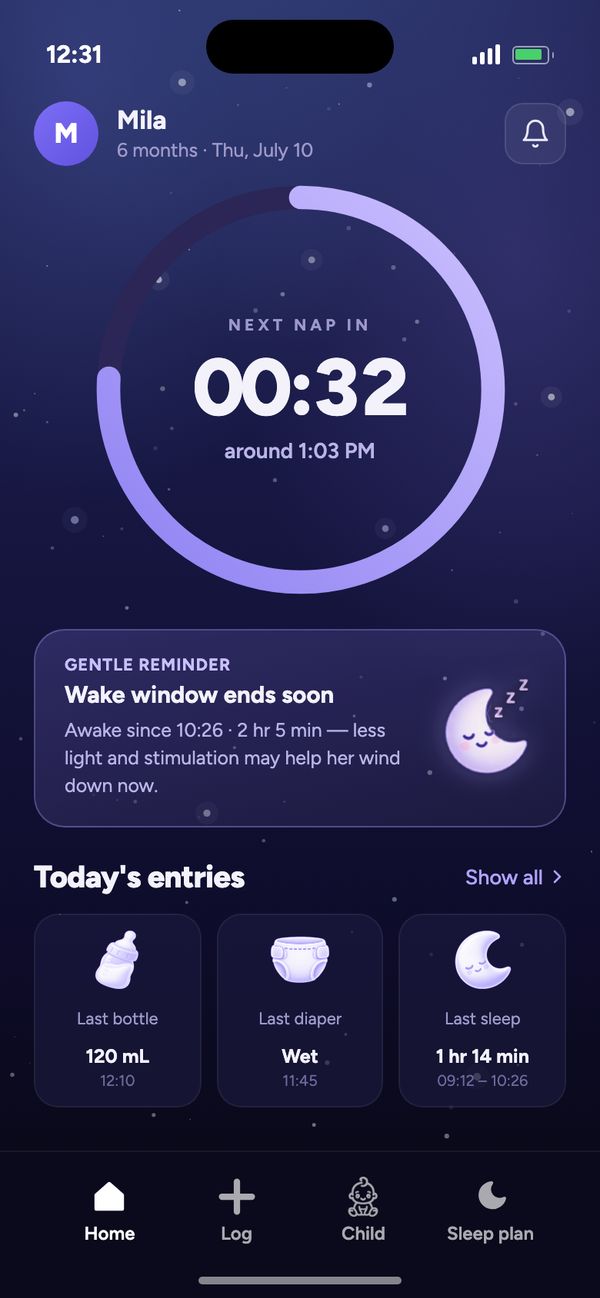
Download Moonsleep and find the rhythm that fits your baby.


Gas, spit-up, and evening crying
While feeding, your baby often swallows some air. Some babies get rid of it easily, others need help. There’s no fixed rule about whether burping works better during or after a feed, and a few minutes is usually enough. Three positions tend to work well:
Over your shoulder: Your baby’s chin rests on your shoulder, one hand supports the head and neck, and the other gently strokes or pats the back. Some babies do better if you walk around slowly while doing this.
Sitting on your lap: Your baby sits upright facing away from you. One hand supports the chest and chin without pressing on the throat, while the other rubs the back.
Tummy-down across your knees: Your baby lies across your lap, you support the chin, and gently stroke the back.
If your baby seems gassy — crying, arching their back, pulling up their legs, clenching their fists — gentle circles on the back or slow bicycling movements with their legs may help. Many babies also calm down when they lie tummy-down while awake on your forearm or across your knees and you stroke their back. This is only a position for awake moments in your arms, never a sleep position.
It’s also common for young babies to bring up a little milk after feeding. This spit-up usually starts before 8 weeks and often improves over the course of the first year. It can help to hold your baby as upright as possible during feeds, pause for a burp in between, and carry them upright for a while afterward. But for sleep, they still belong flat on their back. A raised head end, wedge pillow, or inclined baby sleeper does not help with spit-up and is not safe for sleep.
And then there’s crying that seems to have no clear reason at all. Newborns often cry 1 to 4 hours a day in the first weeks, usually most intensely in the late afternoon and evening. The amount typically increases until about week 6 and then eases again. By 3 to 4 months, it becomes much less for most babies. If a baby cries more than 3 hours a day on more than 3 days a week, for more than 3 weeks, professionals call it excessive crying. That is not caused by parents doing something wrong. Often, the issue is that a baby is flooded with stimulation and has trouble settling into sleep.
What often helps then is less, not more: a calm, dim room, your body, steady rocking or slow walking, quiet humming, or sucking at the breast or a pacifier. If you’re breastfeeding, it’s best to wait with the pacifier until breastfeeding is going well, usually after 3 to 4 weeks. Frantically trying one trick after another tends to make many babies more unsettled. Carrying can help too: in one study, babies who were carried a lot in addition cried noticeably less at 6 weeks, especially in the evening. In babies who were already crying a great deal, though, a later study did not find this effect. So carrying doesn’t hurt, but it isn’t magic either.
If you notice your patience is running out, that isn’t failure—it’s a sign that you need a break. Lay your baby safely on their back in their crib, step out of the room for a few minutes and take a breath, or hand them to someone else. Never shake your baby. Shaking can cause extremely serious injuries and can even be fatal. Get support as soon as you feel overwhelmed, not only if the crying meets the criteria for excessive crying: talk to your pediatrician, who can check for medical causes and help you find support. In the US, you can also call or text the National Parent & Youth Helpline at 1-855-427-2736, day or night, and if you’re in crisis, call or text 988.
If your patience runs out, you haven’t failed — you just need a break.
Too tired to sleep
It sounds backwards, but it’s part of life with a newborn: a baby who has been awake too long does not sleep better — they often have a harder time falling asleep. And newborns can stay awake only briefly at a time. At first, it’s usually about 35 to 75 minutes, including feeding and diaper changes. By about 2 months, it’s usually 60 to 90 minutes, and by 3½ months about 75 to 140 minutes. These wake windows are practical experience, not a medical guideline. Use them as a rough guide, and let your baby show you the rest: looking away, staring blankly, yawning, furrowing the brow, clenching fists, fussing, or seeking your closeness.
And it isn’t only the length of awake time that matters, but what happens during it. For a baby who not long ago experienced light and sound only in a muffled way, even a completely ordinary day is full of stimulation: voices, faces, smells, hands, movement. After an afternoon with lots of visitors, a walk down a busy shopping street, or a family gathering, an especially unsettled evening sometimes follows. That doesn’t mean you have to stay home. But it helps to pace the day a little:
Schedule visits in the morning rather than late afternoon.
Don’t let your baby be passed from arm to arm once they’re already fussy. At that point, one familiar person and a calm room are enough.
Plan for a quiet hour before evening: dim light, very little going on, lots of physical closeness.
Offer the next sleep a little early rather than too late, as soon as you see the first signs of tiredness.
Closeness is not spoiling
Some babies sleep for hours in your arms during the day, but wake again after 20 minutes in their own bed. That isn’t defiance. A newborn depends completely on someone being there to warm, feed, and comfort them when they call out. You cannot spoil a baby this young with attention. In fact, babies whose calls are answered promptly in the first months tend to cry less overall.
For nighttime, that means this: in the first year, your baby sleeps safest in their own bed in your bedroom. That can be a bassinet, cradle, or crib, as well as a bedside sleeper that is firmly attached to your bed with no gap. That way, you’re close enough to hear your baby and get to them quickly, but they still have their own safe sleep space. Many babies settle more easily if your hand rests on their belly for a moment after you put them down, or if you hum softly.
During the day, you can give as much closeness as both of you like: babywearing, cuddles, skin-to-skin contact. In a carrier or wrap, make sure your baby’s face stays visible, their nose and mouth stay clear, and their head doesn’t sink into the fabric. Their chin should not rest on their chest—leave at least a finger’s width of space—and they should be high enough and snug enough against you that you can kiss their head. If your baby falls asleep on your chest, stay awake. If you notice yourself drifting off, put your baby in their bed.
You can’t spoil a newborn with closeness and attention.
Daytime: light and everyday life
So how do you show your baby when it’s daytime? Not with a strict schedule, but with many small signals that repeat every day:
Mark the morning. Pick a rough start to the day, for example between 6 and 8 a.m. The feed in that time window becomes the first one of the day: open the curtains, turn on the lights, take off sleep clothes and put on daytime clothes, and say a cheerful “Good morning.” Your baby doesn’t understand the words yet, but they experience that something changes at about the same time every day.
Get plenty of daylight. Sit by the window with your baby, spend awake time in the brightest room, and go for walks—early afternoon is fine too. Outdoors, the rule is: stay in the shade. Babies should not be in direct sun during their first year. Don’t drape a cloth over the stroller, because heat can build up underneath it—a sunshade or umbrella that still lets air circulate is better.
Daytime naps in the light. Naps can happen in the living room, in daylight, with the normal sounds of the day around them. You don’t need to whisper, close the blinds, or tiptoe around. That contrast is exactly what helps your baby tell day from night. But sleep is still only safe on their back and on a firm, flat surface, such as a bassinet, stroller bassinet, or travel crib—not on the couch, a nursing pillow, a baby nest, or in a bouncer.
Fill awake time with life. When your baby is awake and content, talk to them, sing, show them your face up close, carry them around the house, and narrate what you’re doing. Short periods of tummy time while awake and supervised belong here too. It doesn’t take long — a newborn’s wake window fills up quickly.
Bring your baby along in your day. Breakfast, tidying up, phone calls, a walk: your baby can be there for all of it. Researchers see signs that even in the first weeks, babies orient themselves to the rhythms of their caregivers. So your completely ordinary day is part of the timekeeping.
None of this has to be perfect. What matters is that day and night feel clearly different to your baby — not just on one day, but week after week.
Calm nights start here.
Download Moonsleep and find the rhythm that fits your baby.
Nighttime: dark and boring
Night is the opposite of day: everything happens in a muted way. Your baby gets what they need — milk, a clean diaper if necessary, and your closeness — but not an entertainment program. Night after night, that teaches: there’s nothing to miss here.
A lot feels easier if you prepare for the night before it begins. Set up a small night station next to your bed:
a dim, warm light you can switch on with one hand and that is just bright enough to see safely — no ceiling light
diapers, wipes or a washcloth, a changing pad, and a clean bodysuit
a burp cloth, plus a glass of water and a small snack for you—hot drinks are best avoided while your baby is in your arms
if you bottle-feed: each evening, prepare freshly boiled water in a thermos flask and the measured amount of formula powder in a clean, dry container. Mix it only when your baby is ready to feed: wash your hands, put the water into the bottle first, then add the powder. If you do it the other way around, the formula becomes too concentrated and can strain your baby’s fluid balance. Don’t keep prepared formula warm, and don’t save leftovers for later.
When your baby wakes, the night can go like this:
Listen briefly first. Not every grunt or twitch means your baby is awake—in light, active sleep, both are normal. We’re talking about a few seconds to 1 or 2 minutes. If the sounds become more demanding or your baby shows hunger cues, go to them right away before they work themselves up into a hard cry.
Keep the lights off. The night-light is enough. Turn down your phone screen too, or better yet leave it alone. Bright light says: daytime.
Feed calmly. Use only a few words, keep your voice quiet, and don’t play. A smile is fine, of course — save the full program of songs and silly faces for morning.
A short burp break. Holding your baby upright for a minute or two is usually enough.
Change diapers only if needed. Yes for poop, a very full diaper, or sore skin; otherwise, it’s better not to. If you do change them, keep it quick, use dim light and warm hands—and whether you’re on the bed or at the changing table, always keep one hand on your baby.
Back to their own bed. On their back, in the sleep sack — and you lie back down too.
And if your baby is full, dry, and completely wide awake at 2:30 a.m.? It is still nighttime. Stay in the darkened bedroom, hold them or put them in their bed and stay beside them, humming softly. No TV, no bright living room lights, no playtime. It may feel like wasted time, but it is exactly the message you want to send. If they show hunger cues again, offer a feed. When their eyelids get heavy, lay them down.
And remember yourself: if there are two of you, split the nights in a way that lets each of you get one longer stretch of sleep.
A bedtime routine that grows with your baby
Routines are like signposts for a baby. Pediatric societies recommend making nighttime deliberately different from daytime, because repeated rituals help a baby recognize that it’s time to sleep. You can start that in the first weeks. In a survey of parents of very young babies between 1 and 15 weeks old, babies with a bedtime routine slept in longer stretches at night and spent less time awake overnight. Their parents’ sleep was less disrupted too. That doesn’t prove the routine alone caused the difference, but it’s a good reason to try it.
You don’t need a fixed bedtime for this yet. In the first weeks, many babies don’t have a recognizable bedtime at all. So tie the routine to a moment that repeats every evening anyway—for example, the last feed before you go to bed yourself. Once it becomes clearer after a few weeks when your baby naturally gets tired in the evening, you can move the routine to that time.
What matters more than the content is that the steps come in the same order every evening. A few calm minutes are enough, for example like this:
Dim the lights, lower voices, turn off the TV.
Fresh diaper, pajamas, sleep sack.
The last evening feed in a calm setting.
The same short phrase or song every time, such as “It’s nighttime now. I’m here.”
Lay your baby down — on their back, in their own bed.
Bathing does not need to happen every evening: once or twice a week is completely enough for babies. If your baby enjoys the water, though, a bath can still become a lovely part of the routine — ideally when they are awake and not hungry. Who does the routine matters less. If your partner, grandma, or babysitter follows the same steps in the same order, the message stays the same. And if it doesn’t work right away, that’s normal: a routine is not a switch, but a habit that gains meaning over weeks.
A rhythm isn’t created; it grows — out of bright mornings and quiet nights.
What you can realistically expect
Maybe you’ve heard that someone’s baby was “sleeping through the night” by 8 weeks. That happens, but it is not the benchmark. In the first months, sleeping through the night is simply not something to expect, and night feeds are part of the picture up to about 6 months. For many babies, a continuous sleep stretch of about 6 hours doesn’t emerge until around the sixth month of life. And even then, not for all babies: in a Canadian study of nearly 400 babies, more than 1 in 3 at 6 months still was not sleeping 6 hours in a row at night, and at 1 year more than 1 in 4 still wasn’t. There was no clear link with their development.
In these first months, progress tends to show up more quietly:
The longest sleep stretch gets longer, noticeably for many babies from about 10 weeks.
A larger share of sleep shifts into the night.
Awake periods during the day get longer.
It gradually becomes clearer when your baby gets sleepy in the evening.
How long the longest stretch of sleep is can differ between healthy babies of the same age by hours, not minutes. So comparisons with other babies don’t tell you much.
Because these changes creep in over weeks, they’re easy to miss — especially when you’re tired at night. It can help to track for a few days when your baby sleeps and feeds, on paper or in an app like Moonsleep, which shows night sleep and naps separately. Then you can see in black and white that things are shifting, even if last night didn’t feel that way.
Also expect waves rather than a straight line. A day with lots of visitors or a phase when your baby wants to feed more can throw a few nights off. That doesn’t mean all your efforts were for nothing. And until the nights settle, you’re allowed to make life as easy on yourself as possible: lie down whenever you can, accept help, and let unimportant things wait.
Calm nights start here.
Download Moonsleep and find the rhythm that fits your baby.
Frequently asked questions
Should I keep my baby awake during the day so they sleep better at night?
No. Overtired babies often find it harder to fall asleep, including at night. Newborns are usually only awake for about 35 to 75 minutes at a time at first, and by 2 months usually 60 to 90 minutes. What helps is something else: plenty of daylight, naps in a bright, lively living room, and enough feeds during the day. Until your baby has regained their birth weight, offer a feed during the day no later than about 3 hours after the start of the last feed, and wake them gently if needed. That’s not keeping them awake—it’s making sure they get enough during the day.
Do I need to wake my baby at night to feed?
In the first days, yes, if they don’t wake on their own: until your baby has regained their birth weight, they should not go longer than about 4 hours at night without a feed. Most babies manage this within the first 2 weeks, though some need a little longer. If your baby is gaining weight well after that, you can usually let them sleep at night. A weight check around days 10 to 14 shows whether they’re there yet. That falls between the 3-to-5-day checkup and the 1-month checkup, so ask your pediatrician’s office for a weight check in between. Different advice may apply for babies born preterm, newborn jaundice, or poor weight gain.
When will my newborn start sleeping for longer stretches at night?
It varies a lot. Many babies start to show a clearer difference between day and night at about 8 to 12 weeks, and from around 10 weeks, the longest stretch of sleep noticeably gets longer for many of them. Many babies develop a stretch of about 6 hours by 6 months; some do so later. It doesn’t say anything about your baby’s development.
Does cereal or puree in the bedtime bottle help my baby sleep through the night?
No. Cereal or purées in a bottle do not make sleep last longer, and pediatric experts—including the American Academy of Pediatrics—explicitly advise against it: your baby could choke and is likely to take in too much. Solid foods are not on the agenda in the first months anyway. In Germany, experts say they start no earlier than the beginning of the fifth month and no later than the beginning of the seventh month—and never from a bottle. Until then, breast milk or infant formula is all your baby needs, including at night.
Can my baby nap during the day in the light and with noise around?
Yes — in the first months, that’s actually helpful. Naps in a bright living room, with voices, clattering dishes, and everyday life in the background, show your baby that it’s daytime. Nighttime, by contrast, stays dark and quiet. Daytime safety still matters too: on the back, on a firm, flat surface, with no pillow or blanket. If your baby falls asleep in a car seat or bouncer, move them to a flat position as soon as you can. Outdoors, keep your baby in the shade, because babies should not be in direct sun during the first year.
My baby is wide awake at night and perfectly happy. What should I do?
Make the night as boring as possible. Stay in the dark bedroom, keep the main light off, speak little and softly, and don’t play. Hold your baby or put them in their bed and stay close by. If they show hunger cues, offer a feed; when their eyes get heavy, lay them down. If this keeps happening over many nights, look at the daytime: is your baby getting enough daylight, enough feeds, and naps in the light? This phase usually passes as the internal clock matures, often around week 8.
Watch for this
Call 911 (or your local emergency number) right away: trouble breathing (very fast breathing, grunting with every breath, visible pulling in between or under the ribs, flaring nostrils), pauses in breathing lasting more than 20 seconds, blue, gray, or very pale lips or skin, spots on the skin that do not fade when you press a glass against them, a baby who is very hard to wake, limp, or unusually unresponsive, a seizure, or a high-pitched cry or unusually weak cry that sounds very different from usual. If your baby suddenly stopped breathing, turned blue or pale, or went limp, have them checked immediately even if they seem normal again afterward.
Get medical help right away, even at night—call your pediatrician’s office (use the after-hours line at night) or go to the ER: a fever of 100.4 °F (38.0 °C) or higher, or a temperature below 97.7 °F (36.5 °C) (measured rectally) in a baby under 3 months—at night and on weekends, it’s best to go straight to the ER, ideally at a children’s hospital, and do not give fever medicine without medical advice—yellowing of the skin in the first 24 hours of life, jaundice that is rapidly getting worse, marked sleepiness where your baby is hard to wake for feeds and feeds weakly, a sunken fontanelle or a dry mouth, green or yellow vomit, projectile vomiting, blood in vomit or stool, a swollen or hard belly, refusing feeds, or clearly fewer wet diapers than usual (from about day 5, fewer than six a day).
Arrange a prompt check with your pediatrician: if your baby cries for more than 3 hours a day on more than 3 days a week, if the heavy crying does not ease after the third month, if your baby is gaining weight poorly, if jaundice lasts longer than 2 weeks, if there are pale, white or clay-colored stools or dark urine—ideally the same day for both—or if something just seems different from usual. You know your baby best.
And for you: If you notice you’re losing patience, put your baby safely in their crib and step out of the room for a moment. Never shake your baby. Save 911 and your pediatrician’s after-hours number in your phone now. An infant first-aid course, for example with a recognized first-aid provider, can give you extra confidence. This article does not replace a medical examination.
Moonsleep offers guidance, not medical advice. It is based on clinical guidelines and expert sources, checked against the Moonsleep reference database.