


In the middle of the night, your baby suddenly cries out, but their eyes stay closed: are they still asleep, are they hungry, or is something hurting? Many parents know nights like this, and very often there’s something completely ordinary behind it. Here you’ll learn what crying in sleep can mean, how to figure out step by step what your child needs right now, and which signs mean you shouldn’t wait and see.
At a glance
- Sleep cycle
- about 50 min
- Up to 3 months
- usually hunger
- Night terror
- don’t wake
- Warning signs
- Call 911 now
Often just light sleep
If your baby cries in their sleep, they often aren’t fully awake: babies sleep in shorter stretches than adults. A sleep cycle lasts about 50 minutes for them, compared with about 90 minutes for adults. In each cycle, lighter, more active sleep alternates with deep, quiet sleep. As your baby moves into the next cycle, they briefly come closer to waking: they stretch, sigh, whimper—or let out a short cry. Often they drift on by themselves without ever really waking up.
It’s completely normal for babies to whimper, cry, or occasionally grunt in light sleep. What’s different is grunting with every single breath out, together with fast or labored breathing: that’s a warning sign (more on that below). Pediatric experts stress that babies and toddlers regularly wake at night, often several times and usually when moving between sleep phases — some until about age 5. That isn’t a sign of illness. And not every waking means hunger. Sometimes it’s just a quick check: Is everything still the same as when I fell asleep?
By about 3 to 4 months, babies start learning to link sleep cycles without waking in between. But that doesn’t work every night, and many children still wake at least once a night after their first birthday. A large review of many studies found an average of just under two nighttime waking periods in the first 2 months of life, and around one during the rest of the first year — with big differences from child to child.
We explain why babies twitch, grunt, and snuffle in their sleep in our article about active sleep. Here, we’re focusing on crying: when it’s simply part of normal sleep, what may be behind it, and when your child really needs you.
Calm nights start here.
Download Moonsleep and find the rhythm that fits your baby.


Whimpering, crying, screaming
After a few weeks, babies don’t all cry in the same way anymore, and you start to hear the differences. That instinct doesn’t replace a diagnosis, but it can help you decide more quickly at night. These patterns are typical:
Brief whimpering or a short cry with closed eyes that fades after a few breaths: your baby is probably half-asleep between two cycles.
Crying that slowly builds, after your baby has become restless, sucked on their fist, or turned their head searching: that points to hunger.
Fussing and crying after a long, full day, often already when you lay them down: your baby may be overtired.
A sudden, high-pitched cry that sounds completely different from usual, or a baby who cries out when touched: that can point to pain. Check right away.
A toddler who screams with eyes open, thrashes around, and doesn’t seem to recognize you: that fits a night terror.
A toddler who wakes crying, clings to you, and can be comforted: maybe it was a bad dream.
Looking matters just as much as listening. If your baby’s eyes are closed, they’re breathing calmly, and their skin color looks normal, you have time. But if the crying sounds unusually weak and pitiful, your baby seems limp, or their skin or lips are changing color, don’t wait and see.
Listen for a moment, then act
When a baby cries at night, two pieces of good advice can seem to contradict each other. Pediatric societies say you don’t have to jump in immediately every time your child wakes at night, and your child doesn’t need to come out of the crib right away. At the same time, public health authorities clearly advise against letting babies cry it out. The reason: young babies can’t yet bring themselves back down from intense distress on their own — they need you for that. Both are true if you respond in small steps:
Stay where you are for a moment and listen. If the whimpering gets quieter, your baby is probably just sliding into the next sleep cycle.
Take a look without switching on the bright light. Eyes closed, calm breathing, normal skin color: you can wait a little longer. Unusual breathing, pale or bluish skin, a limp baby: act right away.
If the crying gets louder or more insistent, go to your baby. Keep the lights low, speak softly, place your hand on their tummy or chest, and hum a familiar song. If your baby takes a pacifier, you can offer it — for breastfed babies, only once breastfeeding is well established, and never instead of a feeding if they seem hungry. Never dip it in honey or sugar, and a pacifier clip does not belong in the crib. If it falls out during sleep, you don’t need to put it back in. Many babies can drift back to sleep this way without fully waking up.
Check the basics. When did your baby last feed? Is the diaper very full, or is the diaper area sore? Does the back of the neck feel sweaty? Is the nose blocked? Is an arm or leg stuck between the crib slats?
Pick up your baby if they don’t settle. Carry them, rock gently, offer the breast or bottle if hunger is a possibility. Comforting does not spoil a baby.
Look more closely if nothing helps. Check for fever, take off socks and the sleeper, and look at toes, fingers, and the diaper area. If your baby keeps crying for a long time and can’t be comforted, get medical advice.
How long “briefly” is depends on age. For a newborn, hunger is the most common reason for crying, and hunger isn’t something to wait out. With an older baby, you can listen a little longer: from about 6 months, US pediatricians consider it normal for a baby to wake at night and fall back asleep on their own — and advise not rushing in immediately. There isn’t a fixed number of minutes. Your guide is the crying itself: if it gets quieter, wait. If it gets louder, go in.
Not every cry is a call for help. But every cry that gets louder deserves a response.
Cause No. 1: Hunger
In the first 3 months of life, hunger is the most common reason babies cry — at night too. They need round-the-clock refueling: in the first weeks, breastfed newborns usually have 8 to 12 feeds in every 24 hours, and bottle-fed babies 6 to 10. Up to about 6 months of age, at least one feed during the night is still completely normal.
Hunger usually shows itself before full crying starts. Watch for the quiet early signs: your baby gets squirmy, puts a fist in their mouth, makes soft murmuring sounds, turns their head from side to side, and opens their mouth searching. If you latch or offer the bottle now, feeding is usually easier, because a baby who is already crying hard is harder to feed.
Sometimes your baby wants to feed much more often than usual for a few days, including at night. These clustered phases usually last 2 or 3 days, rarely longer than a week. There aren’t fixed dates for them, even if “growth spurt” calendars suggest otherwise. With breastfeeding, milk supply usually adjusts on its own through more frequent feeding.
As babies get older, the picture changes. From around 6 months, many babies who are growing well can manage longer stretches at night without a feed. Many still drink at night anyway, and that’s normal too. By around 10 months, hunger usually isn’t what’s behind nighttime waking anymore. If hunger is unlikely, pediatric societies advise against encouraging drinking or eating at night. Then your voice, your hand, and your familiar routines are more likely to help.
Overtired and overstimulated
Many parents hope that the more tired a baby is, the better they’ll sleep. Usually, the opposite happens: alongside physical causes, restless nights are often linked to routines that still aren’t a great fit — like an evening that was too full or too long. An overstimulated, overtired child may fight sleep even though their eyes are already closing.
The first signs of tiredness are quiet: yawning, rubbing eyes, staring into space, sucking on fingers, suddenly getting clingy. If you miss them, the louder phase often follows: fussing, crying, and in toddlers even tantrums or a last burst of energy that makes it seem as if they aren’t tired at all.
To prevent that, put your baby down as soon as the first signs show up, not only once they’re already crying. If a nap was missed, move bedtime a little earlier rather than later. But if your child regularly lies awake in bed for more than 30 minutes before falling asleep, they may not have been tired enough yet — up to about 20 minutes is typical.
The following guidelines show how long babies can usually stay awake at a time. At 2 months, it’s about 1–1.5 hours; at 9 months, about 2.5–3.5 hours. These numbers aren’t rules: some children need sleep again sooner, others can stay awake longer. Look at your child first, then at the clock.
Wake windows: typical ranges
- Newborns
- ~35–75 min
- Around 6 months
- ~2–3 hrs
- Around 12 months
- ~3–4 hrs
- 18–24 months
- ~4–6 hrs
Tummy pain, gas, spit-up
If a young baby cries inconsolably in the evening, pulls up their legs, and passes gas, many parents immediately think tummy pain. Experts are more cautious: only about 5 percent of babies who cry a lot actually have a problem with their stomach or bowels. And gas moving through a healthy gut usually doesn’t hurt.
On top of that, babies usually cry more and more in the first weeks. Around the sixth week of life, crying reaches its peak at about 2½ hours a day, then gradually decreases. By week 16, the average is only about 1 hour. Many babies cry especially a lot in the late afternoon and evening. If an otherwise healthy baby cries a great deal over weeks, experts call it excessive crying, formerly often called colic. The exact cause is unclear. It usually gets much better by 3 to 4 months, though sometimes it lasts until 6 months. You’ll find where to get help during this time further down.
Spitting up after feeds is also common. The ring of muscle at the lower end of the esophagus is still weak in babies, so some milk can easily flow back up. It usually starts in the first 8 weeks of life and largely stops by the first birthday. What helps:
Keep your baby as upright as possible during feeds and for as long as you can afterward.
Burp your baby during the feed, not only at the end.
If you suspect tummy pain: while your baby is awake, lay them face-down across your knees and gently stroke their back. Being carried, gently rocked, or given a warm bath also soothes many babies. The bath water should be just lukewarm, checked with your elbow or a thermometer, and your baby should never be left alone in the tub for even a second.
For sleep, though, your baby still lies flat on their back — even with reflux or a stuffy nose. Don’t raise the head end of the crib and don’t use a wedge pillow.
According to health guidance, drops or herbal remedies for colic have no proven benefit. Don’t switch formula on your own, and if you’re breastfeeding, don’t start cutting foods from your diet without talking it through at your pediatrician’s office. Get medical advice promptly if your baby vomits blood, has projectile vomiting (especially after every feeding in the first two months of life), isn’t gaining weight well, or cries so intensely they won’t settle at all. Green or yellow-green (bilious) vomiting in babies, on the other hand, is an emergency: go straight to the ER.
All that crying in the first weeks has a peak — and after that, it eases off.
Teething: often blamed
Very little gets blamed for bad nights as often as teething. Most babies get their first tooth around 6 months, some before 4 months, and others not until after their first birthday. By age 2 to 3, most children have all their baby teeth.
When a tooth is breaking through, the gums can be red and sensitive. Many babies drool more, chew on everything, have rosy cheeks, rub their ears, fuss, and sleep more restlessly. Their temperature may rise slightly, but stays below 100.4 °F (38 °C). Teething does not explain fever, diarrhea, or a baby who seems truly ill. A large US children’s hospital also emphasizes this: teething may make some babies fussy, but it usually isn’t a reason for real crying.
How you can help your baby:
A teether from the refrigerator, never from the freezer, because frozen teethers can injure the gums. Never tie it around your baby’s neck.
Gently massage the gums, using a clean finger.
If your baby is already eating solids, a piece of chilled soft fruit such as melon may feel good — but only while you’re sitting right there.
No amber or teething necklaces: they pose choking and strangulation risks.
Only use numbing teething gels after checking first. There’s very little evidence that they help. Gels containing benzocaine are not recommended for babies, and gels with other numbing ingredients such as lidocaine should only be used on the advice of your pediatrician or pharmacist. There’s also no proof that homeopathic teething remedies work. Only give pain medicine after checking with your pediatrician’s office or a pharmacist, and dose it exactly by weight.
If your baby keeps crying for a long time despite a teether and comfort, has fever, or develops other signs of illness, look for another reason. Often it’s the start of an infection.
Teething often gets the blame. But it tends to make babies fussy, not inconsolable.
Sick, sore, too warm
If a baby from about 3 months onward suddenly cries in a new and unusual way, the most common physical reason is the start of an illness. Run through these possibilities:
Ear pain: A middle ear infection often happens during or a few days after a cold. Typical signs are sharp, throbbing pain, especially at night, along with restless sleep, fussiness, often fever, and sometimes not wanting to feed. Many babies keep grabbing at an ear — but teething babies do that too. If you suspect an ear infection in a baby under 1 year, have them checked by a medical professional.
Stuffy nose: Babies need a clear nose to feed well at the breast or bottle. Saline nose drops can help — for babies under 1 year, 1 drop in each nostril before feeding. You can read more in our article about nighttime coughing.
Fever: If your baby feels hot or is crying differently than usual, take their temperature — in babies, a rectal temperature is the most accurate. Under 3 months old, this applies: 100.4 °F (38.0 °C) or higher should be checked medically right away, and at night it’s best to go straight to the ER, because at this age doctors need to carefully look for a serious infection. At this age, an unusually low temperature below 97.7 °F (36.5 °C) is also a warning sign.
Sore bottom: A raw diaper area hurts and can wake your baby at night. In that case, change the diaper at night too, in dim light and without a big production.
Too warm or too cold: About 61–64 °F (16–18 °C) is ideal in the bedroom. Feel the back of the neck: warm but not sweaty is just right.
A hair around a toe or finger: Rare, but important. A single hair or thread can wrap so tightly around a toe, finger, or the penis that it cuts off circulation. The area swells, turns red or bluish, and often shows a fine groove. That can hurt a lot and is a reason to get medical help immediately.
There’s one rare but serious cause you should know too: intussusception. That’s when one part of the intestine slides into the next section. It most often affects babies between 5 and 9 months. Typical signs are sudden, severe attacks of pain: your baby screams loudly and pulls their knees up to their belly, then seems almost normal for a while, and then it starts all over again. Yellow-green vomiting and stools with blood and mucus can also happen. This is an emergency: call 911 (or your local emergency number) or go straight to the ER, even if there isn’t any blood in the stool yet.
If the crying suddenly sounds different, take a closer look — from the ears down to the little toes.
Separation anxiety at night
In the second half of the first year, your baby makes a big discovery: you still exist even when they can’t see you — and you can leave. At around 8 months, many children start showing separation anxiety and stranger anxiety. It’s usually strongest between 10 and 18 months and fades by around the second birthday. That isn’t a setback. It’s a sign that a secure bond has formed.
At night, that can mean your child wakes several times and calls for you anxiously, often for one specific parent. Around 9 months, many babies are waking more often anyway: in an Italian study, more than 1 in 4 babies at this age had more than two waking periods per night. New skills like crawling and pulling up also happen during this time and can be linked to more restless nights. You can read more about that in our article on sleep regressions.
What helps in this phase:
Comfort briefly and reliably. Go to your child, speak calmly, put your hand on their back. Often, knowing you’re there is enough.
Practice during the day. Simple hiding games where you disappear behind a cloth and come back show your child: people who go away come back.
Don’t hide goodbyes. Say kindly and matter-of-factly that you’re going and will be back soon, instead of sneaking out.
Keep routines familiar. A consistent bedtime routine gives security, especially when a lot is new during the day, such as starting daycare.
A comfort item for toddlers. In the first year, keep the crib free of stuffed toys. After that, a small lovey can help with falling back asleep.
Nightmare or night terror?
Many parents wonder whether even babies can have bad dreams. The honest answer: no one knows for sure, because a baby can’t tell us what they experienced. A bad dream in the second half of the first year can’t be ruled out completely. But nightmares really become more common later: according to the American Academy of Pediatrics (AAP), they tend to cluster between about ages 3 and 12. So when a baby is crying at night, hunger, tiredness, needing closeness, or not feeling well are much more likely.
There’s something else that often deeply frightens parents of toddlers: a night terror, also called pavor nocturnus. In a Canadian long-term study of just under 2,000 children, it was most common at 1½ years, when a good third of children had episodes like these. Other sources place the peak between ages 3 and 8. In young children, night terrors are almost always harmless and go away on their own.
During a night terror, your child does not really wake up. They jolt out of deep sleep, usually 1 to 2 hours after falling asleep, often before you’re even in bed yourself. They scream, seem panicked, may thrash around, sweat, have their eyes open, and seem not to recognize you. Usually, it’s all over after 5 to 15 minutes. Your child goes back to sleep and remembers nothing the next morning.
A nightmare, by contrast, wakes your child up fully, usually in the second half of the night, often toward morning. They cry, want to be close to you, and can be comforted. Once they can talk, they’ll often tell you what they dreamed.
Night terror or nightmare?
- Night terror
- first hours
- Nightmare
- second half
- During a night terror
- don’t wake
- After a nightmare
- comfort them
What helps
With a night terror, the most helpful thing is staying calm, hard as that may be. Don’t wake your child, because being pulled out of deep sleep leaves them confused and often even more upset. Stay close, speak softly and calmly, and make sure they don’t bang into anything or fall out of bed. Only hold them if they could otherwise hurt themselves. Comfort in the usual sense doesn’t work because your child isn’t really aware of you. That isn’t your fault.
To help prevent it, pediatricians recommend enough sleep, regular bedtimes, and a calm evening with a familiar routine. The World Health Organization doesn’t recommend screen media for children under 2 anyway, even during the day. If night terrors happen at the same time every night, health guidance suggests trying this: gently wake your child about 15 minutes before the usual time each night for two weeks. That can help prevent more episodes.
After a nightmare, your child needs exactly what your instincts tell you: you. Hold them, tell them they’re safe, and stay until they calm down. If they want to, they can tell you about the dream. A small night-light can help if the dark feels scary.
Bring it up with your pediatrician’s office if night terrors happen very often, continue over a longer period, or you’re unsure whether that’s really what it is. A short phone video can help with the assessment. If an episode looks more like a seizure — for example with a stiff body, rhythmic jerking, or bluish lips — call 911.
A baby who cries at night is telling you something. It’s enough to listen.
Baby cries excessively? Get help
Some babies cry so much that it pushes parents to their limits, usually in the first three to six months of life and often in the late afternoon and evening. Professionals call this excessive crying. It means a baby who is very hard to soothe and cries for more than three hours a day — on more than three days a week, for at least three weeks. That says nothing about you as a mother or father. And you do not have to get through it alone.
These places can help:
Pediatrician’s office: This is where you can find out whether illness is behind the crying. Outside office hours, call the practice’s after-hours line.
Help with excessive crying: In the US, there’s no network of special crying clinics. Your pediatrician is the place to start, including for sleep and feeding problems: they can check for medical causes and help you find support near you.
Home visiting programs: Some communities offer free home visiting programs for new parents. Your pediatrician or local health department can tell you what’s available.
Parent helpline: In the US, you can call or text the National Parent & Youth Helpline at 1-855-427-2736, day or night. Someone will listen, free of charge.
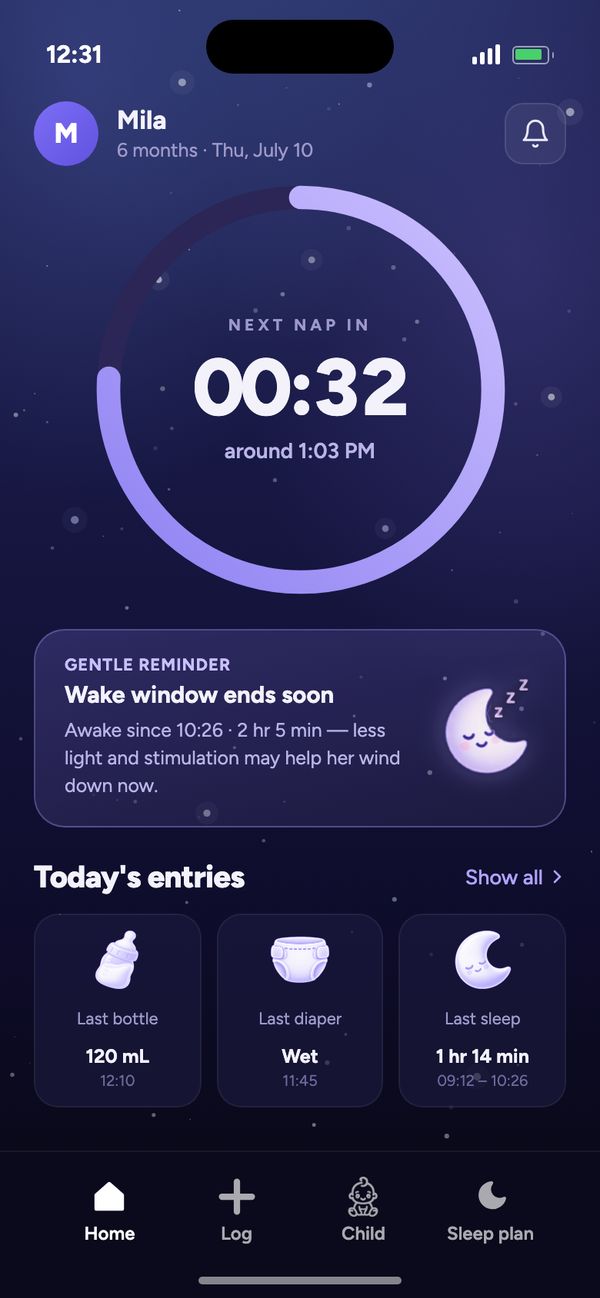
A crying and sleep diary can help with any conversation. Pediatric societies recommend writing down, for about 3 weeks, when your child slept, how often they woke, when they were restless, and when they drank or ate. A piece of paper by the bed is enough. An app like Moonsleep makes it easier: you can log sleep, feeds, temperature, and medicines with a tap, and use a note to record when your baby cried and what helped. That can reveal patterns that disappear in exhausted nights.
If it all feels like too much: Put your baby somewhere safe, ideally on their back in their crib. Step into the next room for a moment, open a window, and take a few deep breaths. Keep checking on your baby, and get support: call someone you trust, or the parent helpline. It is completely okay to put down a crying baby somewhere safe for a moment. Never shake your baby, not even briefly: just a few seconds of losing control can cause severe and permanent brain injury. If it has happened, or you’re worried someone may have shaken your baby, take them to the nearest ER right away or call 911. Talk to everyone who cares for your baby about this danger too.
Calm nights start here.
Download Moonsleep and find the rhythm that fits your baby.
Warning signs: act right away
You know your baby better than anyone else. Get medical advice as soon as their crying feels unfamiliar or they seem very different from usual. Asking once too often is better than asking once too late.
Call 911 right away if your baby …
is breathing hard or very fast, grunts with every breath out, or the skin between the ribs or under the breastbone is pulling in,
has pauses in breathing and turns blue, pale, or limp,
has pale, bluish, gray, or mottled skin, lips, or tongue,
is limp or unresponsive or is hard to wake,
has a seizure,
has a rash that does not fade when you press it,
has severe, repeated pain attacks where they pull up their legs — especially with yellow-green vomiting or blood in the stool.
Go straight to the ER — if you can’t get there quickly, call 911 — if your baby …
is younger than 3 months and has 100.4 °F (38.0 °C) or higher, or is below 97.7 °F (36.5 °C),
has green or yellow-green (bilious) vomit,
has swelling in the groin or scrotum and is crying or showing pain,
has a toe, finger, or penis that is constricted, swollen, or discolored,
as a toddler may have swallowed a button battery.
Get urgent medical advice — overnight through your pediatrician’s after-hours line — if your baby …
cries for longer than 2 hours without a break and can’t be soothed by anything,
has an unusually high-pitched cry or a strikingly weak cry, cries out when touched, or seems very changed from usual,
has a bulging or sunken fontanelle (the soft spot on top of the head),
refuses to drink or has clearly fewer wet diapers than usual — don’t wait until there hasn’t been a wet diaper for 12 hours,
vomits blood or has projectile vomiting.
For context: brief pauses in breathing of under about 10 seconds can be part of normal, slightly irregular newborn breathing, and the same goes for occasional grunting while straining. If the pauses last longer, have your baby checked by a medical professional.
If your baby is crying in a new and unusual way but can be comforted and otherwise seems well, it’s usually enough to call your pediatrician’s office the next day.
How are you doing?
Nighttime crying is draining, especially when it goes on for weeks. If there are two of you, split the nights: the person on duty listens and responds, while the other person really gets to sleep — ideally with earplugs in the next room. If you’re on your own, accept help when it’s offered, and ask for it very specifically — for example, an hour-long stroller walk in the afternoon so you can sleep.
And don’t forget: the fact that your baby cries at night is not a verdict on you. They’re a small person still learning how to cope with hunger, tiredness, closeness, and all the new impressions of life. You do not have to decode every cry right away. With each night, you get to know your child a little better — and they get to know you, too.
Frequently asked questions
Do I need to wake or pick up my baby if they cry in their sleep?
Usually not. If your baby cries or whimpers with their eyes closed, they’re often in light sleep between two sleep cycles and may find their way back to sleep on their own. Give them a moment, and go in if the crying gets louder. The same applies to night terrors in toddlers: don’t wake them, just stay calmly nearby. Newborns are different: crying is often hunger, and until they’ve regained their birth weight, there should generally be no more than about 4 hours between feeds at night. And if their breathing or skin color seems off, wake them right away and get help.
How long can I wait before going to my crying baby?
There isn’t a fixed number of minutes. A short pause to listen is enough to notice whether the crying is fading or getting louder. Babies in the first months of life can’t yet calm themselves out of intense distress, so experts advise against letting them cry it out. In newborns, hunger is the most common reason, and that isn’t something to wait out. With older babies, you can listen a little longer because many fall back asleep on their own after a brief waking. If the crying becomes more demanding, go in — with dim light and a quiet voice.
Does my baby have a nightmare if they suddenly cry out at night?
It’s hard to know in babies, because they can’t tell you what they dreamed. Nightmares may be possible from the second half of the first year, but they don’t become typical until around age 3. So in the first year, nighttime crying is much more often about hunger, tiredness, needing closeness, or not feeling well. In toddlers, night terrors are also common: they happen in the first half of the night, your child seems panicked, doesn’t recognize you, and remembers nothing the next morning. After a nightmare, by contrast, your child is awake and can be comforted.
Am I spoiling my baby if I go in every time they cry at night?
No. Comforting does not spoil a baby. In the first months of life, babies need your help to calm down; they can’t do that alone yet. But you can comfort in small steps: first your voice, then your hand on their belly, and only then pick them up. Many babies can find their way back to sleep like this without fully waking up. As they get older, babies and toddlers gradually become better at falling back asleep on their own after a brief waking.
Can I bring my baby into my bed after comforting them?
You can bring your baby into your bed to breastfeed or comfort them. But put them back in their own crib before you fall asleep. In the first year, the safest sleep place is their own crib in your bedroom: on their back, in a sleep sack, with no pillow, blankets, or stuffed toys, and in a smoke-free room. Never fall asleep with your baby on a sofa or in an armchair. There, the risk of a sleep-related death is up to 67 times higher.
Is my baby teething, or are they sick?
Teething makes some babies fussy: they drool, chew on everything, and rub their ears. Their temperature may rise a little, but it stays below 100.4 °F (38 °C). Fever, diarrhea, refusing to drink, or a baby who truly seems sick are not explained by teething. Often there’s an infection behind it instead, such as an ear infection, which can hurt especially at night. For a baby under 3 months with 100.4 °F (38.0 °C) or more, the rule is always the same: get medical care right away, and at night it’s best to go straight to the ER. If you’re unsure otherwise, call your pediatrician’s office or its after-hours line.
Watch for these warning signs
Call 911 right away: trouble breathing, grunting with every breath out, pauses in breathing with turning blue or pale, pale, bluish, gray, or mottled skin, lips, or tongue, a limp baby or one who is hard to wake, a seizure, a rash that doesn’t fade when you press it, or severe, repeated pain attacks with legs pulled up — especially with yellow-green vomiting or blood in the stool.
Go straight to the ER (or call 911 if needed): fever of 100.4 °F (38.0 °C) or higher or a temperature below 97.7 °F (36.5 °C) in babies under 3 months, green (bilious) vomiting, a painful swelling in the groin or scrotum, a constricted toe, finger, or penis, or a swallowed button battery.
Get medical advice promptly — outside office hours, through your pediatrician’s after-hours line: inconsolable crying for more than two hours, a shrill or unusually weak cry, a bulging or sunken fontanelle, refusing to drink or clearly fewer wet diapers, blood in the vomit, or projectile vomiting.
This article does not replace an examination by a pediatrician. If your gut feeling is sounding the alarm, take it seriously and ask for help.
Moonsleep offers guidance, not medical advice. It is based on clinical guidelines and expert sources, checked against the Moonsleep reference database.