


It’s 3:00 a.m., your baby is nursing, and your head starts to nod forward. Dozing off while breastfeeding isn’t failure—it’s a completely normal result of nights broken into tiny pieces.
In short: Many moms doze off while breastfeeding. The biggest danger is the couch or an armchair, because the risk of fatal sleep accidents there is many times higher. If you notice you’re getting sleepy, put your baby on their back in their own bed. A safely prepared adult bed is only the backup plan.
This article is about you falling asleep while breastfeeding. If your baby falls asleep at the breast, that’s usually normal—how to lay them down afterward is further below.
At a glance
- Safest place
- their own bed
- Risk on a sofa
- 22–67× higher
- Most risky time
- 0–4 months
- Fell asleep?
- check, to bed
Why nursing makes you sleepy
Breastfeeding makes you sleepy because when your baby latches, your body releases the hormone oxytocin. It helps your milk flow and also lowers stress hormones such as cortisol. Your body relaxes, you feel warm—many moms know this breastfeeding drowsiness. Add sleep deprivation, and it can be enough to make your eyes close in the middle of a feed.
Then there’s the rhythm of the early months. In the first weeks, most babies feed 8 to 12 times in 24 hours, many especially often in the evening (cluster feeding). A day-night rhythm usually starts developing around 8 weeks and often settles between 3 and 6 months. At 2 or 3 months, there are usually 2 to 4 hours between feeds, many babies still feed 1 to 3 times at night, and at least one night feed is simply normal until around 6 months.
Sometimes the feeding itself also makes nights longer. Does almost every feed take a very long time? Does your baby mostly comfort-suck without you hearing swallowing, or does breastfeeding hurt? First check the latch yourself: your baby’s mouth is wide open, their chin touches your breast, their nose stays clear, you can see more of the darker areola above the top lip than below the bottom lip, and their cheeks stay rounded while sucking. If that doesn’t fit—or it still hurts—it helps to get another pair of eyes on it: at a breastfeeding support group or with a lactation consultant (your health plan may cover it). Until then, one simple trick can keep sleepy babies drinking: hold your breast far back with your whole hand. If your baby is only sucking, gently compress your breast and hold the pressure until they stop swallowing. Then release, repeat, switch sides.
So no, you are not doing anything wrong if you’re tired.
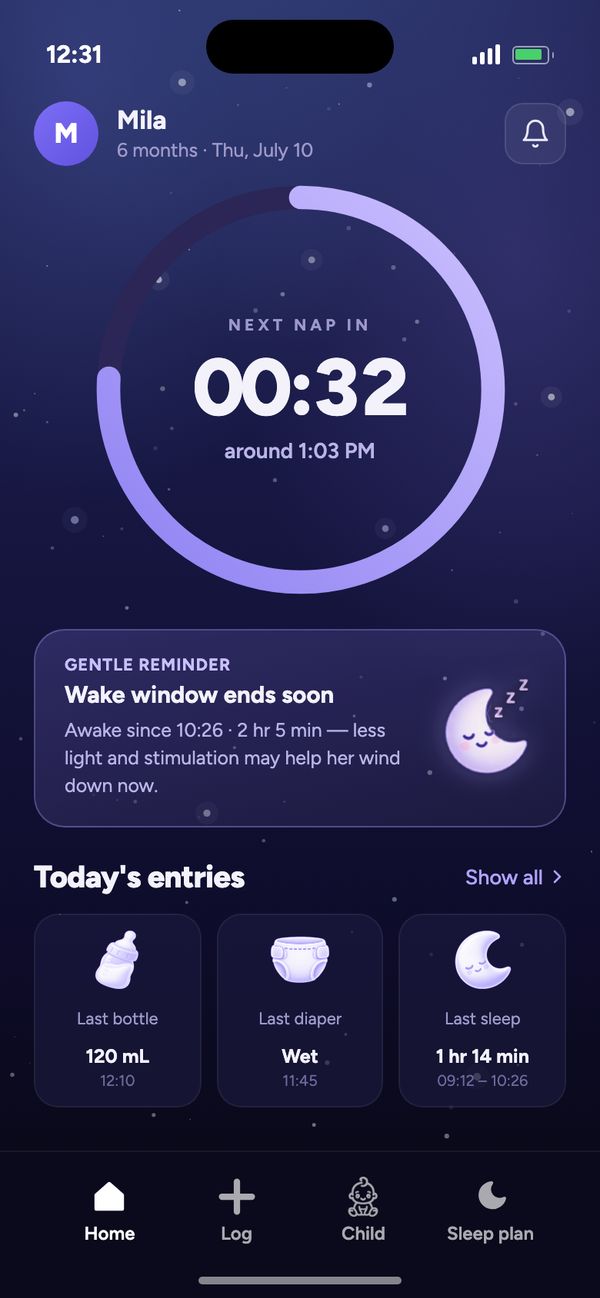
Calm nights start here.
Download Moonsleep and find the rhythm that fits your baby.


Why sofas and armchairs are so dangerous
Couches and armchairs are the most dangerous places to fall asleep with a baby—day or night. The American Academy of Pediatrics (AAP) calls them extremely hazardous: if a baby sleeps there, the risk of SIDS and fatal sleep accidents is 22 to 67 times higher, depending on the study. That’s true even if the baby is lying there alone—and even more so if you fall asleep with them.
The reason is the padding. It gives way and creates gaps and hollows. Your baby can get trapped between the seat and the backrest or sink face-first into soft fabric. If you nod off, your baby can slip from your arms, or you can slump onto them without noticing. In the crook of your arm, your baby’s chin can also tip toward their chest, which makes breathing harder.
The typical situation is well meant: you don’t want to wake your partner, so you take the baby to the living room—or your partner falls asleep on the couch with the baby on their chest in front of the TV. It’s the same danger either way.
The same goes for a nursing chair in the bedroom, sitting upright in bed against a pile of pillows, or a reclined nursing position with your baby lying on their tummy on you. All of that can feel comfortable for feeding, but only while you’re fully awake. If you nod off like that, your baby can slip into pillows or the crook of your arm. If you’re getting sleepy, lay your baby down or lie flat on your side in your prepared bed.
Letting your baby sleep on you is okay as long as you stay awake. Germany’s guideline on preventing SIDS says: if your baby is lying on you, their airway must stay clear. If you get sleepy or distracted—by your phone, for example—put your baby on their back in their own bed. Clear airways means:
You’re sitting semi-upright, not flat and not sunk deep into cushions.
Your baby is chest to chest with you, head turned to the side, and you can see their face.
Their nose and mouth are clear, their chin is not pressed onto their chest, and any blanket is only over their back.
You keep checking: pink lips, calm breathing, normal muscle tone.
Be especially watchful in the first hours after birth. According to the German guideline, sudden emergencies can happen even then, especially when a newborn is lying tummy-down on the chest of a first-time mother. If you’re exhausted or have been given strong pain medication, call the hospital staff or hand your baby to your partner.
Letting your baby sleep on you is fine—as long as you stay awake.
When your eyes start to close
You can’t always tell you’re about to fall asleep. Many parents only realize it when they suddenly startle awake. So watch for these warning signs:
You keep yawning and your eyelids feel heavy.
Your head drops, or you jerk awake for a moment.
You read the same line several times, or you’re missing a few minutes.
And make this a firm rule: if you’ve nodded off once that night, don’t breastfeed in the chair or on the couch again for the rest of the night, and put your baby back in their own bed right after every feed. These small things can make it easier to stay awake during night feeds:
A small light instead of total darkness: a dim night-light is enough so you can see your baby’s face. Bright overhead light wakes everyone fully up.
Sit upright: feet on the floor, not bundled up too warmly. When you switch sides, roll your shoulders for a moment.
Water instead of a hot drink: keep water in a closable bottle. Don’t drink hot tea or coffee while breastfeeding—if you nod off, your baby could be scalded.
Caffeine in moderation: up to 200 milligrams a day—about two cups of drip coffee—is considered safe for your baby while breastfeeding. But coffee at night can also keep you awake afterward. Energy drinks aren’t recommended while breastfeeding.
Use your phone the right way: yes for light, alarms, and emergencies; no for scrolling with a sleeping baby on your chest. The charging cable should stay away from the bed.
A quiet vibration alarm: set it for about half an hour when you latch your baby on—roughly the length of a feed at 2 to 3 months. It reminds you to lay your baby down, but it never replaces a safe sleep space.
These tricks can help you stay awake. But if you notice a warning sign anyway, lay your baby down, wake your partner, or switch to side-lying in your prepared bed.
You can’t always beat the exhaustion. But you can control where it catches up with you.
Where your baby sleeps most safely
The safest place for your baby to sleep is in their own bed in your bedroom. In Germany, public health authorities recommend this for the whole first year; the AAP recommends it for at least the first 6 months—when the risk of SIDS is highest. Just sharing a room helps: according to the AAP, it can lower the risk by up to 50 percent.
Three terms often get mixed up here. Room-sharing means: your baby has their own bed in your room—that’s the recommendation. Bed-sharing means: baby and adults share one sleep surface. Co-sleeping is used for both, which is why many professionals avoid the term.
Recommendations differ on bed-sharing. In Germany, public health authorities consider it acceptable for breastfeeding mothers under clear conditions because it can make breastfeeding easier. The AAP advises against it in general. If your baby gets formula, both recommend your baby’s own bed next to you. For you, that means: the safest choice is a bedside sleeper. If you consciously choose bed-sharing, do it only if none of the exclusion factors below apply—and with the full safety setup every night, not only in emergencies.
Why is the guidance different for formula-fed babies? Researchers at Durham University observed nights at home: breastfeeding mothers usually placed their baby flat at breast level, away from pillows, and curled protectively around them. Formula-fed babies were more often higher up at face level, sometimes between pillows. If you sometimes use a bottle—whether with infant formula or expressed milk—a bedside sleeper is the safer choice.
A bedside sleeper attaches to your bed: your baby has their own sleep surface but is still within arm’s reach. Here’s how to set it up safely:
Adjust the height so both sleep surfaces are level, and fasten it firmly to your bed frame with the straps provided.
Check with a flat hand that there’s no gap between the mattresses where your baby could get trapped.
Use only the matching original mattress with no extra topper. Until the bed is firmly attached, keep the side rail up.
Follow the manufacturer’s age and weight limit, then move your baby to a crib right next to your bed.
The label can help when you buy one: use a bedside sleeper that meets US federal safety standards (set by the Consumer Product Safety Commission, CPSC). A crib where you remove one side yourself is not the same thing. If you don’t have a bedside sleeper, a bassinet or crib right next to your bed is just as safe—you’ll simply lift your baby out to breastfeed.
When bed-sharing is off-limits
If any of these apply, even the best preparation is not enough. Your baby should always sleep in their own bed if:
you, your partner, or anyone else in the bed smokes or vapes—even if they only smoke outside—or you smoked during pregnancy.
someone in the bed has had alcohol, even a small amount, or used cannabis or other drugs. The simple rule: on any evening with alcohol, your baby sleeps in their own bed all night.
someone is taking medication that makes them sleepy or harder to wake (more on that in a moment).
your baby was born early, before 37 completed weeks of pregnancy, or weighed less than 5.5 lb (2,500 g) at birth. The recommendations do not give an age when this no longer applies.
your baby gets formula.
your baby is swaddled.
anyone besides the parents is in the bed, such as siblings, grandparents, a babysitter—or a pet.
the sleep surface is soft: a couch, armchair, waterbed, or a sagging mattress.
you’re ill or so exhausted that you can barely respond.
Medications: Things that can make you sleepy include strong pain medicines such as opioids, which some mothers receive after a C-section, sleeping pills and sedatives, some antidepressants, and older allergy or motion-sickness medicines that are also sold over the counter as sleep aids; the warning is usually on the label, under driving or operating machinery. Don’t stop anything on your own. During the day, ask a pharmacist, your doctor’s office, or a medication information service for pregnancy and breastfeeding. If you’re unsure at night, your baby sleeps in their own bed tonight, and you ask tomorrow.
And what about plain exhaustion? The AAP counts it among the strongest risk factors when someone is harder to wake because they are overtired; German public health authorities describe this as reduced responsiveness. There isn’t a number-based cutoff. Clear warning signs are fever or a stomach bug, dozing off several times in the same night, or not remembering whether you put your baby back. For you, that means: on nights like that, your baby goes back into their own bed after every feed, and you get help—where to find it is further below.
Under 4 months old
In the first 4 months of life, bed-sharing is especially risky—even for breastfed babies and even if nobody smokes. According to the AAP, the risk is 5 to 10 times higher than the baseline risk of bed-sharing. So parents who breastfeed a baby this young in bed should be especially careful not to fall asleep. In practice, for one night, that means:
Plan A: Breastfeed wherever is comfortable for you, including in bed. After every feed, your baby goes onto their back in their bedside sleeper or crib—before you fall asleep yourself.
Plan B: If you notice you’re nodding off and you can’t manage to put your baby down anymore, a prepared bed is safer than anywhere else. As soon as you wake up, you put your baby back.
Never: fall asleep with your baby on the couch or in an armchair—and no bed-sharing if any of the exclusion factors apply.
A Plan B isn’t failure. It’s care for the nights when your strength runs out.
Your evening checklist
First, check whether any of the reasons not to bed-share apply to your family. If not, make the family bed safe in the evening while you’re still thinking clearly — at 3:00 a.m., nobody is moving pillows out of the way. Here’s why each step matters:
Firm mattress: waterbeds, sagging mattresses, and soft toppers are unsuitable because your baby can sink into them and their mouth and nose can be blocked. It’s best to remove a thick, soft topper.
Keep pillows away from baby: one flat pillow goes under your head; your baby lies clearly below it, flat at breast level.
Your blanket only up to your hips: with a warm long-sleeved top, you won’t need to pull it up in the night. In fatal bed-sharing accidents, the baby’s face or head is often covered by bedding.
Your baby wears their own sleep sack: your baby never sleeps under your duvet and should not wear more layers than you do.
On your side: your baby lies next to you, never between two adults, and your partner knows the baby is in the bed. You face your baby, and your baby is on their back.
No gaps, no edge: your baby must not be able to slip between the mattress and the wall or fall out of bed. If the bed is against a wall, push it all the way in. Rolled towels and pillows are not safe ways to fill gaps, and portable bed rails or slatted headboards can become traps. A firmly attached bedside sleeper is better.
Take the nursing pillow out: once your baby is latched on, it comes out of the bed, because a sleeping baby can roll face-first into its hollow.
Keep cords and ties away: charging cables and strings can strangle a baby.
No swaddling, nothing weighted: a swaddled baby cannot push bedding away from their face or wake you if you get too close. Weighted sleep sacks and blankets are never safe.
Not too warm, no pets, no siblings: no hat, no extra blanket, and keep the room on the cool side—overheating is considered a risk factor. Pets and other children do not sleep in the bed.
On vacation or at the grandparents’, check the unfamiliar bed the same way. And even if you usually put your baby back every night, this preparation is your safety net for the one night things go differently.
Side-lying nursing
Breastfeeding while lying down saves a lot of getting up at night, and it can work from the start, including in the first weeks after birth and after a C-section, when your back and incision need relief. The first few tries are often clumsy, so it’s best to practice during the day:
Lie on your side on the flat, prepared mattress. A flat pillow supports your head; if needed, one pillow supports your back and one goes between your knees.
Your lower arm is above your baby’s head or under your pillow, never under your baby.
Bring your baby fully toward you on their side, tummy to tummy, with ear, shoulder, and hip in one line.
Their nose is level with your nipple, not their mouth. That way they tip their head back slightly and open wide.
Then use your top hand at their back to bring them close, instead of leaning over your baby.
If your breast presses on their nose, bring their bottom closer to you—then the head tips back a little and the nose clears.
For the second side, take your baby in your arms, roll over with them, and latch again.
To finish, slip your little finger into the corner of your baby’s mouth between the gums. That breaks the suction without pulling on your nipple.
Here’s the position if you doze off anyway: your baby is on their back, flat at breast level below the pillows, you are facing them, your knees are drawn up, and your arm is above their head. Researchers in Durham repeatedly observed this position—the “cuddle curl”—in breastfeeding mothers. It is not permission to sleep together, but it helps explain the rule “at breast level, away from the pillows.”
After a C-section, the rule is: as long as you’re receiving pain medicine that makes you sleepy, you must not fall asleep in bed with your baby. Call for help after breastfeeding so your baby can be put back in their bed, and ask the staff which medication causes drowsiness.
Calm nights start here.
Download Moonsleep and find the rhythm that fits your baby.
How to put your baby down without waking them
“Put them back in their own bed” sounds simple — but often the hard part is actually putting your baby down after nursing. These tips can help your baby stay asleep:
Prepare first: change your baby before the feed or when switching sides, not after, and put the sleep sack on beforehand. If you warmed the bed with a hot water bottle, remove it before you lay your baby down.
Wait until they’re deeply asleep: breathing is even, the face is relaxed, and a lifted arm falls back loosely.
Release gently: put your little finger into the corner of your baby’s mouth until the suction eases.
Slide instead of lift: from a lying position, slide your baby into the attached bedside sleeper. If you have to carry them, lay down bottom and legs first, then back and head.
Leave your hand there for a moment: keep your hand flat on their tummy briefly. Keep the light dim and don’t talk, or only whisper very softly.
Do they need to burp first? Not necessarily. Breastfed babies often swallow little air, and some do not need to burp at all. If your baby seems content, you can lay them down without it—lying on their back does not make them choke.
A pacifier is okay when you lay your baby down, and it even lowers the risk of SIDS. For breastfed babies, wait until breastfeeding is well established—according to the German guideline, beyond the first 2 to 3 weeks of life. If it falls out, don’t put it back in, and it should never be attached to a string.
What if your baby wakes up right away? Put your hand on their tummy, hum softly, and wait a moment. If they keep crying, pick them up briefly and try again. If they’re hungry, latch them on again. There isn’t a fixed number of tries—only the limit of how awake you are. If your eyes are closing, your partner takes over, or you breastfeed side-lying in your prepared bed and put your baby back as soon as you wake up.
Does your baby only sleep on you or at the breast at night? That’s very common in the first months and not a mistake. Still, keep practicing putting them down—during daytime naps too.
Could I accidentally roll onto my baby?
Yes, it can happen, even though it is rare. Professionals call this overlaying. In an adult bed, there are two other typical accidents as well: a pillow or blanket slides over the baby’s face, or the baby gets trapped between the mattress and the wall.
The risk rises sharply with anything that makes you harder to wake, and with soft surfaces—which is exactly why those things are on the exclusion list.
For perspective: according to CDC data, about 1,351 babies died of SIDS in the US in 2024, part of a wider count of about 3,400 sudden unexpected infant deaths that year. SIDS rates have dropped several-fold since the 1990s, thanks in part to safe-sleep education. So the numbers in this article describe how much a rare risk goes up or down.
Rolling onto your baby is rare. Knowing about safe sleep makes it even rarer.
Fell asleep — now what?
It happened: you fell asleep while nursing, jolted awake, and your baby is lying next to you or on you. Take a breath, then go through these steps in this exact order:
Check with proper light: turn on your phone flashlight or the room light. Is your baby’s face clear? Are they breathing? Are their lips and tongue pink? With darker skin, a bluish color shows best there. Do they respond to touch?
If something is wrong: call 911 (or your local emergency number) right away. If your baby is not breathing normally, is limp, blue or gray, or is very hard to wake, call 911. Put your phone on speaker, place your baby on a firm surface—best on the floor—and do not hang up: the 911 dispatcher will guide you step by step until help arrives.
If everything looks normal: put your baby on their back in their own bed, even if they’re sleeping peacefully right now.
Only then is it your turn: have a drink, lie back down, and make a plan for the next evening.
What counts as normal breathing? Young babies often breathe irregularly in their sleep. Pauses of 5 to 10 seconds, after which they start breathing again on their own and keep their normal color, are normal. To check, place your hand on the tummy just below the ribs and feel whether it rises and falls. A pause longer than 20 seconds, more than 60 breaths per minute at rest, grunting with every breath, or pulling in between the ribs is an emergency—call 911.
Was your baby briefly blue, gray, very pale, limp, or not breathing—and now seems completely normal again? Still have them checked by a doctor right away: overnight, call your pediatrician’s after-hours line or go to the ER at a children’s hospital. If your baby does not recover fully within a few minutes, call 911.
Blaming yourself won’t help now. Experts know that parents often fall asleep during night feeds, and they shape their recommendations around that reality. Still, take the scare seriously: it shows you where your nights can be safer. An infant first-aid and CPR class—many hospitals and community centers offer them—can give you confidence for exactly this moment.
You do not have to be perfect at night. It’s enough to plan ahead once in the evening.
How your partner can help
Only you can nurse. Everything around it can be shared — and that helps both of you get more sleep, even with nighttime feeds. It’s best to talk through who will do what during the night in the daytime, not when you’re both half-asleep.
Bring baby and put baby back: your partner takes the baby out of the bedside sleeper, changes them, and brings them to you. After the feed, they burp the baby if needed and put them back on their back.
One firm rule: whoever wakes up and finds the baby in the big bed—or notices the other parent’s eyes closing—puts the baby back without debate.
The same rules for both of you: sober, smoke-free, no sedating medication—and no napping with the baby on your chest on the couch.
A night in shifts can look like this: you go to sleep right after the evening feed. Your partner handles everything until the next feed except latching the baby on, and only brings the baby to you when they are truly hungry. If your partner has to work early, keep this evening shift on weekdays and add the morning shift on weekends.
Expressed milk by bottle: your partner can occasionally handle a night feed with expressed milk. It’s best to wait until you and your baby feel confident with breastfeeding. If you skip a feed, your breasts should not become uncomfortably full: hand express a little or pump, otherwise you may end up with painful milk buildup.
If one of you needs to sleep elsewhere to catch up, let it be your partner in another room—not you and the baby on the couch. And this phase does end: after 6 months, many thriving babies can go longer stretches without a feed.
Alone with your baby
Maybe you’re parenting solo, your partner works nights, or your family lives far away. In that case, “accept all the help you can get” is not very helpful. These are supports you can reach yourself:
Know who to call: In the US, most families don’t get home visits after the birth. Make sure you know who to call once you’re home: your pediatrician’s office for your baby and your OB-GYN or midwife for you.
Breastfeeding help: Volunteer La Leche League Leaders offer support, including by phone and online. You can also look for a lactation consultant with IBCLC certification—your health plan may cover it.
Help at home: Ask family and friends for concrete help, such as meals, laundry, or an hour so you can sleep.
Home visiting and local support: Some communities offer free home visiting programs for new parents; your pediatrician or local health department can tell you what’s available. For local help with things like food or diapers, you can call 211.
Someone to talk to: In the US, you can call or text the National Parent & Youth Helpline at 1-855-427-2736, day or night. If the night feels unbearable, call or text 988 right away rather than staying alone with it.
Your solo night plan: keep the bedside sleeper or bassinet right next to your bed, lay everything out in the evening—water bottle, diapers, night-light—and lie down during the day as soon as your baby is asleep in their own bed. The housework can wait.
And if the exhaustion turns into anger or despair: put your baby on their back in their bed, step out of the room for a moment, breathe, and call someone. It is completely okay to lay a crying baby down safely for a moment. You must never shake your baby, not even briefly—it can be life-threatening.
Calm nights start here.
Download Moonsleep and find the rhythm that fits your baby.
Does breastfeeding protect against SIDS?
Yes. Breastfeeding lowers the risk of SIDS, and the longer your baby gets breast milk, the greater the protection. Breastfeeding for at least 2 months already cuts the risk by about half, even if you are not exclusively breastfeeding. Even the frequent waking has an upside: breastfed babies wake more easily and more often at night, and that is thought to be one reason breastfeeding is protective.
If you supplement or sometimes give a bottle at night, the same is still true: safe-sleep rules protect every baby, no matter how they are fed.
Between 6 and 12 months, your baby gets more mobile: pay even closer attention that they cannot fall out of bed. And even then, babies still wake on average about once a night, many breastfed babies to feed—that’s normal and not a reason to wean.
Frequently asked questions
Can my baby sleep on my chest?
Yes, as long as you are fully awake. Contact naps on your chest are okay if you are sitting semi-upright, you can see your baby’s face, their nose and mouth are clear, and their chin is not pressed onto their chest. Keep checking, and put your phone away. If you notice you’re getting sleepy or distracted, put your baby on their back in their own bed. The same applies to partners: dozing on the couch with a baby on your chest is one of the most dangerous situations of all.
When can my baby sleep in my bed?
There is no cutoff date when bed-sharing suddenly becomes safe. The riskiest period is the first 4 months of life. In Germany, the recommendation for the whole first year is your baby’s own bed in your bedroom, ideally a bedside sleeper; the AAP recommends room-sharing for at least the first 6 months. If you consciously choose bed-sharing, only do it when none of the exclusion factors apply and you have done the full preparation from this article every night.
Can my baby sleep on their side so they don’t choke?
No. For sleep, your baby should be on their back for every sleep. Side sleeping is not considered safe. The fear of choking is understandable, but back sleeping on a flat surface does not raise the risk—not even for babies with reflux. Your baby is protected by their gag reflex and the way their airway is built. A tilted bed does not help with spit-up either and is not recommended. During side-lying breastfeeding, of course your baby can lie on their side; for sleep afterward, they go onto their back. Once they can roll both ways on their own, you do not need to roll them back.
Does a baby nest or sensor pad make bed-sharing safer?
No—don’t rely on it. According to the AAP, there is not enough evidence for products that claim to make sleeping in an adult bed safer. Many baby nests also have soft padded sides, and safe-sleep guidance specifically advises against that kind of padding and surround. There is also no evidence that sensor mats or socks that measure oxygen levels reduce the risk of SIDS. The AAP even warns that they can make parents less careful about the safe-sleep rules. The same goes for any app or timer: it can help you stay organized, but it never replaces a safe sleep space. Your money is better spent on a securely attached bedside sleeper.
My partner only smokes outside. Can our baby still sleep in our bed?
No. Smoking greatly increases the risk in bed-sharing, even if nobody ever smokes indoors. The AAP counts sleeping next to a smoker—even one who never smokes in bed—among the strongest risk factors. The same applies if you smoked during pregnancy. Your baby is safer in their own bed right next to you, ideally a bedside sleeper. If someone wants to quit smoking, local stop-smoking support can help.
Do I need to wake my baby to breastfeed at night?
In the first weeks of life, yes—until your baby has regained their birth weight. Until then, they should not go longer than about 4 hours at night without a feed. That is usually reached after 10 to 14 days. After that, a thriving baby may sleep longer stretches at night. Thriving means: they keep gaining weight at weigh-ins and well-baby checkups, have at least 6 wet diapers in 24 hours from day 5 onward, and wake on their own to feed. To wake your baby, make the light a little brighter, open the sleep sack, undress them down to the bodysuit, change them, stroke their back or feet, and switch sides. If your baby was born early or you’re unsure, ask your pediatrician’s office.
Can a swaddled baby come into the adult bed?
No. A swaddled baby cannot use their arms to push bedding away from their face or wake you if you get too close. The German guideline generally advises against tightly wrapping babies for sleep anyway. If parents choose to swaddle despite that, it should only be for back sleeping in the baby’s own bed and only until the baby starts trying to roll, usually at 3 to 4 months, sometimes earlier. Weighted swaddles, sleep sacks, or blankets are never safe.
I had a glass of wine. Can my baby still sleep in our bed?
No. After alcohol, you react more slowly than usual, even after a small amount. So the simple rule is: on any evening with alcohol, your baby sleeps in their own bed all night, and you also do not breastfeed on the couch. Ideally, another adult is nearby that night who can help. In general, it’s best to avoid alcohol while breastfeeding. If you do occasionally have a drink, health guidance in some countries advises waiting 2 to 3 hours before the next feed—and only once breastfeeding is well established.
When to get help right away
All numbers here are for the US.
Call 911 right away if your baby is struggling to breathe, has breathing pauses longer than 20 seconds, has bluish, gray, or very pale lips, seems limp, or is very hard to wake.
Get medical help urgently—through your pediatrician’s office, their after-hours line, or the ER at a children’s hospital—if your baby is younger than 3 months and has a temperature of 100.4 °F (38.0 °C) or higher measured rectally, if they are vomiting forcefully, or if they are no longer feeding properly. Green vomit: go straight to the ER at a children’s hospital.
See your pediatrician the same day if your newborn sleeps through several feeds, drinks fewer than 8 times in 24 hours, or from day 5 onward has fewer than 6 wet diapers—or if they are getting more yellow and are feeding poorly or seem unusually sleepy.
Call 911 right away for yourself if you suddenly become very short of breath, have pain in your chest or upper back, or your heart is beating very fast. A blood clot in the lungs or another serious cause could be behind it.
Call 911 right away or go to the nearest ER if you feel confused, hear voices, or see things other people do not. This could be postpartum psychosis—rare, but an emergency.
Get help immediately—call 911, or call or text 988—if you are having thoughts of hurting yourself or your baby.
Book a conversation soon with your OB-GYN, midwife, or primary care doctor if sadness, lack of energy, or anxiety lasts longer than 1 to 2 weeks—or sooner if it is hitting you hard or you cannot sleep even when you have the chance. In the US, the National Maternal Mental Health Hotline at 1-833-852-6262 (1-833-TLC-MAMA) and Postpartum Support International (PSI) can also help.
Contact your OB-GYN or midwife the same day if you have a hard, red, hot, painful area in your breast along with fever or flu-like symptoms. Continuing to breastfeed is the right thing to do.
Get checked if you feel persistently exhausted even when you do get breaks. There may be a treatable cause, such as anemia or a thyroid problem after birth.
Moonsleep offers guidance, not medical advice. It is based on clinical guidelines and expert sources, checked against the Moonsleep reference database.