


Has your child been falling asleep only at the breast, in your arms, or in a moving stroller for months—and are you being woken so often at night that you’ve stopped counting? At some point, the question comes up: should you change something, and is your baby even ready? Here you’ll learn how to tell, what needs to be in place first, and which gentle approaches let you support your child without leaving them to cry alone.
At a glance
- Earliest
- about 6 mos.
- Avg. night wakings
- about once
- Crying alone
- not necessary
- Where to turn
- pediatrician
Why “sleep training” is so controversial
Hardly any baby topic sparks more debate. For some people, “sleep training” means a baby crying alone in a dark room until they finally fall asleep from exhaustion. For others, it simply means a plan that helps the whole family sleep again. The problem is that one term gets used for very different things:
Cry it out: The baby is put down, the door is shut, and no one comes back until they’re asleep. Professionals call this extinction. We do not recommend this approach.
Timed check-ins, often called the “Ferber method”: Parents leave the room and check on their child at set, usually lengthening intervals—for example after five, then 10, then 15 minutes. Comfort is brief each time.
Chair method: You stay in the room while your child falls asleep, comfort them if needed, and move a little farther away over many evenings. In studies, this is called “camping out.”
Rhythm and routine: You adjust wake windows, bedtime, and the evening routine so your child gets to bed tired enough and relaxed enough to fall asleep well.
When we talk here about sleep support, we mainly mean the last two points: approaches where you stay available, comfort your child when they need you, and still gradually trust them with a little more. Not training, but supporting.
Recommendations from experts can sound different, too. In Germany, public health authorities clearly advise against leaving babies to cry at night: in the first months of life, babies can’t yet calm themselves down from intense distress, they need comfort—and you can’t spoil them by giving it. The German clinical guideline on mental health problems in babies and toddlers, led by child and adolescent psychiatry specialists, views checking as the first-choice approach for true sleep-onset and night-waking disorders based on the current evidence. But it also stresses that it isn’t a good fit for every parent.
That’s less contradictory than it sounds. It’s really about different ages, different levels of difficulty—and what fits your family.
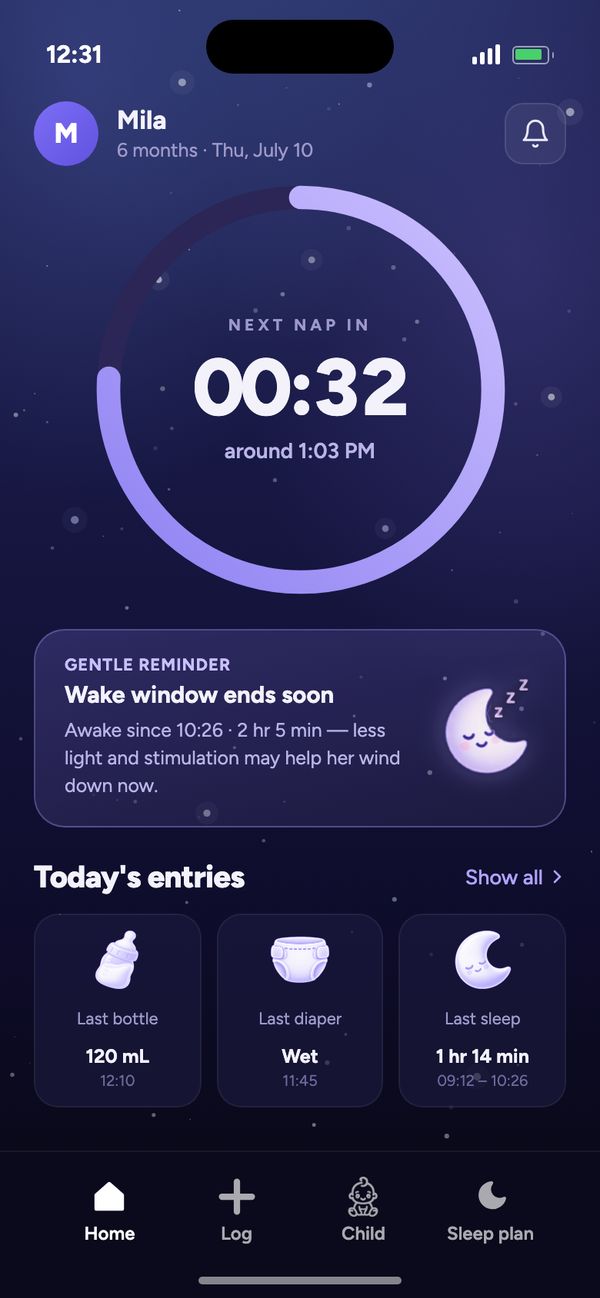
Calm nights start here.
Download Moonsleep and find the rhythm that fits your baby.


Why not before 6 months
In the first months of life, your baby already has plenty to do just learning how to sleep. Before they can “learn” anything else, a lot still has to mature:
Your baby’s internal clock is still developing. The interaction between the body clock and sleep pressure develops during the first half-year. After just a few weeks, sleep gradually becomes more regular, but it’s only at around 6 months that daylight and darkness really start to act as strong cues for waking and sleep.
Longer stretches of night sleep develop later. It isn’t until around the sixth month that longer, uninterrupted stretches of sleep begin to develop at all. Until then, it’s completely normal for a baby to wake at least once at night and want to feed — and for many babies, that remains normal afterward too. In the second half of the first year, babies wake about once a night on average; up to three times is still within the normal range.
Starting earlier doesn’t help. A systematic review found no evidence that sleep programs in the first 6 months of life benefit babies or mothers. The authors even warn of unwanted effects: more crying, earlier weaning, more anxiety in mothers—and, if the baby is expected to sleep alone in a separate room for it, a higher risk of sudden infant death syndrome.
Even the diagnosis has a minimum age. By standard criteria, professionals do not diagnose a sleep-onset disorder before 6 months or a night-waking disorder before 8 months—and even then, only if the problem has been present on most nights for at least 4 weeks and is clearly affecting your family.
Does that mean you can’t do anything before then? You can. A calm daily rhythm, a short bedtime routine, and—starting at about 4 months—occasionally putting your baby down tired but still awake are all fine. What your child doesn’t need yet is a program with fixed rules.
If your baby was born early, use corrected age for sleep questions until about their second birthday—that is, count from the due date. A baby born 2 months early is, by that measure, 6 months old at 8 months of life.
And most importantly: 6 months is not a starting gun. Many families never need a plan, because sleep settles on its own or nighttime waking feels manageable for them. Age only tells you when a change can make sense—not when it is due.
Check the basics first
Before you tackle sleep habits, it’s worth doing an honest check-in—often the problem already feels smaller once you do.
Your child is healthy. When your baby has an infection or is in pain, it’s not the time for something new. Allergies, eczema, or intolerances can also disrupt sleep. If your child snores loudly on a regular basis, seems to struggle to breathe in sleep, or has pauses in breathing, have it checked by your pediatrician. And: sleep aids or calming medicines are not the answer. Never give melatonin or sedating drops on your own, and honey is off-limits in the first year—including on a pacifier.
Your child is growing well and getting enough to eat. Are they gaining weight well? Are they drinking and eating enough during the day? You’ll find more below on what that means for feeds at night. If you’re unsure, bring it up at the pediatrician’s office—for example at the 6-month or 12-month checkup.
The daily rhythm fits their age. A child who’s meant to go to bed too early may simply not have enough sleep pressure yet. A child who’s been awake far too long may be overtired and wired. In the evening, both can look the same: protest. The guide values in the box below can help you sort it out.
The sleep space is safe and comfortable. Their own bed, a sleep sack, dark, quiet, and on the cool side—see the “Safe sleep” box below for details.
Life is relatively calm right now. A move, vacation, starting daycare, or a new sibling: at times like these, children often need extra closeness. It’s usually better to save bigger changes for a few calmer weeks afterward.
You’re on the same page and have a little energy to spare. Everyone who cares for your child in the evening and at night should know the plan and support it—an approach only one of you follows is hard for your child to understand. And the first few evenings are often tough.
For reference: babies between 6 and 12 months usually sleep about 12–16 hours in 24 hours; between ages 1 and 2, about 11–14 hours. The nighttime sleep ranges include brief wake-ups. Some children need clearly less, others more—what matters is whether your child seems well-rested during the day.
Sleep guidelines from 6 months at a glance — ranges, not rules:
At 6 months: about 2–3 hours awake at a time, 2–3 naps, about 10.5–11.5 hours at night.
At 9 months: about 2.5–3.5 hours awake at a time, usually 2 naps, about 11–12 hours at night.
At 12 months: about 3–4 hours awake at a time, 1–2 naps, about 11–12 hours at night.
At 18 months: about 4–5.5 hours awake at a time, 1 midday nap, about 11–12 hours at night.
Bedtime: usually 6–7:30 p.m. in the first year, then 6–8 p.m. — depending on wake-up time.
Falling asleep: about 20 minutes on average. If it takes much longer, your child often isn’t tired yet or is already overtired.
Awake windows from 6 months
- At 6 months
- 2–3 hours
- At 9 months
- 2.5–3.5 hours
- At 12 months
- 3–4 hours
- At 18 months
- 4–5.5 hours
When it may be time to change things
You’re not alone: research suggests that problems falling asleep and staying asleep affect about 20 to 30 percent of young children, and almost one in three families with a child under 3 worries about sleep at some point. Even so, there is no cutoff where you have to change something—the key question is how your family is doing. These signs suggest a change might help:
You’re running on empty. Not just tired after one bad night, but exhausted, irritable, maybe low for weeks. That’s a real reason to take seriously. In an Australian study, 2 out of 3 mothers with significant depressive symptoms had a baby with sleep problems—and the link can work both ways. If you can’t sleep even when your baby is sleeping, that can be a sign of postpartum depression or an anxiety disorder. At that point, this isn’t only about baby sleep: bring it up with your primary care doctor or OB-GYN.
Bedtime drags on. Your child regularly needs much longer than half an hour to fall asleep, even though bedtime and the routine fit. On average, babies and toddlers fall asleep in about 20 minutes.
The sleep association has become too much for you. Hours of carrying, driving around in loops, offering the breast at every little sigh: as long as it works for you, all of that is okay. But if it’s wearing you down or no one but you can take over, it’s okay for something to change.
Your child wakes often and has a hard time getting back to sleep, even though they’re healthy, well fed, and on an age-appropriate rhythm. This does not mean one or two brief wakings, but nights when your child is repeatedly awake for long stretches for weeks or can only go back to sleep with a lot of help.
Your child seems overtired during the day. Young children often do not show lack of sleep by yawning, but by fussiness, a bad mood, and unusually high activity levels.
A German sleep medicine society suggests a quick self-check: Does your child usually need 30 minutes or longer to fall asleep or get back to sleep at night? Do they stand out during sleep—for example with loud snoring? Are they doing well during the day? How much time do they spend in front of screens (experts recommend as little as possible under age 3)? And do you feel affected by their sleep behavior? The answers aren’t a diagnosis, but they can show you whether this is more about rhythm and habits—or whether it would help to get an outside perspective.
And when do you not need to change anything at all? If your daily life works—even if other people say their baby is already “sleeping through the night.” In a Canadian study, depending on the definition, 28% to 57% of babies at 6 and 12 months still were not sleeping 6 or 8 hours straight at night. That wasn’t linked to their mental or motor development, or to their mothers’ mood. The only noticeable difference: babies who slept through the night were breastfed much less often. So if your breastfed baby wakes more often at night, that’s common and not, by itself, a warning sign. And at 9 months, about 1 in 4 babies wakes more than twice a night.
Your baby isn’t doing anything wrong by calling out at night. And you aren’t doing anything wrong for wanting some rest.
What the research says
There are surprisingly many studies on behavior-based sleep methods. Here are the main findings in brief:
They do work, at least for a few months. A task force of the American Academy of Sleep Medicine reviewed 52 studies. In 94 percent of them, the methods helped, and more than 80 percent of the children treated slept clearly better afterward—for 3 to 6 months.
Parents benefit too. In a large Australian study, families whose baby slept poorly at 7 months received a brief consultation at 8–10 months through a community parent-and-baby service. Afterward, the babies had fewer sleep problems and their mothers had fewer depressive symptoms—the latter still held even when the children were 2 years old.
No long-term harm was found—but no lasting benefits either. Five years later, when the children were about 6 years old, the same group was assessed again. There were no differences compared with children whose families had not received counseling in emotions, behavior, stress, sleep, or the parent-child relationship.
Stress hormones and attachment have been measured too. In a small, carefully controlled study of 43 babies between 6 and 16 months, neither timed check-ins nor a temporarily later bedtime led to higher saliva stress levels. One year later, the children were just as likely to be securely attached to their mothers as those in the comparison group.
They are not right for everyone. Sleep guidelines note that parents’ attitudes range from hesitant to negative about such methods, and that about 20 to 30 percent of families who try them in a structured way do not benefit enough. More anxious children seem to respond less well to methods with more physical separation. And parents who find their child’s crying especially hard to bear tend to have less success with them.
For an honest picture, it’s also important to know this: many studies rely on parent reports, and the researchers themselves would like more objective measurements. Most of these studies were done with healthy children, many of them in the second half of the first year or later. And “no harm found” doesn’t mean every method feels right for every child and every mother.
Why we focus here on the gentler approaches: Some clinical guidelines also explicitly describe an approach where parents stay in the room and only gradually pull back, and there are successful parent programs that do not involve leaving a baby to cry. These approaches sometimes take more patience. But for many parents, they’re easier to stick with—and they respect what babies need when they’re upset: closeness. That’s why we do not recommend leaving a baby to cry alone without comfort.
Research finding no harm doesn’t mean every approach feels right for every family.
Option 1: Rhythm and bedtime routine
It may sound unspectacular, but it’s often the most effective step. In a study of more than 400 families, babies and toddlers between 7 months and 3 years fell asleep faster after just 2 weeks with a consistent bedtime routine, woke less often and for shorter periods, and their mothers’ mood improved. In that study, the routine included a bath, massage or lotion, and calm cuddling, and the study was funded by a skincare manufacturer—but the findings fit with the rest of the research. A survey of mothers of more than 10,000 children up to age 5 across 13 countries and regions also found: the more consistent the routine, the better the sleep.
How to build a routine that works
Keep it short and the same every time: about half an hour, every evening in the same order. For example: last feed, diaper and pajamas, brushing teeth, a book or a song, your good-night phrase, lights out.
Move milk earlier: If your child currently falls asleep while feeding, put the feed at the beginning of the routine instead of the end. Then come brushing teeth, book, and bed. That way, your child gradually learns that feeding and falling asleep can be two different things.
Keep the last hour calm: dim light, no wild play, no screens. That helps your child wind down slowly.
Into bed tired, but still awake: The American Academy of Pediatrics recommends this from about 4 months. At first, your hand can rest on your baby’s belly, and you can keep humming softly.
Similar times, plenty of daylight: Regular bedtimes and wake times, ideally on weekends too, plus bright daylight in the morning help the body clock tell day from night.
If falling asleep still takes forever, the problem often isn’t your child—it’s the timing. They simply aren’t tired enough yet. In that case, a temporarily later bedtime can help, a method called “bedtime fading.” In the study with the 43 babies, it clearly shortened the time it took to fall asleep. This approach focuses on timing, not on leaving a baby to cry. Here’s how to do it:
Write down for one week what time your child actually falls asleep in the evening—not what time you put them down.
For now, set bedtime to that actual time. If your child usually doesn’t fall asleep until around 8:15 p.m., start the routine so they’re in bed around 8:00 p.m.
Once your child falls asleep within about 20 minutes for a few evenings in a row, move bedtime 10 to 15 minutes earlier and keep it there for a few more evenings.
This lets you move toward your target bedtime in small steps—usually somewhere between 6 and 7:30 p.m. in the first year. If your mornings start later, bedtime can be a little later too. The wake-up time stays fixed, even after a late evening.
The opposite can happen too: if your child stays up far beyond their usual wake window, they often don’t get sleepier—they get more wound up. Then an earlier bedtime may be the answer. Your notes will show which direction fits your child.
If falling asleep takes forever, it’s often not your child—it’s the timing.
Option 2: Gradually reduce sleep aids
At the breast, in your arms, or on the go: babies fall asleep the way they know—that’s completely normal. The tricky part is that all children briefly wake several times at night, usually when moving from one sleep cycle to the next. In babies and young children, these cycles last only about 45–60 minutes. If everything feels different when they wake than it did when they fell asleep, your child will call for exactly the same help they had at bedtime.
The idea of this approach is simple: you don’t take everything away at once. You make the help a little smaller in small steps. Stay with each step until it feels okay for both of you. A few examples:
If your child only falls asleep while breastfeeding or with a bottle: End the feed as soon as your child’s sucking slows and their eyes get heavy, then lay them down drowsy—with a hand on their tummy and soft humming. If they protest strongly, you can offer the breast again briefly. Over time, they can manage the last few minutes before sleep without feeding. Take the bottle out as soon as they’re only sucking for comfort, and never leave it in bed—constant bottle sucking harms teeth.
If they only fall asleep in your arms or while being rocked: Rock for less time and more gently: first sway while walking, then gently rock while standing still, then just hold them while sitting. At some point, you’ll lay your child down drowsy and keep your hand on them until they fall asleep.
If you have to lie down next to them for sleep: Sit by the bed instead and hold their hand until they fall asleep. That’s the starting point for the chair method.
At night, a comfort ladder helps. Not every waking needs the full response right away. According to the American Academy of Pediatrics, it is normal for a 6-month-old to wake at night and go back to sleep on their own after a few minutes. In Germany, the national pediatric society advises not reacting immediately to every waking, and early-childhood support experts recommend giving a child only as much help as they need in that moment. It can look like this:
Pause for a moment and listen: is your child just fussing in light sleep, or truly awake?
Use a soft voice, humming, a familiar sleep phrase—without turning on the big light.
Lay a hand on them, stroke gently, or pat in rhythm.
Pick them up until calm, then lay them back down drowsy.
Nurse or offer a bottle if they are genuinely hungry.
Only move up one step if the one before it isn’t enough. If your child is truly upset, you can jump straight to the top at any time—with children who are hard to settle, that’s often the better choice. And a sudden, shrill cry that sounds like pain or fear always means: go to them right away. The goal isn’t to hold back comfort, but to give your child the chance to manage the lower steps on their own.
Calm nights start here.
Download Moonsleep and find the rhythm that fits your baby.
Option 3: The chair method
The chair method is the best-known form of gradual withdrawal, and many parenting guides describe it too: first sit next to the bed, then move farther away over several days, and eventually leave the room. There’s a lovely idea behind it: your child gets the security of not being alone. And you gain the confidence to trust them with the next step.
What that can look like in practice
The first few evenings: chair right by the bed. After the routine, put your child into bed awake, say your good-night phrase, and sit beside them. You can stroke them, hold their hand, and hum softly. If they cry hard, pick them up until they’re calm, then lay them back down.
After a few evenings: move the chair a little away. Now you sit about halfway to the door. Comfort is still allowed, especially with your voice. You can get up whenever your child needs you—then sit back down again afterward.
Later: chair by the door. You’re still visible and audible, but no longer within reach.
At the end: outside the door. Leave the door slightly open and stay within earshot. Eventually, you leave after the good-night phrase and come back when your child calls for you.
How long each step lasts is up to you. As a rule of thumb, only move on when the current step has gone well for 2 or 3 evenings in a row. And it’s fine to take a step back if an infection or a developmental leap gets in the way. If your child sleeps in your room, in the final step you simply leave and come back at your own bedtime—this approach doesn’t require a separate nursery.
What helps
Stay kind, but a little boring: soft voice, dim light, no play, no phone. At night, your child doesn’t need entertainment—they need calm and the feeling that you’re there.
Handle nights the same way as bedtime: If your child wakes, you sit in your current spot. That way, they experience the same setup every time.
Practice little separations during the day: For children, falling asleep is always a kind of parting from you. A child who learns during the day that Mom or Dad can step away briefly and reliably come back—during peekaboo or at Grandma’s, for example—often finds it easier to let go at night.
A comfort object after the first birthday: For toddlers, a small stuffed animal or lovey can ease the transition. In the first year, though, keep the bed free of soft objects.
Your child feels: I’m not alone. And you learn to trust them to take the next step.
Breastfeeding, bottles, and nighttime
Many parents wonder whether they’re still “allowed” to feed at night. The short answer: yes. German pediatric and sleep medicine societies do assume that healthy babies over 6 months generally no longer need a nighttime feed. That’s a statement about nutritional needs, not a call to wean: the WHO recommends breastfeeding alongside solid foods until age 2 and beyond, and nighttime breastfeeding is part of that for many families. You do not have to stop as long as it still works for both of you.
It helps to look closely: Is your child really drinking at night—long, calm feeds? Or are they only sucking a few times and immediately falling back asleep? In the second case, the breast or bottle is more of a sleep aid than a meal. The older your child gets, the less often hunger is the reason for waking.
If you’d like to reduce nighttime feeds, go gently
Make sure your child gets enough milk and, depending on age, complementary foods during the day so they start the night well fed.
Tackle one feed at a time, not all of them at once.
Shorten the feed gradually or put a little less in the bottle, instead of cutting it out overnight. “Less” means only less volume. Always measure the powder exactly according to the package instructions, and never dilute the milk.
If possible, have the other caregiver do the comforting at night. Then the breast isn’t right there within reach.
For a nighttime bottle, keep boiled water in a clean thermos and mix in the powder only right before feeding. Don’t keep prepared milk warm, and throw away leftovers.
If your breasts feel uncomfortably full because one feed is gone, hand-express only enough milk to feel better, then cool the area. Pumping until empty tends to stimulate more milk production. If you develop a hard, red, painful area with fever or flu-like symptoms, get medical advice.
If your child isn’t gaining weight well, is sick, or you have doubts, discuss nighttime feeds with your pediatrician.
Your plan, step by step
Often, less is more: if you change everything at once, you won’t know what actually helped. Here’s one way to do it:
Observe: For 1 to 2 weeks, write down when your child falls asleep, wakes up, drinks, eats, and what helped at night. Professionals recommend a sleep log like this because single nights can vary a lot. Whether you use paper or an app like Moonsleep, where you can log sleep and feeds with one tap, doesn’t matter—what matters is that everyone caring for your child writes things down.
Adjust the basics: Match bedtime, wake windows, and the bedtime routine to the guide values and give it about a week. Sometimes the problem is already smaller after that.
Choose one change: either start fading one sleep prop or begin the chair method. Many families start with bedtime in the evening; others prefer to practice first during the day with the first nap, when everyone is more rested.
Stick with it: Give each step a few evenings. One bad evening in between is normal and not a sign that it isn’t working.
Take stock after about 2 weeks: Is your child falling asleep faster? Are you awake less often or for less time at night? Do they seem more balanced during the day? Small gains count too. If absolutely nothing is changing, the approach may not fit—or something else may be going on.
Sick, teething, or on vacation? Then pause. A sick child needs as much closeness as they need, and in the days after a vaccination they may need extra comfort too. Teething usually lasts only a few days: in one large study, symptoms clustered in the 4 days before through 3 days after the tooth came through. The important thing is simply finding your way back to your usual routine afterward, before the exception turns into the new habit.
When to pause: Take a break or go back a step if your child vomits from distress, panics and can barely be calmed even in your arms, or becomes noticeably more anxious, clingy, or less interested in food during the day. And also if it simply feels wrong to you.
If there are two of you, agree in advance what you’ll do if your child cries, who handles which evenings, and when you’ll check in together about how it’s going.
Calm nights start here.
Download Moonsleep and find the rhythm that fits your baby.
Supporting means being there while your child learns something new.
Your family, your values
How children sleep is also a cultural question. Sleep experts describe sleep patterns as a mix of cultural expectations, living circumstances, parenting ideas, and the child’s own temperament. In some families, nursing a toddler to sleep is completely normal; in others, a 1-year-old sleeps in their own room. Nighttime waking is normal either way, and the need for closeness is part of every child from birth.
By this standard, sleep only needs treatment when it persistently and seriously affects the child or the family. Everything before that is your decision. There is no competition over whose child falls asleep alone first. And no one gets to tell you how much closeness your child should have at night—either way.
There is one limit, though, and it has nothing to do with parenting style: a safe sleep space. In the first year, the safest place for your baby to sleep is in their own crib or bedside crib in your bedroom.
Where to get help
Some things children outgrow, and some they don’t: true sleep disorders often continue into school age without support. So getting help is not a failure—and you do not have to wait until you’re desperate. Some services are free, and your health plan may cover others, so ask about costs up front:
Your pediatrician’s office: They can check whether something physical is behind the poor sleep and know specialist services near you. You do not need to wait for the next checkup.
Specialized help: In the US, there’s no network of infant sleep and crying clinics like the ones in Germany. If sleep stays very hard, your pediatrician can check for medical causes and help you find specialized support. Ask your health plan about coverage and possible costs before an appointment.
Home visiting programs and local support: Some communities offer free home visiting programs for new parents; your pediatrician or local health department can tell you what’s available. For local help with things like food, diapers, or child care, you can call 211.
A parenting helpline: In the US, you can call or text the National Parent & Youth Helpline at 1-855-427-2736, day or night, and talk to someone who will listen.
If you’re struggling emotionally: Postpartum Support International (PSI) supports parents through mental health crises around birth. This applies to fathers too: about 1 in 10 experiences depression around the time of birth. Your primary care doctor or your OB-GYN or midwife can also be good first points of contact. In the US, you can also call or text the National Maternal Mental Health Hotline at 1-833-852-6262 (1-833-TLC-MAMA), any time. If you’re in crisis, call or text 988.
If you feel like you might lose control: Put your child in a safe place, such as their crib, leave the room briefly, and take some deep breaths. Check on them every few minutes and get support. Never shake your baby—it can cause severe, lifelong injuries. Tell anyone who cares for your child that too. If it has happened, or you think someone may have shaken your baby, go to the nearest ER immediately or call 911 (or your local emergency number), even if your baby seems fine at first.
You can take your time
Whether you change anything, when, and how is up to you. Start with the basics: healthy, well fed, a rhythm that fits their age, and a bedtime routine your child looks forward to. Often, that alone already makes things easier.
And if you take the next step, do it at your pace and in a way that still feels like you. Your child is not just learning to fall asleep on their own. They’re also learning that you’re there when they need you. Those two things go beautifully together.
Frequently asked questions
When can I start sleep training?
The earliest is around 6 months, or corrected age for preemies. Before then, the internal clock and sleep rhythm are still maturing, and a systematic review found no benefit from sleep programs in the first 6 months of life. That said, there is still a lot you can do before then: a calm daily rhythm, a short bedtime routine, and from about 4 months onward, occasionally putting your baby down tired but still awake. And remember: 6 months is not a date you have to start. Many families never need a plan.
Does the Ferber method harm my attachment to my child?
Based on current research, there’s no evidence that it harms attachment. Studies found neither increased stress levels nor less secure attachment, and even 5 years later—when the children were about 6 years old—there were no differences in emotions, behavior, or the parent-child relationship. There were no lasting benefits either, though. The German clinical guideline also emphasizes that this method is not a good fit for every family, and some children respond less well to it. That’s why we put the gentler approaches first—ones where you stay in the room and remain responsive. Which approach fits your family is up to you.
Does my baby need to sleep through the night by age 1?
No. In research, “sleeping through the night” can mean anywhere from 5 to 8 hours in a row—sometimes even just midnight to 5 a.m. Many children manage that by their first birthday, but far from all do. Brief waking is still normal: between ages 1 and 2, children wake on average just under once a night, and some wake more often. What matters is whether your child can get back to sleep afterward and how your family is coping with it. By the way, whether and when a child sleeps through the night says nothing about their development.
Can I keep nursing my baby to sleep?
Yes. If it works for both of you, there is no reason you have to change it. Just keep in mind: a child who falls asleep at the breast will often look for the breast again when they wake at night. If you want to change that, move nursing to the beginning of the bedtime routine and gradually end it a little earlier, before your child is fully asleep. Whether they still need feeds at night depends on age and growth. If you’re unsure, ask your pediatrician.
What if my partner and I don’t agree?
That’s not a disaster—often one parent finds the crying harder to hear, while the other is more exhausted. First talk about the goal, not the method: should bedtime get shorter? Do you want to be able to take turns at night? Do you want to phase out a specific sleep prop? Then agree on an approach you can both live with and try it together for 2 weeks. If you just can’t get onto the same page, a conversation with a family counselor or your pediatrician can help.
How long does it take before things improve?
That varies a lot. In one study, children slept better after just 2 weeks with a regular bedtime routine. Gradual withdrawal with the chair method often takes longer because each step gets a few evenings. Think in weeks rather than days, and measure success by your goal, not by a perfect night. If absolutely nothing changes after 2 to 3 weeks—or things are getting worse—have your child checked by your pediatrician, who can also help you find specialized support.
Watch for this
Have your child’s sleep checked by your pediatrician if …
… they regularly snore loudly, seem to work hard to breathe in sleep, or have pauses in breathing.
… they are not gaining weight well, drink or eat strikingly little, or often seem to be in pain.
… a fever lasts longer than 3 days.
… the sleep problems continue for weeks despite all your efforts and are putting a heavy strain on your family.
… a child who used to sleep well suddenly starts sleeping much worse—then think of illness first, for example an ear problem.
… your child was born prematurely and had breathing problems, or has an underlying medical condition. In that case, talk through any sleep changes with a doctor first.
Your child needs immediate medical help—call 911 in an emergency—if they are struggling to breathe, have blue or gray lips, have pauses in breathing with color change or floppiness, have spots on the skin that do not fade when you press a glass against them, are very hard to wake, seem unresponsive, refuse to drink, have a seizure, or if something about them seems fundamentally different from usual. Outside office hours, call your pediatrician’s after-hours line.
And for you: If you’ve felt empty and hopeless for weeks, or you’re having thoughts of harming yourself or your child, get help immediately—call or text 988 any time, call your doctor’s after-hours line, or in an emergency call 911.
Moonsleep offers guidance, not medical advice. It is based on clinical guidelines and expert sources, checked against the Moonsleep reference database.