


It’s 3 a.m., and the crib next to you is busier than it was all afternoon: your baby’s legs twitch, they grunt, sigh, scrunch up their face — and keep right on sleeping. You’re wide awake, wondering if you need to do something. Most of the time, the honest answer is no. What you’re seeing and hearing is active sleep, and in the first months of life it’s as normal as night feeds.
Is twitching in sleep normal?
Most of the time, yes. Twitching, grunting, sighing, and irregular breathing are part of active sleep, a baby’s version of REM sleep. In newborns, it makes up about half of total sleep time. Have a doctor check twitching that continues when your baby is awake, and breathing pauses over 10 seconds. If a pause lasts longer than 20 seconds, if the lips turn blue or gray, or if your baby is struggling to breathe or has a seizure, call 911 (or your local emergency number) immediately.
A quick check before you keep reading
Is your baby breathing — can you see the belly rise and fall, even if the rhythm is irregular?
Are the lips, tongue, and face pink, not blue, gray, or very pale?
If you’re unsure: can your baby be woken when you speak and touch them, and then move strongly?
Three yeses? Then it’s very likely active sleep — keep reading calmly. If not, jump to the section “Is it an emergency?” below. To check, you can always turn on a light; shining your phone flashlight at the ceiling is enough.
At a glance
- Time in active sleep
- about ½
- Normal pause
- 5–10 sec., pink
- Pause over 10 sec.
- doctor today
- Pause over 20 sec.
- call 911 now
Active sleep and deep sleep
In the first few weeks, babies have two sleep states: active sleep is a baby’s version of REM sleep, sometimes called dream sleep, and quiet sleep is their version of deep sleep. Unlike adults, newborns usually slip into the lively phase right after falling asleep — about eight hours a day. Even in dim light, you can tell the two apart:
Active sleep: The eyes move under the lids, fingers, arms, or legs twitch, and the mouth sucks or smacks. Breathing is irregular, sometimes faster, sometimes with short pauses, plus grunting, whimpering, and sighs. In this phase, your baby wakes easily — a noise or a small jolt can be enough.
Quiet sleep (deep sleep): The face is relaxed, the hands are often loosely open, and breathing is steady; in the first weeks, the twitching mostly stops. Your baby needs a clearer stimulus to wake — getting undressed, a diaper change, a stroke over the sole of the foot — but then opens their eyes and fusses.
So if your baby takes longer to wake from deep sleep, that’s normal. It only becomes a warning sign if they don’t really wake even with those stimuli, stay limp, or immediately drift off again.
Smiling, crying, half-open eyes: what else can happen
Smiling in sleep: Many babies smile in active sleep long before they consciously smile at you. This early smile is considered a reflex.
Crying without waking: A whimper or brief cry with closed eyes can happen too, and often passes within seconds.
Half-open eyes: Some babies sleep with their eyes slightly open. That’s usually harmless; if the eyes look red or irritated afterward, mention it at your pediatrician’s office.
Is my baby dreaming? No one knows for sure. But twitching is not a sign of a nightmare.
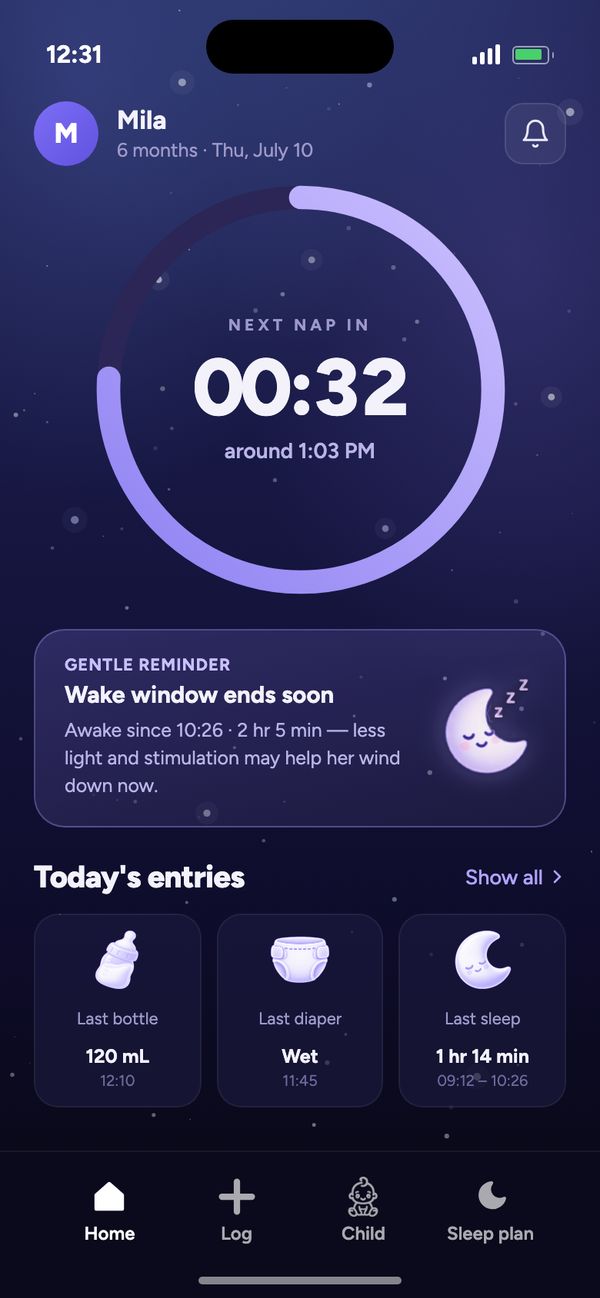
Calm nights start here.
Download Moonsleep and find the rhythm that fits your baby.


Why your baby often wakes at night
One sleep cycle — one stretch of active sleep and one stretch of quiet sleep — lasts about 50 to 60 minutes in young babies. A newborn usually starts with active sleep and slides into quiet sleep after about 20 minutes. At the end of a cycle, babies often become almost awake, stretch, or make a sound. Often they drift into the next cycle on their own; sometimes they call out. That also explains short naps: often your baby made it through about one cycle but not the transition into the next.
In the first weeks, your baby doesn’t know day from night yet and sleeps in chunks of about 30 minutes to 3 hours around the clock. A clearer day-night rhythm usually develops between about 8 and 12 weeks. Helpful: daylight and normal everyday noise during the day, dim light, a quiet voice, and no play at night.
Brief waking between two sleep phases is normal, pediatricians emphasize — not a sign of illness.
What kind of twitch is it?
- Sleep twitch
- do nothing
- Series of twitches
- film for doctor
- Infantile spasms
- doctor today
- Seizure
- call 911 now
Why does my baby twitch?
Researchers suspect that each twitch in active sleep tells the brain which muscle just moved — possibly helping build an inner map of the body, little by little.
Sleep twitches. Single twitches of the arms, hands, or legs that last only seconds are part of sleep at any age — especially if they happen irregularly and your baby wakes normally afterward and feeds well.
Moro reflex: why your baby startles in sleep. A loud noise or the feeling of tipping backward — and your baby suddenly flings arms and legs out, opens their hands, then pulls the arms back in again, often with a brief cry. Typical features: there’s a trigger, the reflex happens once, and then it’s over. It’s strongest in the first month, weakens from about the second month, and usually disappears between the third and sixth month.
Benign sleep myoclonus. Some healthy newborns have series of rhythmic twitches in sleep, often in the arms or legs. They begin in the first days to weeks of life, happen only in sleep, and stop as soon as your baby is truly awake. Holding the limb still doesn’t reliably stop them, and can sometimes even make them stronger — so that’s not a test; rocking can trigger them. Because they can look like a seizure, a doctor should see a video within the next few days. If benign sleep myoclonus is confirmed, you can breathe easier: it doesn’t cause any lasting problems, but in about one-third of babies it continues beyond the third month. If these series only start after the first month of life, call your pediatrician’s office the same day.
Harmless or not? Film first, then wake — in that order
If your baby isn’t breathing, is blue or gray, or isn’t responding: call 911 immediately, don’t film. If you’re alone, always call first.
Otherwise, turn on the light, briefly open the sleep sack, and film your baby’s whole body — face with eyes, arms, and legs, ideally from beginning to end.
Speak to your baby, stroke the sole of the foot, pick them up — and keep filming.
If the twitching stops and your baby looks at you the way they normally do: note the time and length, and show the video at your pediatrician’s office in the next few days.
If the twitching continues and your baby doesn’t respond to you: call 911. Brief flexor spasms in series, with your baby responsive in between: get medical help today (see infantile spasms).
Shaking while crying. If the chin, arms, or legs shake while your baby is crying, that’s normal in newborns. It stops when your baby sucks or when you gently hold the arm or leg, and usually settles by about 2 months. If your 10-week-old still only has a trembling chin when crying, bring it up at the 4-month checkup. If your baby shakes even when calm, or it’s getting stronger, have it checked in the next few days.
The twitching that keeps you awake is probably a brain learning its own body.
Baby grunts and sounds rattly
Such a tiny person can sleep surprisingly loudly. Most of the noises have a simple explanation:
Snorting, snuffling, or whistling through the nose: A baby’s nose is tiny, so even a little dried mucus can be heard.
Rattling and gurgling in the throat: usually saliva or a little milk that came back up.
Grunting and straining: Often the intestines are working — more on that below under “Baby grunting and straining.”
Sighs, gasps, panting: A deep breath or a short burst of faster breathing right after a little pause is part of periodic breathing.
Squeaks, whimpers, groans, hiccups: also normal in active sleep.
Two sounds are different. A high-pitched squeak or whistle with every breath in, even with a clear nose, is called stridor and often gets louder with feeding, crying, and lying on the back. The most common cause is a still-soft voice box (laryngomalacia), which usually improves during the first year and is typically outgrown by about 18 to 24 months at the latest. Your pediatrician’s office should still check it within the next few days, or the same day if there are feeding problems, poor weight gain, or breathing pauses.
The second is grunting or groaning with every breath. Gut-related grunting comes in episodes while your baby strains; in between, your baby breathes calmly, often followed by gas or stool. Respiratory grunting keeps going and comes with fast breathing, flared nostrils, or retractions: with each breath in, the skin between the ribs, under the rib cage, or above the breastbone gets sucked inward. That is not a sleep noise — call 911.
Stuffy nose — how to help: Before feeding, put one or two saline nose drops (available over the counter) into each nostril, then suction loosened mucus with a clean nasal aspirator only right at the entrance of the nose. Use decongestant drops only briefly, in an infant dose, and after checking with your pediatrician’s office or pharmacy. Avoid balms or oils with menthol, camphor, or eucalyptus — in babies, even small amounts can trigger a life-threatening spasm of the voice box with breathing distress — and don’t raise the head of the mattress or use a wedge pillow. If your baby is hardly feeding because of the blocked nose, have them seen by a doctor.
Worried about choking? Gurgling is not a reason to use the side-lying position: healthy babies do not choke in the back-sleeping position, because their gag reflex and airway anatomy protect them. If milk runs out of the mouth or nose, briefly turn the head to the side and wipe it away; if your baby keeps coughing or gagging, pick them up until they’re breathing freely.
Snoring can happen, for example with a stuffy nose. If your baby snores almost every night, mention it to your pediatrician’s office in the next few days; with breathing pauses, gasping, or poorer feeding, do it the same day.
Baby grunting and straining
Some babies grunt, push, and turn red in the face, sometimes for minutes, until a soft stool or a fart finally comes. Professionals call this infant dyschezia; in everyday language, parents often talk about “grunting baby syndrome.” It is not constipation: your baby first has to learn how to push with the belly while relaxing the sphincter at the same time. Typical in babies under 9 months are at least about 10 minutes of straining and crying before soft stool comes — or sometimes none at all. Over time, the coordination gets better on its own.
What helps: patience. Hold your baby if they cry, and give them time. You don’t have to “fix” anything.
What doesn’t help: stimulating the bottom with a thermometer or cotton swab, or using suppositories or laxatives on your own. That takes the practice away from your baby, and the grunting can last longer because of it.
This is no longer just a grunting baby: If the stool is hard, there’s blood in it, your baby is vomiting, feeding poorly, or not gaining weight, call your pediatrician’s office the same day.
What helps most with grunting is patience — and your arms when your baby cries.
Pauses in breathing during sleep
Brief breathing pauses are part of active sleep. This is what the normal pattern looks like: breathing stops for 5 to 10 seconds. Then your baby breathes faster for 10 to 15 seconds, about 50 to 60 breaths per minute, and then settles back into their usual rhythm. The color of the lips and face stays the same. Professionals call this periodic breathing; most babies outgrow it by about 6 months.
How to watch a pause
Light: Turn on a dim night-light or aim your phone flashlight at the ceiling — in the dark, you can’t judge color.
Look: Watch the belly; in babies it rises and falls more clearly than the chest. Rest a hand lightly on it and you’ll feel the breathing too.
Count: At night, guessed seconds are almost always too long. Count slowly “one-one-thousand, two-one-thousand …” or use the stopwatch on your phone.
At 10 seconds: Speak to your baby and rub their back or the soles of their feet. Never shake your baby.
If breathing doesn’t restart right away, or your baby is limp or changing color: call 911 and put your phone on speaker. The 911 dispatcher will tell you what to do.
Afterward: note the time, duration, color, and how the breathing started again.
The traffic light guide: up to 10 seconds with pink color is normal; over 10 seconds should be medically assessed that same night; over 20 seconds or any color change means call 911 immediately. Special situations — for example, if your baby only started breathing again after you touched them — are covered in the section “Is it an emergency?” below.
Counting breaths. In quiet sleep, count for a full minute how often the belly rises — not 15 seconds times four, because breathing is irregular, and not right after a pause. In young babies, normal is about 40 to 60 breaths when awake and more like 30 to 40 in sleep. Repeatedly over 60 at rest: have your baby seen today; with retractions, flared nostrils, or grunting: call 911.
Which color matters? Lips, tongue, and face. Cool, slightly bluish hands and feet are common in young babies and turn pink again when warmed up — by themselves, that is not an emergency. With darker skin, look at the lips, tongue, gums, and the inside of the eyelids.
Preterm babies have more frequent and longer breathing pauses; for them, follow the plan you made with the hospital or pediatrician’s office. For preemies, calculate all age information by corrected age until about the second birthday.
Babies breathe irregularly in their sleep — brief pauses are part of active sleep.
Is it an emergency?
You know your baby best: if something seems different to you, get medical advice — better once too often than once too late. Each warning sign here appears at exactly one level, and each one alone is enough.
Level 1 — call 911 immediately if your baby …
is not breathing for longer than 20 seconds, or after a pause does not seem like themselves again,
has blue, gray, or very pale lips, tongue, or facial skin,
is struggling for every breath: retractions, flared nostrils, grunting with every breath,
cannot be woken, seems limp, or suddenly becomes stiff,
is twitching rhythmically and does not respond to you, even when you try to wake them,
suddenly starts having breathing pauses with a cold or cough.
Level 2 — today, even at night: call your pediatrician’s after-hours line, go to the ER at a children’s hospital, or during office hours contact your pediatrician right away, if …
a breathing pause lasted longer than 10 seconds, even if everything seems normal afterward,
your baby only started breathing again after your touch, or during the pause was pale, bluish, limp, or briefly unresponsive, but now seems back to normal — then go straight to the ER at a children’s hospital; if you can’t get there safely, call 911,
your baby is younger than 3 months and has 100.4 °F (38.0 °C) or higher, measured rectally,
your baby is feeding clearly worse, skips several feeds, or can hardly be woken to feed,
your baby repeatedly breathes faster than 60 times per minute at rest,
you see series of brief bending or stretching spasms, like infantile spasms (below).
Level 3 — call your pediatrician’s office in the next few days if …
rhythmic series of twitches happen only in sleep and stop as soon as your baby is awake (bring a video),
the startle reflex or movements look different on one side of the body than the other,
your baby trembles even when calm, or the trembling is getting stronger,
you hear a high-pitched noise when your baby breathes in, without poor feeding or breathing distress,
your baby snores almost every night, without breathing pauses.
Level 4 — bring it up at the next checkup (at 4 months, then at 6 months): mild chin trembling when crying after the second month, a startle reflex that is still clearly present after the sixth month, or sleeping with the eyes half open. But you can always call sooner, even “just” because of twitching.
What happens when you call your pediatrician’s after-hours line? In the US, most pediatricians’ offices have one, often answered by a nurse or the on-call doctor, and many health plans also offer a 24/7 nurse line. They’ll ask what’s happening and suggest the best next step: advice, urgent care, or the ER. Have your baby’s age in weeks, what happened, how long it lasted, and your video ready. That is exactly what these lines are for, even at 3 a.m. and “just 12 seconds.” For babies under 3 months with breathing pauses or signs of illness, going straight to the ER at a children’s hospital is often faster.
Infantile spasms: rare, but important. They are sometimes called lightning, nodding, or Salaam spasms because the head and arms bend forward as if in a bow. This form of epilepsy affects about 1 in 2,000 children and usually begins between the second and twelfth month of life, most often at 4 to 8 months.
What it looks like: The body suddenly stiffens, the back arches, or the head, arms, and legs jerk forward; sometimes only the eyes roll upward or the belly briefly tightens.
When: Each spasm lasts seconds, but they come in series every 5 to 10 seconds, usually shortly after waking.
Unlike the startle reflex, they happen without a trigger and repeat one after another. A single eye roll while falling asleep, on the other hand, is part of active sleep.
Also watch for less smiling, less eye contact, or losing skills your baby had already learned.
What to do: get medical help the same day, with a video if possible — outside office hours, go straight to the ER at a children’s hospital, because an EEG is needed. The earlier treatment starts, the better the outlook.
If you call 911
Put your phone on speaker and stay with your baby. The 911 dispatcher will stay on the line and tell you step by step what to do — even if you need to give rescue breaths or CPR. You are not alone.
Give your address, including your apartment number if you have one.
Turn on the lights and unlock the door if you can do that without leaving your baby alone.
If there’s time: have your health insurance card and your baby’s health records ready.
During a seizure: Put your baby on a safe, flat surface — the floor or the middle of a large bed, not the changing table — and turn them onto their side so saliva can drain. Don’t hold them down, don’t put anything in their mouth, and note the time. Stay with your baby and don’t give anything to drink until they’re fully awake again. This side position applies only while you are right there — for sleep, your baby always belongs on their back.
During the day, with no pressure, an infant first-aid and CPR class—many hospitals and community centers offer them—can show you the hands-on steps so you won’t be hearing them for the first time in an emergency.
Should I pick my baby up right away?
First, this: going to your baby right away is never wrong. In the first months of life, you cannot spoil your baby with comfort and closeness, and it’s best to respond to crying as soon as you can. The short pause described here is an option for moments when your baby grunts, whimpers, or twitches with their eyes closed — it is not letting your baby cry it out. That’s because in active sleep, picking your baby up often wakes them fully. The pause lasts from a few seconds to a minute or two:
Listen. Is it a grunt, a sigh, a brief whimper — or is real crying building?
Look. Eyes closed, lids twitching, mouth working? Then your baby is very likely in active sleep.
Give them a chance to keep sleeping. Often they go quiet again after a few breaths.
Go to them as soon as the crying gets louder, the eyes open, or you see hunger cues.
Don’t wait out hunger. The advice from German pediatricians not to react immediately to every waking at night comes from parent information about sleep problems; it does not mean waiting when your baby is hungry. In the first weeks especially, hunger comes first. It usually shows before crying: your baby gets restless, sucks on a fist, makes murmuring sounds, and turns the head searching. If the last feed was a while ago, go to them right then — a crying baby has a harder time feeding. If you’re breastfeeding, nurse if in doubt; feeding on demand is encouraged day and night, and evening cluster feeding is normal. Count intervals from the start of one feed to the start of the next. If you’re bottle-feeding, look for hunger cues first instead of answering every whimper with milk.
How often do babies feed? In the first weeks, breastfed babies feed at least 8 times in 24 hours, often more; bottle-fed babies a little less often — both also at night. From day 5 onward, at least six heavy, wet diapers in 24 hours show that enough milk is getting in. Until your baby is back to birth weight, they should not go longer than about 4 hours at night without a feed; after that, if they are thriving, they may sleep for longer stretches.
Waking a sleepy newborn works easiest in active sleep, when the lids and mouth are already moving: undress down to the bodysuit, change the diaper, talk to your baby, and do skin-to-skin. If your baby still can hardly be roused to feed, looks yellowish, or has clearly fewer wet diapers from day 5 onward: see your pediatrician the same day.
At 2 to 3 months (about weeks 9 to 13) most babies sleep about 14 to 17 hours total per day. Breastfed babies often feed 5 to 9 times in 24 hours, bottle-fed babies about 5 to 7 times. In the first five months, the longest stretch at a time averages just under 6 hours, though some babies are well below that. The startle reflex, periodic breathing, and twitching in active sleep are all still normal.
Going to your baby right away is never wrong. Pausing briefly to listen is an option — not letting your baby cry it out.
Baby wakes up when you put them down
You gently put your sleeping baby down — and the arms fly out. The feeling of tipping backward triggers the startle reflex, and in the first minutes your baby is still in light, active sleep. In newborns, quiet sleep often doesn’t start until about 20 minutes later. From about 12 weeks, many babies fall asleep straight into quiet sleep, and putting them down gets easier.
Signs of deep sleep you can spot even in the dark: Breathing is steady, the hands are loosely open, and the mouth has stopped working. As a rule of thumb, not a medical test: lift one arm a little. If it drops back loosely and heavily, your baby is usually sleeping deeply enough.
How to put your baby down
Put the sleep sack on before feeding.
After breastfeeding, break the latch by sliding your pinky gently into the corner of the mouth. If bottle-feeding, burp your baby first.
Lay your baby down slowly and close to your body: bottom and back first, head last. Only slide your hand out from under the head once the bottom and back are resting on the mattress.
Leave your hand still on the belly or chest for a moment, then remove it slowly.
If your baby wakes anyway, they may simply not have been ready yet. Pick them up again, let them fall asleep peacefully, and try once more. That’s not failure — it’s everyday life with a baby.
Safety comes first. If your baby falls asleep in an infant car seat or bouncer, move them to a flat surface on their back as soon as possible — even if they wake up.
What about swaddling? In Germany, public health authorities advise against tight swaddling for sleep; a correctly sized sleep sack is the safe option. If you already use a swaddle sack, use it only with your baby lying on their back, with the hips and legs loose, room for two to three fingers at the chest, not too warm, and nothing weighted. As soon as your baby tries to roll — often around the second month — switch to a sleep sack with the arms free.
Other reasons your baby seems restless
If your baby is wriggling, kicking, and opening their eyes again and again, a quick check is worth it:
Hunger: rooting, sucking on a fist? Then nurse or offer the bottle.
Too warm: Feel the neck. If it’s sweaty, remove a layer or use a lighter sleep sack. Cool hands alone do not mean your baby is cold.
Dirty diaper: Do a quick check and change in dim light, without much interaction.
Stuffy nose: snuffly breathing and poor feeding? Use saline drops as described above.
Straining with a red face: Often this is the “grunting baby” phase.
Overstimulated in the evening: lots of visitors, a loud day? Then a calm, darkened room and body contact help.
Ill: If your baby feels hot, is feeding worse, or seems listless, take the temperature rectally — the most accurate method for babies — and insert the thermometer only 0.4 to at most 0.8 inches (1–2 cm). At 100.4 °F (38.0 °C) or higher in a baby under 3 months: get medical help today.
Is it a developmental leap? Many parents explain restless nights with fixed-week developmental “leaps.” Those calendars go back to a very small observational study of 15 mother-baby pairs; there is no proof they apply to all babies. More helpful than a schedule is looking at your own baby: what changed, are they feeding well, do they seem healthy?
A close look at your own baby helps more than any leap calendar.
Sleep at 3 to 4 months
At 3 to 4 months — around 13 to 17 weeks — sleep starts to look more grown-up. By about 3 months, your baby gradually moves through the same sleep stages adults do, and many babies start linking sleep cycles together. From about 3 months on, your baby also twitches in quiet sleep — a sign that their brain is still wiring itself up, not a reason to worry.
Some parents experience this transition as suddenly more restless nights, often called the “4-month sleep regression.” But studies do not find a general sleep crash at this age; on average, sleep stretches actually get longer between the first and fourth month. If things feel bumpy at your house, it’s usually maturation, not going backward.
Calm nights start here.
Download Moonsleep and find the rhythm that fits your baby.
And how are you doing?
A baby who sleeps this noisily in the crib next to you — grunting and twitching — is alive and growing, and can still keep you from sleeping. A few things can help:
If you’re alone at night: place the crib so you can see into it from your pillow, and keep a dim night-light within reach — that way you can check breathing and lip color while lying down. During the day, get some sleep whenever your baby naps, and if possible, have someone come over for a few hours.
Split the nights if there are two of you: whoever is on duty brings the baby over for breastfeeding, changes the diaper, burps them, and puts them back down in their crib; the other person truly sleeps. If you’re breastfeeding, don’t replace a night feed with a bottle in the first weeks without pumping too — otherwise milk supply can drop.
Write it down and film it instead of spiraling: the time, duration, and what you saw, on paper or in a note in Moonsleep, plus a video. That gives your pediatrician’s office much more to work with than a 3 a.m. memory.
Who you can ask: during the day your pediatrician’s office, even for small questions; at night and on weekends their after-hours line; in an emergency, 911 or the ER at a children’s hospital; for feeding questions, a lactation consultant (your health plan may cover it).
For yourself: if nights become too much, call or text 988 any time. In the US, you can also call or text the National Parent & Youth Helpline at 1-855-427-2736, day or night.
At your limit: lay your baby safely on their back in their crib, leave the room for a moment, take a breath, call someone. Never shake your baby — just a few seconds can cause severe brain injury.
If the fear doesn’t go away and you feel you have to keep checking a healthy baby’s breathing, talk to your OB-GYN, family doctor, or pediatrician’s office. Anxiety and depression after birth are treatable.
And if you’re lying awake at night listening to your baby, remember this: the twitching and grunting have a purpose. Your baby is growing, learning, and organizing themselves, even in sleep. You don’t have to step in every minute. It’s enough that you’re there when your baby truly needs you.
Frequently asked questions
Why does my baby twitch in sleep?
Most often because your baby is in active sleep, a baby’s version of REM sleep. In newborns, it makes up about half of total sleep time, and brief, irregular twitches of the arms, legs, or face are part of it. Researchers suspect they help the brain learn the body. You do not need to interrupt them. Film rhythmic series of twitches and show the video at your pediatrician’s office in the next few days. If your baby is twitching and does not respond to you, call 911.
Is it normal for my baby to grunt and rattle in sleep?
Yes, in the vast majority of cases. The nose is tiny, saliva collects in the throat, and many babies grunt when their intestines are working. A warning sign is grunting or groaning with every single breath, together with fast breathing, flared nostrils, or skin pulling in between the ribs when breathing in. That is breathing distress, and you should call 911. A high-pitched squeak with every breath in should be checked by your pediatrician’s office in the next few days.
Is twitching in sleep a sign of epilepsy?
Usually not. Harmless sleep twitches happen only in sleep and stop as soon as your baby is truly awake. During a seizure, waking or holding does not stop it, and your baby is unresponsive, staring, or changing color — then call 911 immediately. Series of brief flexor spasms shortly after waking can point to infantile spasms, a rare form of epilepsy in babies. In that case, get medical help the same day, ideally with a video.
Can my baby choke on spit-up or milk while sleeping on their back?
No. Healthy babies do not choke in the back-sleeping position; their gag reflex and airway anatomy protect them. That is why your baby should sleep on their back even with spit-up and gurgling — not on the side and not on an incline or wedge pillow. If milk runs out of the mouth or nose, briefly turn the head to the side and wipe it away. If your pediatrician has found an airway difference in your baby, ask them what applies to your child.
How long does my baby have the startle reflex?
The Moro reflex is strongest in the first month of life, gets weaker from about the second month, and usually disappears between the third and sixth month. If it looks different on the two sides of the body, call your pediatrician’s office in the next few days. If it is still clearly easy to trigger after the sixth month, bring it up at the 6-month checkup. For preemies, go by corrected age.
Does swaddling or a swaddle sack help with startling awake?
In Germany, public health authorities advise against tightly wrapping babies for sleep; a correctly sized sleep sack is safer. To reduce startling, it often helps simply to wait for deep sleep and lay your baby down slowly, with the head last. If you do swaddle anyway: only with your baby lying on their back, with hips and legs loose, not too warm — and stop right away as soon as your baby tries to roll.
Do I need a sensor mat or breathing monitor for my baby’s crib?
Not for a healthy baby. There is no evidence that over-the-counter sensor mats, movement monitors, or smart socks lower the risk of sudden infant death, and they can create a false sense of security. What helps are the safe sleep rules in the box above. If your baby needs monitoring for medical reasons, for example because they were born preterm, the hospital or your pediatrician’s office will decide that.
My baby sleeps much more calmly on their stomach. Can I put them down that way?
No. For sleep, your baby always belongs on their back, including for naps. In the back-sleeping position, the risk of sudden infant death is much lower, and the side position is not safe either because babies can easily roll from there onto the stomach. When awake and with your supervision, your baby can spend short periods on their stomach several times a day, for example on your chest. Once they can confidently roll both ways on their own later on, you do not need to turn them back at night.
Watch for this
Call 911 immediately: pause over 20 seconds, blue, gray, or very pale lips, tongue, or facial skin, breathing distress, new breathing pauses with a cold or cough, a baby who cannot be woken, seems limp or stiff, or a seizure.
Today: breathing pause over 10 seconds, fever of 100.4 °F (38.0 °C) or higher under 3 months, clearly worse feeding, series of brief flexor spasms after waking — through your pediatrician’s after-hours line, the ER at a children’s hospital, or your pediatrician during office hours.
All levels are listed in the section “Is it an emergency?” above. This article does not replace a medical examination. If something seems unusual to you, trust your instincts and ask.
Moonsleep offers guidance, not medical advice. It is based on clinical guidelines and expert sources, checked against the Moonsleep reference database.