


Your baby falls asleep while feeding, in your arms, in the bassinet—and sometimes you only realize hours later that they never really asked to eat. Somewhere between relief and quiet worry, the question comes up: is this much sleep still normal? Most of the time, yes. What matters less is how long your baby sleeps and more whether they’re getting enough milk in between—and that’s something you can check yourself at home with a few clear signs.
At a glance
- Sleep 0–4 weeks
- 14–18 hrs
- Feeds
- 8–12 a day
- Longest stretch
- up to ~4 hrs
- Wet from day 5
- at least 6 a day
A lot of sleep is normal
Newborns usually sleep 14–18 hours a day in the first four weeks of life, and 14–17 hours in the second month. That’s more than half the day, and for some babies it’s closer to three-quarters. There isn’t a fixed number of hours at which sleep becomes “too much.” The ranges are so wide because babies are different: some sleep a lot, some sleep less, and both can be completely healthy. Hunger does set a natural limit, though: in the first few weeks, eight or more feeds a day take time, and a baby who sleeps almost around the clock will hardly manage that.
This sleep doesn’t come in one long stretch. Newborns sleep in chunks of about 30 minutes to 3 hours, spread across the whole day and night, and wake every few hours to feed. They don’t yet know the difference between day and night. A clear sleep-wake rhythm usually starts to develop only after the second month. Until then, your baby’s sleep is mostly set by one rhythm: the next wave of hunger.
On top of that, wake windows are very short at first. In the first days, a baby can usually only manage about 35 to 75 minutes at a time; by about 8 weeks, it’s usually 60 to 90 minutes. A lot has to fit into that short time.
An everyday example: Your baby is 2 weeks old and wakes up to feed. Breastfeeding takes half an hour, then you change the diaper, they burp, and you put on a fresh onesie. After 45 minutes, they’re yawning again. In all that time, they may only have been truly awake and alert for 10 minutes. That’s how the whole day goes, and by evening you feel like your baby did nothing but sleep. At this age, that can be completely normal.
The sleep itself is often lively too. Newborns spend about half their sleep time in light, active sleep: their eyes move under their lids, hands and feet twitch, their mouth works, and their breathing speeds up now and then. That’s useful for you to know, because this is the phase when your baby is easiest to wake. More on that below.
Some babies sleep a lot, some sleep less—and both can be perfectly healthy.
Five questions matter more than hours
Whether your baby is sleeping too much isn’t something the clock can tell you. A baby who sleeps 18 hours, feeds well, has wet diapers, and gains weight is simply a big sleeper. A baby who sleeps only 15 hours but barely feeds needs your attention. These five questions help you tell the difference:
Are they getting enough feeds? Day 1 is a special case: after that first feeding, many babies sleep deeply for a few hours and feed less often overall that day, often only five or six times. From day 2 on, most babies feed at least eight times in 24 hours, often 10–12 times. Breastfed babies usually feed every 1.5–3 hours in the first month; bottle-fed babies usually every 2–4 hours. In the second month, many babies have a few fewer feeds, often six to nine a day, but many breastfed babies still feed eight times or more. Fewer feeds than before are only okay as long as diapers and weight gain are on track.
Are they really feeding—or just sucking? With breastfeeding, you can tell real feeding by the rhythm: after a few quick sucks at the start, the sucking becomes slow and steady. The mouth opens wide, pauses briefly, closes again, and you can hear or see a swallow. At the end, your baby usually comes off on their own, their fists open up, and they look relaxed. With a bottle, you can see the milk level going down.
Are the diapers wet enough? Wet and dirty diapers are the most reliable sign you can check yourself at home. How many to expect on which day is in the next section.
Are they gaining weight? In the first few days, almost all babies lose some weight; up to about 7% is typical, with the lowest point usually between day 2 and day 4. After a cesarean birth, babies often lose a little more and take a little longer to start gaining again. If your baby has lost more than about 7%, have a feeding observed at the pediatrician’s office or by a lactation consultant: Is the latch good, and is enough milk getting in? At about 10%, have a doctor assess whether supplementation is needed—don’t just wait it out at 8% or 9%. Most babies regain their birth weight within 10–14 days. If your baby is still losing weight after day 5, or hasn’t regained birth weight by about 2 weeks, have that checked by a doctor. Your baby is weighed at every checkup, including the 3-to-5-day checkup and the 1-month checkup.
What are they like when they’re awake? A healthy newborn may have short wake windows, but during them they’re truly awake. They open their eyes, look at you, respond to your voice, kick strongly, and protest loudly when they don’t like something. They have body tone and their usual skin color.
If you can answer yes to all five questions, your baby can sleep as much as they want. With one exception in the first weeks, which comes next.
The hours your baby spends asleep matter less than the minutes they’re awake and feeding.
What diapers can tell you
You can’t see how much your baby drinks at the breast. But diapers can still tell you whether enough milk is getting in. As a guide for wet diapers in 24 hours:
Day 1: 1–2 wet diapers
Day 2: 2–3
Day 3: 3–4
Day 4: 4–5
From about day 5: at least 6 heavy wet diapers, often 6–8
What “heavy” means can be surprisingly hard to feel with modern diapers that absorb moisture so well. A simple comparison helps: pour 2 to 4 tablespoons of water (1–2 fl oz, about 30–60 mL) into a fresh diaper and lift it up. That’s about how a properly wet diaper should feel from day 5 on.
Urine should be light, almost colorless to pale yellow. In the first days of life, you may see reddish-orange stains in the diaper, sometimes called “brick dust.” These are crystals from very concentrated urine, and as long as the number of wet diapers is right, they’re normal in those first few days. If you still see brick dust after day 4 or 5, or the urine is dark yellow, your baby probably needs more milk. If your baby is otherwise alert and has enough wet diapers, offer the breast or bottle more often and mention it to your pediatrician’s office that same day. If your baby also has few wet diapers, seems sleepy, or is feeding weakly, get medical help right away.
Stool tells you a lot too. In the first 1–2 days, babies pass black-green, sticky meconium. Around day 3 or 4, the stool becomes greenish-brown and softer, and by about day 5 it turns mustard yellow. From about day 4 and through the first roughly 6 weeks, breastfed babies have at least two, usually three or more, soft yellow stools a day, each about the size of a quarter or larger. Bottle-fed babies poop less often, usually 1–4 times a day. If the stool stays dark beyond day 5, that’s a sign not enough milk is getting in: offer the breast or bottle more often and have your baby weighed at your pediatrician’s office that same day. From about 6 weeks on, breastfed babies often stool less often, sometimes only every few days. As long as your baby is feeding well, has enough wet diapers, is gaining weight, and the stool is soft, that’s normal.
Important: If the stool is pale, gray, whitish, or clay-colored, call your pediatrician’s office right away. Pale stool can point to a bile duct problem that needs early treatment.
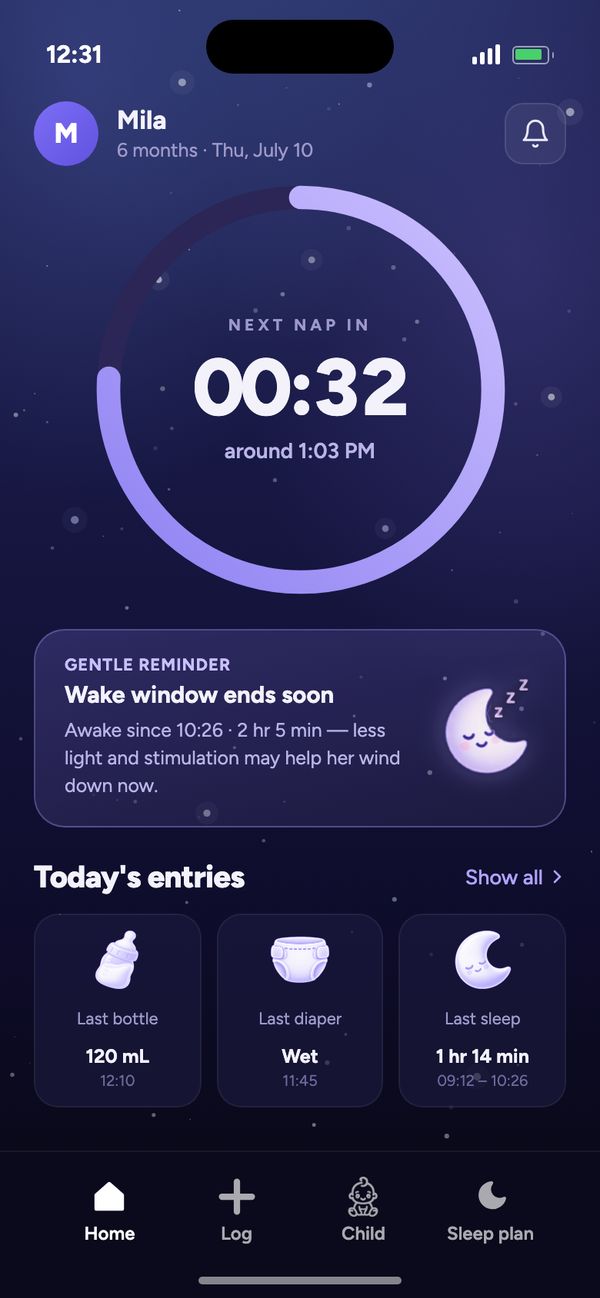
At 3 a.m., hardly anyone keeps a reliable tally. Keep a note by the changing table or log feeds and diapers with a tap in an app like Moonsleep. That way, you don’t have to struggle to remember in the morning—you can just look.
Calm nights start here.
Download Moonsleep and find the rhythm that fits your baby.


Wake your baby or let them sleep?
In the first days and weeks, there’s one important exception to “let a sleeping baby sleep”: as long as your baby hasn’t regained birth weight and isn’t clearly gaining well, no more than about 4 hours should pass between feeds, day or night. If your baby hasn’t woken by then, gently wake them and offer the breast or bottle. This applies to breastfed and bottle-fed babies alike. Important: the 4 hours is the upper limit for a single longer stretch, perhaps once at night—not the usual interval. To reach at least eight feeds, your baby will usually need to feed about every 3 hours on average, and breastfed babies often every 2–3 hours.
The gap is usually measured from the start of one feed to the start of the next. If your baby started feeding at 10 p.m., the next feed should begin by about 2 a.m. at the latest.
Why this limit matters so much: in the first weeks, milk production is still getting established, and it responds to how often milk is removed. And a baby who isn’t getting enough often doesn’t get louder—they get quieter: they conserve energy, sleep more, and ask even less often. That’s how an “easy” baby can quietly become a baby who isn’t feeding enough.
Babies are especially sleepy after a difficult birth, if you had pain medication during labor, with jaundice, or if they were born early. And sleepy babies often don’t cry for milk. So watch for the quiet hunger cues, even in light sleep: licking lips, rooting with the mouth, hands to mouth. Crying is a late hunger cue. If your baby sleeps close to you, it’s easier to catch these signals.
When you no longer need to wake your baby at night: Once your baby has regained birth weight and is gaining well, you can let them sleep at night, even if they occasionally go longer. For many babies, that’s the case after about 2 weeks. You’ll only know for sure once your baby has been weighed sometime around day 10–14. The 3-to-5-day checkup often happens before then, so ask your pediatrician’s office for a weight check if the 1-month checkup is still a while away. If a nurse visits you at home after the birth, they can weigh your baby there too.
Even after that, keep an eye on the total number over 24 hours. What matters is that your baby is still feeding enough overall. If there are clearly fewer feeds and wet diapers than before, bring it up with your pediatrician’s office.
Sleepy babies often don’t cry for milk. They show their hunger quietly.
Jaundice and sleepiness
Many newborns look a little yellow in the first few days. Their liver needs a few days before it can reliably break down bilirubin, the yellow pigment. The yellow color usually shows up between day 2 and day 4, most often peaks between day 3 and day 5, often later in preterm babies, and is usually gone after about 2 weeks. By then, many families are already home, so check your baby’s skin every day in daylight during this time. In breastfed babies, a slight yellow tinge sometimes lasts longer. In the vast majority of cases, this is harmless. But there’s one important thing to know: jaundice can make babies sleepy and less interested in feeding.
That can turn into a cycle. If your baby feeds little, the jaundice is more likely to get stronger, and a more yellow baby gets even sleepier. So with jaundice, one thing matters above all: frequent feeding, 8 to 12 times in 24 hours. If your baby is too sleepy to ask on their own, wake them: to get to at least eight feeds, that usually means about every 3 hours, counted from the start of the last feed. If the hospital or your pediatrician’s office gave you a different schedule, follow that.
How to check the skin color: Look at your baby in daylight, not under warm lamplight. Press briefly and gently with one finger on the forehead or nose, then let go. If the spot looks yellowish for a moment instead of simply lighter, that suggests jaundice. Also look at the whites of the eyes and inside the mouth, such as under the tongue or inside the cheeks. Especially in babies with darker skin, yellowing is often easier to spot there than on the skin. The yellow color usually starts in the face and, as levels rise, moves over the chest and belly to the arms and legs.
Take your baby straight to the ER at a children’s hospital if
they become yellow in the first 24 hours of life—if you’re still in the hospital, tell staff right away,
your yellow baby is sleepier than usual, hard to wake, or doesn’t want to feed.
If your baby is barely waking or won’t wake at all, or seems floppy, call 911 (or your local emergency number) right away.
Call your pediatrician’s office right away—after hours, use their after-hours line—if
the yellow color is getting stronger or has reached the belly, arms, or legs,
the stool becomes pale or whitish, or dark urine is staining the diaper.
If the yellow color lasts longer than 2 weeks—or longer than 3 weeks in a preterm baby—have it checked promptly, even if your baby seems well otherwise.
If your baby was born early
If your baby was born late preterm (34 weeks 0 days to 36 weeks 6 days) or early term (37 weeks 0 days to 38 weeks 6 days), they’re often sleepier than a baby born later. They stay awake for shorter stretches, tire faster during feeds, and may have more trouble latching, sucking, and swallowing. Some of these babies even look vigorous at the breast and still take in less milk than it seems.
The 4-hour limit matters especially for these babies: if your baby shows no hunger cues 4 hours after the start of the last feed, wake them by then at the latest. Usually, they’ll need to feed sooner, because the goal is 8–12 feeds in 24 hours. If more than one factor applies—for example, prematurity and jaundice—always follow the shorter interval. These babies also cool down quickly and become even sleepier as a result: keep your baby warm, ideally skin-to-skin, as long as you’re awake. Jaundice is also more common in babies born early or just before their due date. Preterm babies also have a higher risk of sudden infant death syndrome, so safe sleep rules are especially important for them.
If the hospital gave you a plan at discharge for how often and how much your baby should feed, follow it until your pediatrician tells you otherwise. For babies born before 34 weeks or cared for in the NICU, the hospital’s plan applies anyway. Late preterm babies and babies born just before their due date should usually be weighed again and observed during a feed 1–2 days after discharge, then regularly after that until they’re clearly gaining weight. And don’t be surprised if your preterm baby stays a big sleeper for longer. For sleep, corrected age counts until about the second birthday—that is, age from the estimated due date. A baby born 6 weeks early may sleep more like a 2-week-old at 8 weeks.
You’re not bothering your baby when you wake them. You’re helping them get what they can’t get for themselves yet.
How to wake your newborn gently
Getting a newborn out of deep sleep isn’t always easy. But with the right timing and a little patience, it usually works without startling your baby. You won’t need every step every time. Sometimes two or three are enough.
Catch light sleep. Your baby wakes most easily from active sleep. You can spot it by eye movements under the lids, twitching hands or feet, smacking sounds, and little noises. If your baby is lying there fully relaxed and breathing evenly, and time allows, wait a few minutes.
Dim the light instead of switching it on fully. In bright light, babies are more likely to squeeze their eyes shut. Soft light makes it easier for your baby to open them.
Unwrap them. Open the sleep sack, take off one layer, or undress your baby down to a bodysuit or diaper. The change on the skin gently wakes many babies. But only undress them briefly and warm them up again afterward: little babies lose heat quickly, and a chilled baby becomes even sleepier.
Change the diaper. A fresh diaper is a reliable wake-up call for many babies, and you get the diaper check done at the same time.
Skin-to-skin. Lay your baby, wearing only a diaper, on your bare chest. Sit semi-upright, never flat; turn your baby’s face to the side; keep nose and mouth clear and visible to you; and place a blanket over their back, not over their head. The closeness often gets babies searching for the breast on their own. While they’re there, gently stroke their back, arms, palms, and soles of the feet.
Hold them upright and talk to them. Hold your baby upright in front of you so they can look at you, and speak softly.
A drop of milk. Hand express a few drops of milk and put them on your baby’s lips, or let a drop from the bottle fall onto their lips. That often gets them smacking and opening their mouth.
Latch or offer the bottle when the mouth opens wide. Wait until your baby opens their mouth wide, then latch them or offer the bottle. Don’t push the nipple or bottle teat into a closed mouth.
To help your baby stay awake during the feed
Breast compression: Hold your breast with your free hand well back from the nipple, with your thumb on one side and your fingers on the other. If your baby is only sucking without swallowing, gently compress the breast and hold the pressure. This usually gets them swallowing again. When swallowing slows, release, move your hand to a different spot, and repeat. It should not hurt.
Switch sides: If sucking gets weak, break the seal with a clean finger at the corner of your baby’s mouth and latch them to the other breast. The fresh milk flow wakes many babies up again. You can switch back and forth more than once.
Rub the palm: Gentle rubbing in the palm often gets babies to open their mouth and suck again.
With a bottle: Hold your baby semi-upright in your arms for the feed, not lying flat. If your baby starts drifting off, the same tricks help: take off a layer, change the diaper, talk to them. Never prop the bottle so your baby keeps drinking alone, and never leave your baby in bed with a bottle: a sleepy baby can choke on the milk.
If your baby falls asleep again after a few minutes despite all this, you haven’t done anything wrong. Let them rest on your chest for a little while—as long as you stay awake—and then try again. But if your baby takes in almost nothing for two feeds in a row, even though you woke them and tried Plan B, or is feeding much less than usual overall, call your pediatrician’s office right away; after hours, call their after-hours line. If you can’t really wake your baby at all, call 911.
No matter how tired or desperate you feel at night: never shake your baby—not even briefly—to wake them. Even brief shaking can cause life-threatening brain injuries. If you feel you can’t cope, place your baby on their back in their bed, step out of the room for a moment, take a breath, and get support.
If your baby falls back asleep despite everything, you haven’t done anything wrong.
Plan B: too sleepy to feed
Some babies are so sleepy in the first few days that they barely get anything at the breast, even though you’ve tried everything. Then you need two things: your baby needs milk, and your breasts need the signal to keep making it. You can do both by expressing milk by hand. In the first days, that often works better than a pump.
Wash your hands and have a clean container ready, such as a small cup or a spoon.
To get started, gently stroke your breast a few times from the outside toward the nipple.
Place your thumb and index finger in a C-shape about 1 inch (a few centimeters) behind the nipple, just outside the darker areola.
Gently press together, release, and repeat in a calm rhythm. Don’t slide over the skin, and don’t press on the nipple itself. At first, only drops may come out—that’s normal.
When the flow slows, move your fingers to another spot around the breast and later switch to the other side.
Give the milk to your baby in small amounts with the spoon or little cup. Hold your baby upright in your arms, rest the rim gently on their lower lip, and tip it only enough for the milk to touch the lips. Your baby will lap and sip it at their own pace. Don’t pour it into the mouth, and only feed when your baby is awake and swallowing.
As long as your baby isn’t feeding well at the breast, it helps to remove milk 8 to 12 times in 24 hours, by hand or with a pump. But Plan B is a bridge, not a long-term solution. If you need it for more than one or two feeds, get support: from your pediatrician’s office or a lactation consultant (your health plan may cover it). If your baby is bottle-fed and is drinking clearly less than usual over several feeds, have that checked by a doctor too.
Calm nights start here.
Download Moonsleep and find the rhythm that fits your baby.
How to help your baby’s body clock
Many parents find the first weeks feel backward: the baby sleeps for hours in the daytime and is alert at night. That’s because the internal body clock is still immature, and it usually settles on its own. But you can help your baby learn the difference:
Daytime can be bright and lively. Let daylight into the room, even while your baby sleeps, and talk and sing when they’re awake. Conversations, clattering dishes, the vacuum in the next room: normal everyday sounds are fine during the day.
At night, keep everything quieter. A dim light is enough for feeding and diaper changes. Speak softly, save playtime for daytime, and lay your baby back down after the feed.
Only change the diaper at night if needed. Of course you’ll change a full diaper, but an extra diaper change only wakes your baby unnecessarily. Exception: if you need to wake your baby to feed, a diaper change is exactly the right wake-up tool.
Your baby doesn’t need a fixed schedule at this age. Feed on cue, day and night, with the 4-hour rule as a safety net in the first weeks. After the second month, most babies gradually develop some rhythm, which often doesn’t settle in until somewhere between the third and sixth month. Until then, irregular days are not a sign that you’re doing anything wrong.
Sleepy or sick?
A healthy newborn can sleep deeply. But you can wake them. If you undress them, change the diaper, or pick them up, they’ll grimace, stretch, protest, open their eyes at least briefly, or look for the breast. Then they’ll actively feed for a few minutes, even if they drift off again afterward. And if they cry, it’s a strong cry.
A sick baby looks different. Health professionals talk about reduced responsiveness or lethargy. These signs are typical:
They don’t really wake up despite being undressed, changed, and spoken to, or they fall right back asleep.
They feel floppy and have very little body tone.
They barely respond to your voice, your touch, or your face.
They don’t want to feed, or they feed only briefly or very weakly.
They only whimper weakly, or they cry in an unusually high-pitched way or without stopping.
Their skin looks pale, gray, or mottled, and their lips look bluish or gray.
They’re breathing fast and with effort, moaning or grunting with every breath, the nostrils flare, or the skin pulls in between the ribs.
By contrast, occasional grunts, sighs, and short pauses in breathing of 5 to 10 seconds without any color change are normal during sleep. If you want to check breathing, count for a full minute how often the belly rises, ideally while your baby is calm. Normal for newborns is about 40 to 60 breaths per minute, often only 30 to 40 during sleep.
Also watch for changes. If your baby was bright and alert yesterday and today is hard to wake, that change matters more than any number of hours.
If something seems off, take your baby’s temperature. For babies, a rectal temperature is the most accurate: put a little cream on the tip of a digital thermometer, lay your baby comfortably on their back, and gently insert only the tip, about 0.4 to no more than 0.8 inches (1–2 cm). If you feel resistance, don’t push farther. When it beeps, remove it slowly and clean it afterward. Don’t take the temperature right after a bath or when your baby has been bundled up heavily. Normal is about 97.7–99.5 °F (36.5–37.5 °C). In babies under 3 months, both a temperature of 100.4 °F (38.0 °C) or higher and a temperature below 97.7 °F (36.5 °C) are reasons to get medical help right away. A baby who is too cold can be just as sick as a baby with a fever: warm them immediately with skin-to-skin contact under a blanket while you call. Don’t give a baby under 3 months any fever medicine, including a suppository, unless a doctor has told you to.
And trust your instincts. You know your baby better than anyone else. If you feel something isn’t right, it’s better to call the office one time too many than one time too few. You’ll find the signs that need immediate medical help or an emergency call summarized again at the very end.
Frequently asked questions
My 3-week-old slept 5 hours straight at night: should I wake them?
That mainly depends on weight. If your baby has regained their birth weight and is gaining well, you can let them sleep at night. Five hours in a row is a gift then, not a warning sign. Over the next few days, make sure they’re still feeding enough over 24 hours and still having enough wet diapers. If you’re not sure whether they’ve regained their birth weight yet, or they’re only gaining slowly, it’s better to wake them after about 4 hours and have them weighed soon, for example at your pediatrician’s office.
How many hours of sleep is too much for a newborn?
There isn’t a fixed number. In the first 4 weeks, babies usually sleep 14 to 18 hours in 24 hours; in the second month, usually 14 to 17 hours, with some sleeping a little more or less. What matters is whether your baby is feeding enough, has enough wet diapers, is gaining weight, and seems alert during wake windows. Until they’ve regained their birth weight, wake them to feed after about 4 hours at the latest. If a baby who used to be alert suddenly becomes very sleepy and feeds poorly, call your pediatrician’s office right away. If they’re hard to wake, call 911 right away.
“Never wake a sleeping baby”—is that true?
Not entirely in the first weeks. As long as your baby hasn’t regained their birth weight yet, waking to feed is sometimes necessary—after about 4 hours at the latest. It won’t harm your baby. It works best from light, active sleep, which you can recognize by eye movements under the lids, twitching, and smacking sounds. Undressing, changing the diaper, skin-to-skin contact, and a few drops of milk on the lips can all help your baby wake up. Once your baby has regained their birth weight and is gaining well, the old saying becomes true again: at night, you can then let them sleep.
My baby falls asleep at the breast after just a few minutes. Did they get enough?
That’s hard to tell from a single feed. Some babies feed quickly and efficiently. If you clearly heard swallowing, your baby looks relaxed afterward, and they have enough full diapers, everything is usually fine. If they fall asleep before they’re really swallowing, breast compression, switching sides, and gently rubbing the palm can help. Look at the whole day: the number of feeds and diapers, and whether your baby is gaining weight. If your baby regularly drifts off after a few minutes and the diapers stay light, bring it up with your pediatrician’s office or a lactation consultant.
My baby sleeps almost all day after their first shots. Is that normal?
Sleepiness is one of the very common reactions after the first round of baby vaccines (in Germany, a 6-in-1 shot usually given from 8 weeks). Reactions like this usually happen within 1 to 3 days and generally pass quickly. During that time, it’s fine to offer the breast or bottle more often. Important: in a baby under 3 months, a fever of 100.4 °F (38.0 °C) or higher is a reason to get medical advice right away, even after a vaccination. If your baby is hard to wake or seems floppy, call 911 right away. If they no longer want to feed at all, get medical help immediately.
Do preterm babies sleep more than other babies?
Often, yes. Babies born early or just before their due date are often sleepier, tire faster during feeds, and cue less often. That’s why it’s especially important for them to feed 8–12 times in 24 hours and to be woken no later than 4 hours after the start of the last feed if they haven’t shown hunger cues. The 4 hours is the upper limit, not the usual gap. For sleep, preterm babies are judged by corrected age—age from the due date—until about their second birthday. If the hospital sent you home with a feeding plan, follow it until your pediatrician tells you otherwise.
Watch for these signs
Call 911 right away if your baby:
can’t be woken, is barely waking, or drifts straight back off even though you undress them, change the diaper, and talk to them,
seems floppy or barely responds to you,
has pauses in breathing longer than 20 seconds, or a shorter pause during which they turn blue, gray, or pale or go limp; grunts with every breath; breathes so hard that the skin between the ribs pulls in; or keeps breathing faster than 60 breaths per minute while resting,
has bluish or gray lips, or gray, pale, or mottled skin,
cries in a high-pitched or unusually weak way, very different from usual,
has a seizure,
has red or purple spots that do not fade when you press a glass against them.
Get medical help right away—from your pediatrician’s office, after hours through their after-hours line, or at the ER at a children’s hospital—if:
your baby is younger than 3 months and has a rectal temperature of 100.4 °F (38.0 °C) or higher, or below 97.7 °F (36.5 °C),
takes in almost nothing for two feeds in a row even though you woke them, refuses to feed, or is feeding much more weakly than usual,
has clearly fewer wet diapers than expected for their age, has a diaper that stays dry for longer than about 8 hours from around day 4 onward, or has dark urine and also seems sleepy or is feeding poorly,
they become yellow in the first 24 hours of life, or they’re yellow and at the same time sleepier than usual or feeding poorly—in that case, go straight to the ER, ideally at a children’s hospital if there’s one nearby,
the yellow color is getting stronger, or the stool is pale, gray, or whitish,
you have the feeling something isn’t right, even without one specific sign.
With a newborn, asking is never overreacting.
Moonsleep offers guidance, not medical advice. It is based on clinical guidelines and expert sources, checked against the Moonsleep reference database.